 Add to Chrome
 Add to Firefox
 Add to Edge
Symb-xMIL: Symbolic Explanations for Multiple Instance Learning in Digital Pathology
Jun 04, 2026
Explanations of multiple instance learning (MIL) models are widely used for validation and discovery in digital histopathology. Existing methods primarily rely on heatmaps that highlight influential regions but do not explain how evidence from different tissue regions is combined to produce a prediction. This limits interpretability, especially when decisions depend on interactions between tissue features. We introduce Symbolic explainable MIL (Symb-xMIL), a post-hoc explanation framework that quantifies how a MIL model's behavior aligns with human-readable decision rules, expressed as logical relationships (e.g., AND, OR, NOT) between input features. These alignment scores reveal semantic patterns underlying the model's predictions. We evaluate Symb-xMIL on synthetic and real-world histopathology datasets. On synthetic MIL data, Symb-xMIL reliably recovers ground-truth logical rules. In a clinical tumor detection task, the best-aligned rules uncover heterogeneous decision patterns and expose hidden model errors. On an HPV-prediction task on TCGA-HNSCC, a cohort of head and neck cancer, our framework refines patient survival stratification beyond HPV status with potential clinical relevance. Overall, Symb-xMIL extends MIL explainability beyond visual attribution toward structured, rule-based reasoning, enabling more transparent and semantically grounded interpretation of model predictions.

Beyond Attention Heatmaps: How to Get Better Explanations for Multiple Instance Learning Models in Histopathology
Mar 09, 2026Multiple instance learning (MIL) has enabled substantial progress in computational histopathology, where a large amount of patches from gigapixel whole slide images are aggregated into slide-level predictions. Heatmaps are widely used to validate MIL models and to discover tissue biomarkers. Yet, the validity of these heatmaps has barely been investigated. In this work, we introduce a general framework for evaluating the quality of MIL heatmaps without requiring additional labels. We conduct a large-scale benchmark experiment to assess six explanation methods across histopathology task types (classification, regression, survival), MIL model architectures (Attention-, Transformer-, Mamba-based), and patch encoder backbones (UNI2, Virchow2). Our results show that explanation quality mostly depends on MIL model architecture and task type, with perturbation ("Single"), layer-wise relevance propagation (LRP), and integrated gradients (IG) consistently outperforming attention-based and gradient-based saliency heatmaps, which often fail to reflect model decision mechanisms. We further demonstrate the advanced capabilities of the best-performing explanation methods: (i) We provide a proof-of-concept that MIL heatmaps of a bulk gene expression prediction model can be correlated with spatial transcriptomics for biological validation, and (ii) showcase the discovery of distinct model strategies for predicting human papillomavirus (HPV) infection from head and neck cancer slides. Our work highlights the importance of validating MIL heatmaps and establishes that improved explainability can enable more reliable model validation and yield biological insights, making a case for a broader adoption of explainable AI in digital pathology. Our code is provided in a public GitHub repository: https://github.com/bifold-pathomics/xMIL/tree/xmil-journal
xMIL: Insightful Explanations for Multiple Instance Learning in Histopathology
Jun 06, 2024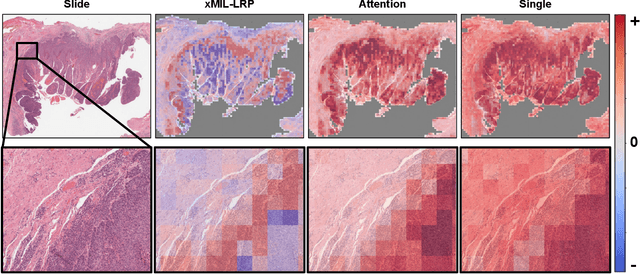
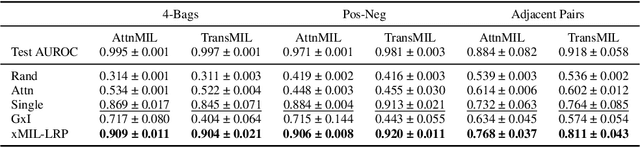
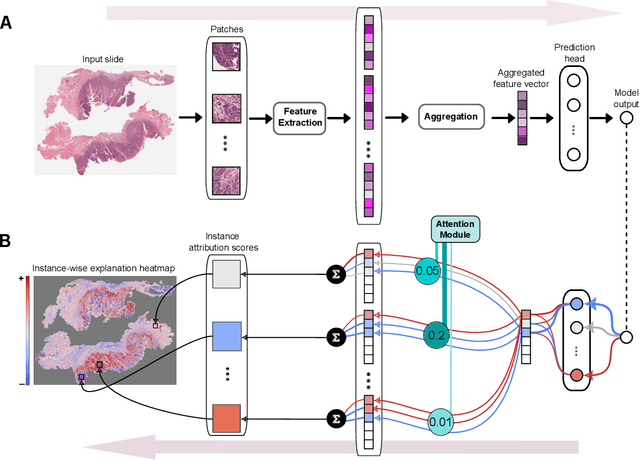
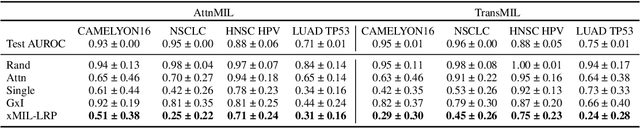
Multiple instance learning (MIL) is an effective and widely used approach for weakly supervised machine learning. In histopathology, MIL models have achieved remarkable success in tasks like tumor detection, biomarker prediction, and outcome prognostication. However, MIL explanation methods are still lagging behind, as they are limited to small bag sizes or disregard instance interactions. We revisit MIL through the lens of explainable AI (XAI) and introduce xMIL, a refined framework with more general assumptions. We demonstrate how to obtain improved MIL explanations using layer-wise relevance propagation (LRP) and conduct extensive evaluation experiments on three toy settings and four real-world histopathology datasets. Our approach consistently outperforms previous explanation attempts with particularly improved faithfulness scores on challenging biomarker prediction tasks. Finally, we showcase how xMIL explanations enable pathologists to extract insights from MIL models, representing a significant advance for knowledge discovery and model debugging in digital histopathology.