 Add to Chrome
 Add to Firefox
 Add to Edge
OpenProver: Agentic and Interactive Theorem Proving with Lean 4
Jul 10, 2026
In this system paper, we present OpenProver, an open-source system for LLM-driven automated theorem proving (ATP) with integrated Lean 4 formal verification. OpenProver integrates a Planner-Worker-Verifier architecture inspired by recent ATP agentic systems such as Aletheia. A Planner agent maintains a compact Whiteboard scratchpad and an unbounded Repository of intermediate findings, and decomposes mathematical work into parallel Workers. OpenProver is fully open-source, offers reproducible evaluation through automatic formal verification of generated proofs, and provides an interactive terminal interface for human-guided proof search. In interactive mode, OpenProver allows the human operator to monitor and steer the proof search process, motivated by the established human-AI synergy in interactive code generation. To showcase the potential for quantitative ablation experiments enabled by automatic formal verification, we evaluate OpenProver on ProofNet and compare it with a simple baseline. OpenProver is publicly available at https://github.com/kripner/OpenProver.

Introducing corpora Hlava Cor and Hlava AD: Human Label Variation in Coreference and Discourse Relations
Jun 24, 2026As previous research on annotator disagreement in discourse phenomena has shown, understanding text coherence varies considerably from one individual to another. To explore this phenomenon, we created two corpora with multiple annotations of Czech texts, accompanied by annotators' explanations of their choices. The first corpus consists of 1,024 contexts annotated in parallel by three annotators. It captures differences in the identification of coreference across various text types and grammatical-semantic categories, including pronouns, full noun phrases, and anaphoric adverbials. The second corpus comprises 512 contexts, annotated in parallel by five annotators, and focuses on identifying discourse relations in attributive and non-attributive constructions. Both corpora achieve a comparable inter-annotator agreement of approximately 60-65%. For coreference annotation, agreement tends to be lower in cases where automatic coreference resolution models disagree, suggesting that when the models disagree, the examples tend to be more difficult or ambiguous for human annotators to interpret. The annotators' comments, both for coreference and discourse relations, further reveal differences in interpretation, varying levels of confidence in text understanding, and individual reading strategies.
Meet UD_Czech-PDTC: A Large and Genre-Rich Treebank in Universal Dependencies
Jun 23, 2026Czech has been part of Universal Dependencies since its first release in 2015. It has also been one of the best represented languages, with the Prague Dependency Treebank being order of magnitude larger than most other UD treebanks. More recently, three other datasets from the Prague family were added and the annotations thoroughly revisited, forming the "Prague Dependency Treebank-Consolidated" (PDT-C). In comparison to the original PDT, PDT-C is more than twice as large, but it is also much more diverse in terms of genres and domains. In this paper, we describe the conversion of the new resource to Universal Dependencies. While the two annotation schemes are relatively similar at the first sight, there are numerous small differences in topology of the dependency structures and in granularity of the POS and relation type inventories. We demonstrate a selection of such differences on examples, discuss the diverging motivations, as well as ways to overcome the differences during conversion. We argue that while PDT is less "universal" and more tightly bound to one language, its multi-layer annotation is rich and provides all information needed for basic UD trees, and much more.
MorfFlex: Handling Rich Morphology
Jun 23, 2026We present MorfFlex, a morphological dictionary architecture suitable for languages with extensive regularity in both inflection and derivation. As the primary example of MorfFlex in use we introduce MorfFlex CZ, a morphological dictionary of Czech. It is distributed as a simple, unstructured list of <wordform, lemma, tag> triplets, however, its manually maintained, unpublished source files and conversion scripts encode a sophisticated system of inflectional and derivational patterns. These patterns dramatically reduce the otherwise enormous size of the dictionary, which currently contains over 100 million wordforms and more than 1 million lemmas. The MorfFlex CZ dictionary serves as an essential resource for ensuring the consistency of manual morphological annotation in the Prague Dependency Treebanks and underpins state-of-the-art automatic tools such as MorphoDiTa. In this paper, we focus on: (i) presenting an effective method for managing the rich morphological system within the dictionary, and (ii) demonstrating the utility of such a language resource for maintaining annotation consistency in corpora and supporting the development of advanced NLP applications.
Prague Dependency Treebank -- Consolidated 2.0: Enriching a Complex Annotation Scheme
Jun 23, 2026The Prague Dependency Treebank framework is unique in its attempt to systematically include and link different layers of language, including a meaning representation with several types of inter-sentential phenomena, especially coreference and discourse relations. We present its second consolidated version (PDT-C 2.0), which concludes almost 30-years long project of sustained development of the resource to a uniformly and coherently annotated, genre-diversified, almost 4 million token language resource of Czech language, with accompanying fully compatible lexicons. In addition to continuous linguistic research, the richly linguistically annotated corpus is also widely used in international comparisons of the development of traditional and novel NLP tools as well as in conversions into other formalisms. The corpus and the trained parsers are available under the CC BY-NC-SA licence.
CorPipe at CRAC 2026: Empty Nodes and Cross-Lingual Transfer in Multilingual Coreference Resolution
May 28, 2026We introduce CorPipe 26, our winning submission to the CRAC 2026 Shared Task on Multilingual Coreference Resolution. The fifth edition of this shared task focuses mainly on the comparison of generative LLMs and specialized systems; additionally, 5 more datasets and 2 new languages are introduced. CorPipe 26 is an improved version of CorPipe 25, with a new variant predicting empty nodes together with mentions and coreference links in a single model. Our system outperforms all other submissions in the LLM track by 2.8 percent points and all submissions in the unconstrained track by 9.5 percent points. Furthermore, we perform a series of ablation experiments with different model sizes, empty node prediction methods, and cross-lingual zero-shot evaluation. The source code and the trained models are publicly available at https://github.com/ufal/crac2026-corpipe.
Findings of the Fifth Shared Task on Multilingual Coreference Resolution: Expanding Datasets for Long-Range Entities
May 20, 2026This paper describes the fifth edition of the Shared Task on Multilingual Coreference Resolution, held in conjunction with the CODI-CRAC 2026 workshop. Building on previous iterations, the task required participants to develop systems capable of mention identification and identity-based coreference clustering. The 2026 edition specifically emphasizes long-range entities, defined as coreferential chains spanning significant distances, across many words and sentences. The task expanded its linguistic scope by incorporating five new datasets and two additional languages. These additions leverage version 1.4 of CorefUD, a harmonized multilingual collection comprising 27 datasets in 19 languages. In total, ten systems participated, including four LLM-based approaches (three fine-tuned models and one few-shot approach). While traditional systems still maintained their lead, LLMs demonstrated significant potential, suggesting they may soon challenge established approaches in future editions.
NameTag 3: A Tool and a Service for Multilingual/Multitagset NER
Jun 06, 2025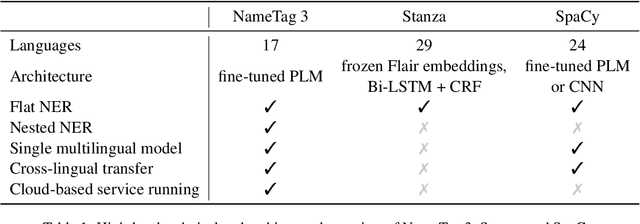
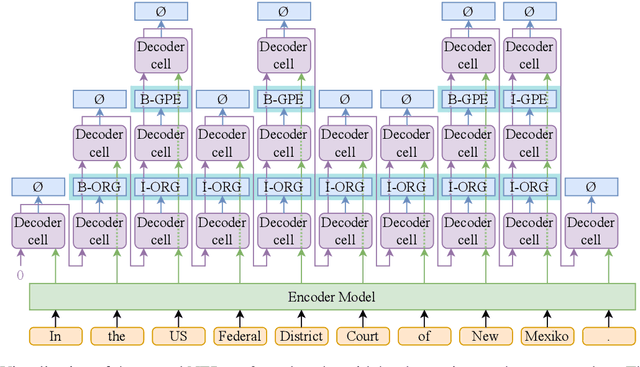
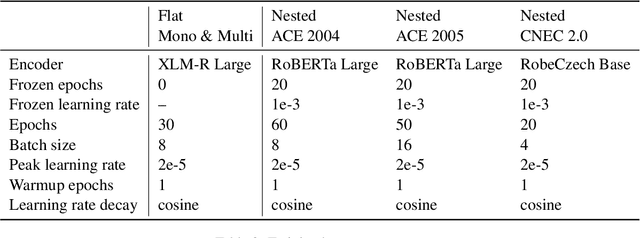
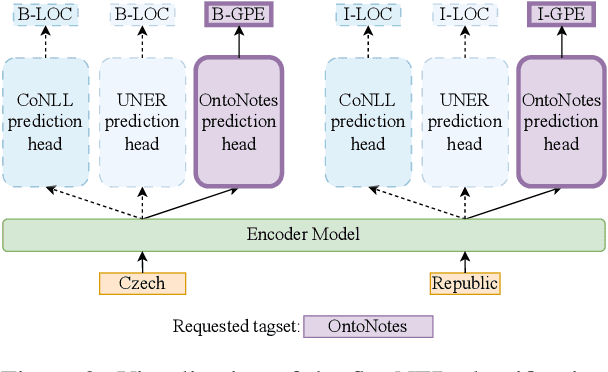
We introduce NameTag 3, an open-source tool and cloud-based web service for multilingual, multidataset, and multitagset named entity recognition (NER), supporting both flat and nested entities. NameTag 3 achieves state-of-the-art results on 21 test datasets in 15 languages and remains competitive on the rest, even against larger models. It is available as a command-line tool and as a cloud-based service, enabling use without local installation. NameTag 3 web service currently provides flat NER for 17 languages, trained on 21 corpora and three NE tagsets, all powered by a single 355M-parameter fine-tuned model; and nested NER for Czech, powered by a 126M fine-tuned model. The source code is licensed under open-source MPL 2.0, while the models are distributed under non-commercial CC BY-NC-SA 4.0. Documentation is available at https://ufal.mff.cuni.cz/nametag, source code at https://github.com/ufal/nametag3, and trained models via https://lindat.cz. The REST service and the web application can be found at https://lindat.mff.cuni.cz/services/nametag/. A demonstration video is available at https://www.youtube.com/watch?v=-gaGnP0IV8A.
Findings of the Third Shared Task on Multilingual Coreference Resolution
Oct 21, 2024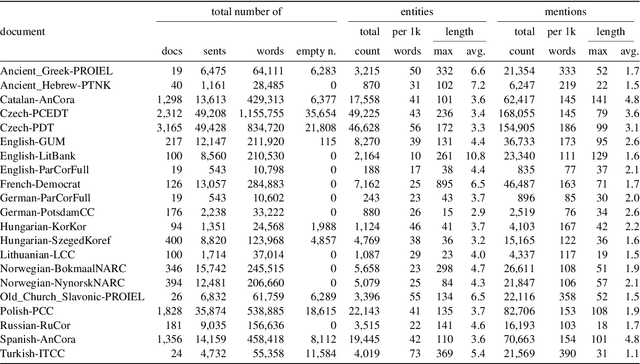
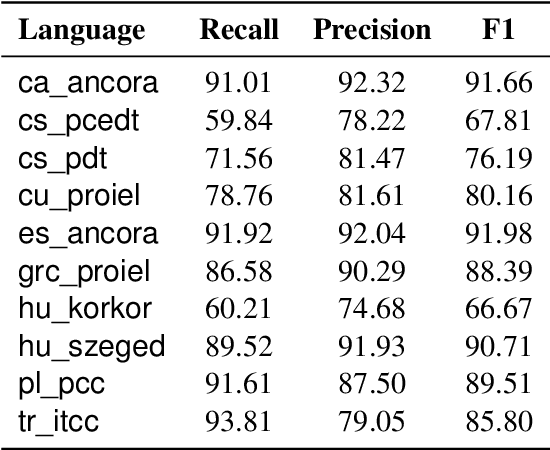
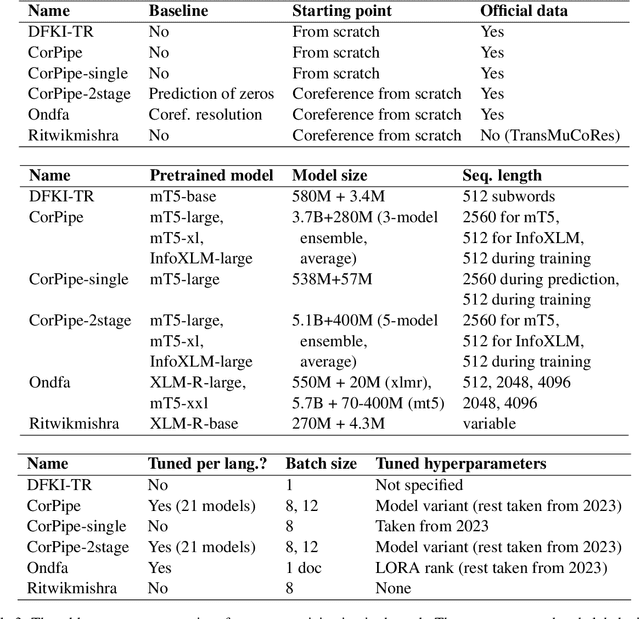
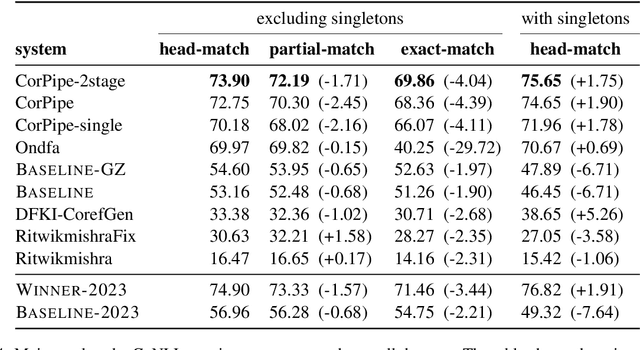
The paper presents an overview of the third edition of the shared task on multilingual coreference resolution, held as part of the CRAC 2024 workshop. Similarly to the previous two editions, the participants were challenged to develop systems capable of identifying mentions and clustering them based on identity coreference. This year's edition took another step towards real-world application by not providing participants with gold slots for zero anaphora, increasing the task's complexity and realism. In addition, the shared task was expanded to include a more diverse set of languages, with a particular focus on historical languages. The training and evaluation data were drawn from version 1.2 of the multilingual collection of harmonized coreference resources CorefUD, encompassing 21 datasets across 15 languages. 6 systems competed in this shared task.
CorPipe at CRAC 2024: Predicting Zero Mentions from Raw Text
Oct 03, 2024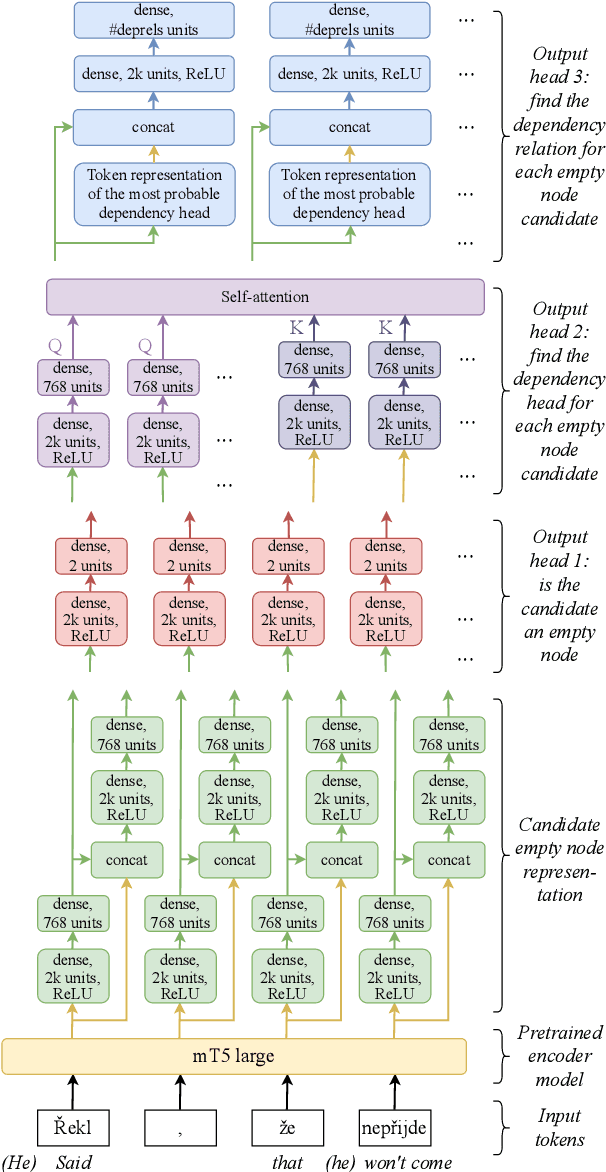
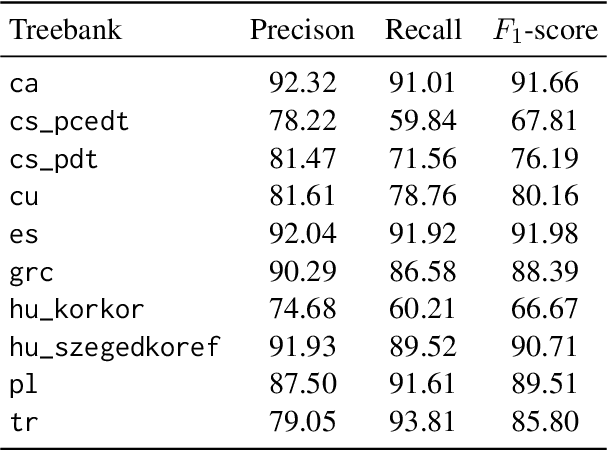
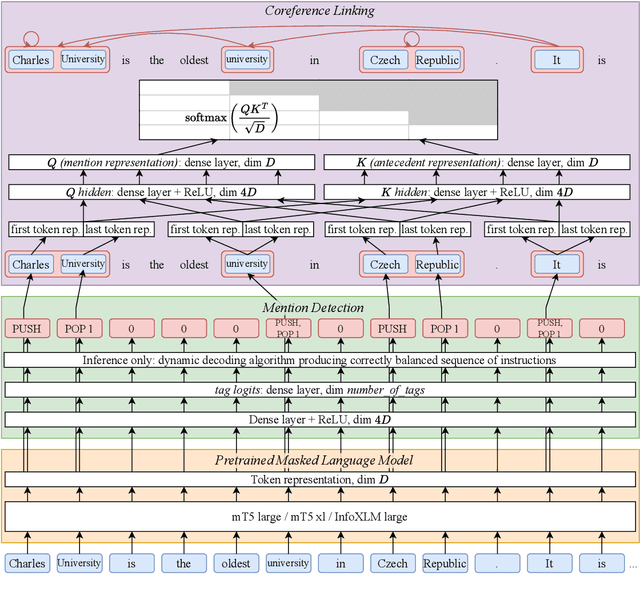
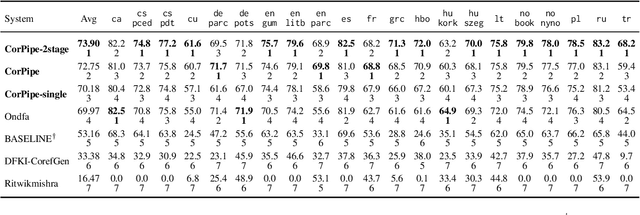
We present CorPipe 24, the winning entry to the CRAC 2024 Shared Task on Multilingual Coreference Resolution. In this third iteration of the shared task, a novel objective is to also predict empty nodes needed for zero coreference mentions (while the empty nodes were given on input in previous years). This way, coreference resolution can be performed on raw text. We evaluate two model variants: a~two-stage approach (where the empty nodes are predicted first using a pretrained encoder model and then processed together with sentence words by another pretrained model) and a single-stage approach (where a single pretrained encoder model generates empty nodes, coreference mentions, and coreference links jointly). In both settings, CorPipe surpasses other participants by a large margin of 3.9 and 2.8 percent points, respectively. The source code and the trained model are available at https://github.com/ufal/crac2024-corpipe .