 Add to Chrome
 Add to Firefox
 Add to Edge
SoccerNet 2026 Challenges Results
Jul 08, 2026
The SoccerNet 2026 Challenges constitute the sixth annual edition of the SoccerNet open benchmarking effort, dedicated to advancing computer vision research in sports video understanding. This year's challenges span five vision-based tasks: (1) Ball Action Anticipation, predicting the timing and class of ball-related actions within a short future window from a preceding observation window; (2) Player-Centric Ball Action Spotting, temporally localizing and classifying ball-related actions while assigning each action to the acting player through team affiliation and jersey number; (3) Novel View Synthesis, rendering images from unobserved camera poses in multi-view football scenes; (4) Spiideo SoccerNet Synloc, localizing athletes in real-world pitch coordinates from a single calibrated static-camera image; and (5) Visual Question Answering, answering multiple-choice questions about football broadcasts across text, image, and video inputs. For each task, participants were provided with annotated data, a unified evaluation protocol, and a public baseline. This edition saw broad participation, with 427 teams submitting 1,129 entries across the five tasks and 28 teams contributing reviewed technical reports. This paper describes each task and its evaluation protocol, presents the challenge leaderboards, and summarizes the leading submissions, with the aim of documenting the current state of each task as measured on held-out challenge data.

Catching MRI outliers: unsupervised detection and localization of MRI artefacts and clinical anomalies using deep learning
May 23, 2026Artificial intelligence is increasingly integrated into radiotherapy workflows, yet such pipelines remain vulnerable to out-of-distribution image data that may introduce unexpected behavior in clinical tasks. Deep learning-based anomaly detection for pelvic magnetic resonance imaging (MRI) remains largely unexplored, and transparent evaluation of its feasibility for full automation is limited. We developed and evaluated a fully automated, unsupervised anomaly-detection framework for pelvic and brain MRI. A two-stage framework was trained on reference images from public datasets: LUND-PROBE for pelvic MRI, and IXI, fastMRI, and fastMRI+ for brain MRI. In the first stage, MRI slices were compressed into discrete tokens; in the second, the distribution of normal tokens was modeled. Anomaly evidence was estimated by combining perceptual image differences with token-surprisal scores based on negative log-likelihood. Automated detection was evaluated on pelvic MRI with synthetic global and real clinical anomalies, and on brain MRI with clinically annotated fastMRI+ abnormalities. Sensitivity, specificity, area under the receiver operating characteristic curve (AUC), and false-positive behavior in held-out normal cases were assessed. The framework achieved robust detection across hidden evaluation cohorts, with AUCs of 0.97 (95% CI, 0.95-0.98) and 0.81 (95% CI, 0.74-0.87) for pelvic and brain MRI, respectively. Heatmap analysis showed strong spatial agreement between detected anomalies and ground-truth locations, supporting localization accuracy and interpretability. These results support the potential of unsupervised anomaly detection as an automated MRI quality-control layer for radiotherapy workflows, with transparent visualization of image regions likely to compromise downstream AI-based tasks.
Impacts of Color and Texture Distortions on Earth Observation Data in Deep Learning
Mar 07, 2024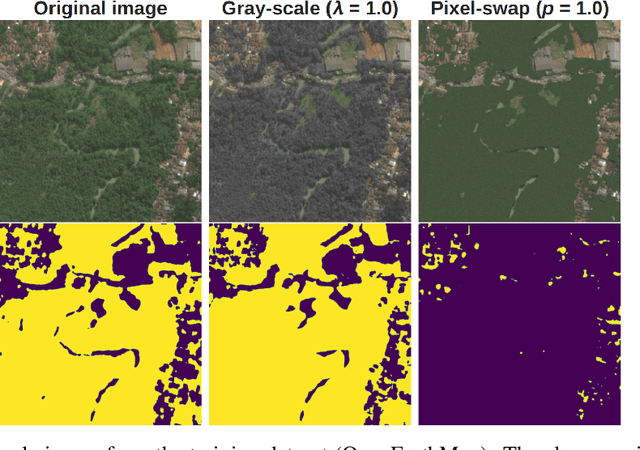
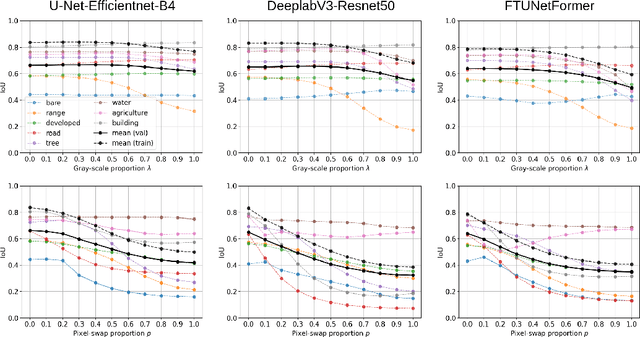
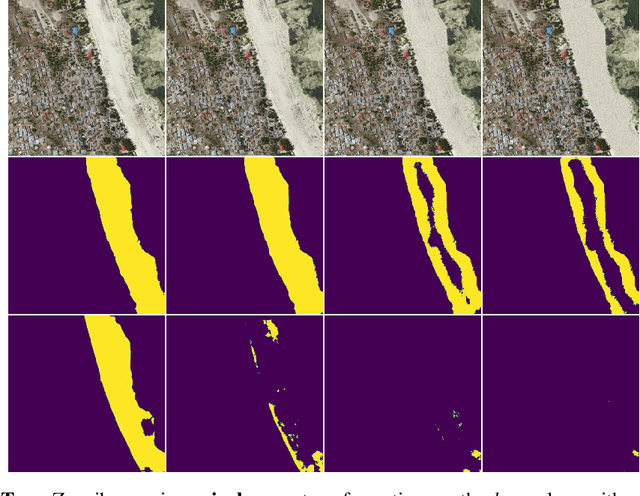
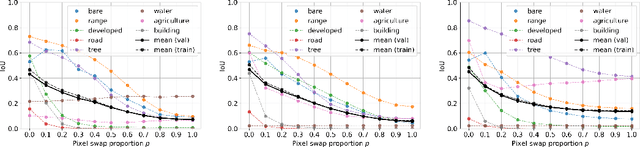
Land cover classification and change detection are two important applications of remote sensing and Earth observation (EO) that have benefited greatly from the advances of deep learning. Convolutional and transformer-based U-net models are the state-of-the-art architectures for these tasks, and their performances have been boosted by an increased availability of large-scale annotated EO datasets. However, the influence of different visual characteristics of the input EO data on a model's predictions is not well understood. In this work we systematically examine model sensitivities with respect to several color- and texture-based distortions on the input EO data during inference, given models that have been trained without such distortions. We conduct experiments with multiple state-of-the-art segmentation networks for land cover classification and show that they are in general more sensitive to texture than to color distortions. Beyond revealing intriguing characteristics of widely used land cover classification models, our results can also be used to guide the development of more robust models within the EO domain.
Multi Target Tracking by Learning from Generalized Graph Differences
Aug 19, 2019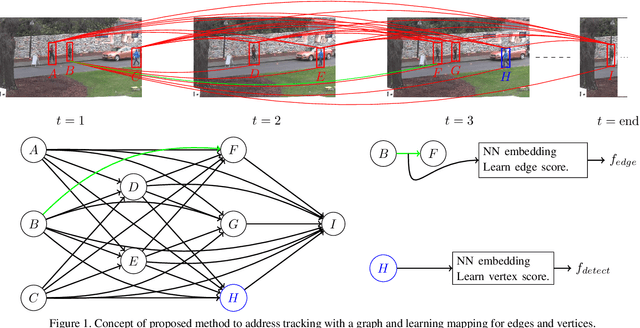
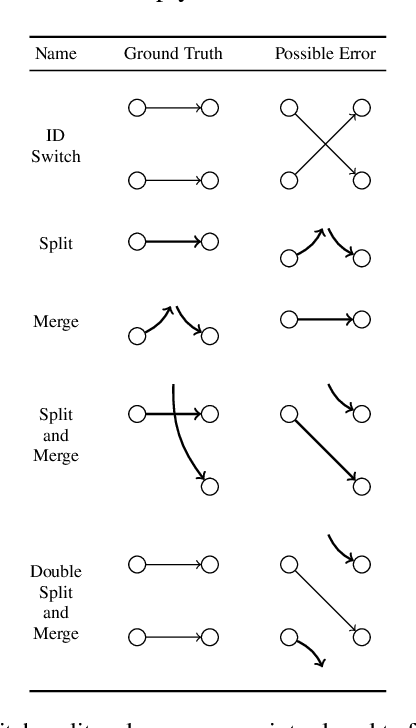
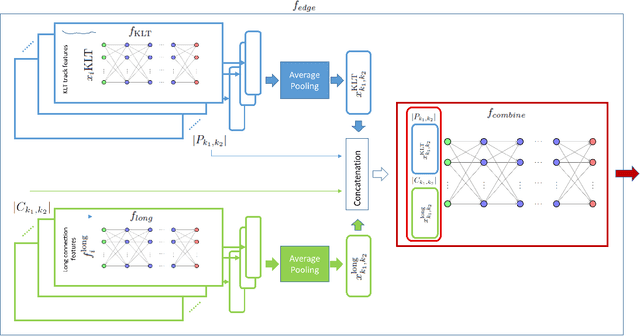
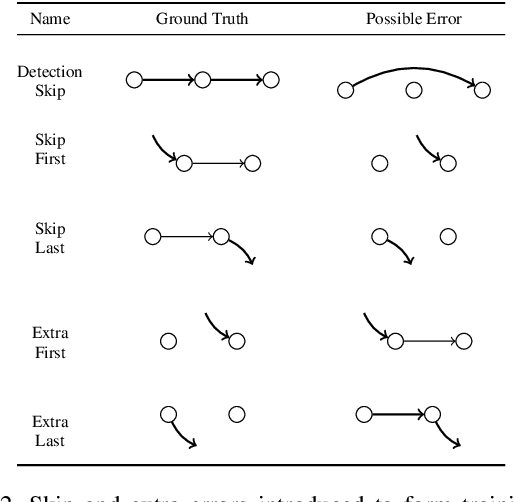
Formulating the multi object tracking problem as a network flow optimization problem is a popular choice. In this paper an efficient way of learning the weights of such a network is presented. It separates the problem into one embedding of feasible solutions into a one dimensional feature space and one optimization problem. The embedding can be learned using standard SGD type optimization without relying on an additional optimizations within each step. Training data is produced by performing small perturbations of ground truth tracks and representing them using generalized graph differences, which is an efficient way introduced to represent the difference between two graphs. The proposed method is evaluated on DukeMTMCT with competitive results.