 Add to Chrome
 Add to Firefox
 Add to Edge
Uncertainty-Guided Conservative Propagation for Structured Inference in Vessel Segmentation
May 19, 2026
Accurate vessel segmentation is essential for medical image analysis, yet remains challenging due to complex vascular patterns and imaging ambiguity. Most deep models rely on single-pass prediction, limiting their ability to refine uncertain or disconnected regions during inference. To address this limitation, we propose Uncertainty-Guided Conservative Propagation (UGCP), a general plug-in module for vessel segmentation. Instead of directly using a one-shot output as the final prediction, UGCP performs a small number of logit-space update steps to refine the segmentation through local predictions interaction. Predictive uncertainty guides reliable regions to support ambiguous regions, while structure-aware modulation and source-based stabilization reduce unreliable propagation and excessive drift. The module is differentiable and can be trained end-to-end with different segmentation networks. We evaluate UGCP on four public vessel segmentation datasets covering 2D and 3D tasks, including retinal vessel, coronary artery, and cerebral vessel segmentation. Experiments with convolutional neural network-based and Transformer-based backbones show consistent improvements in Dice similarity coefficient, centerline Dice, and 95th percentile Hausdorff distance. Further analysis demonstrates that UGCP reduces vessel disconnections and improves structural consistency with limited additional computation. The code will be made available at https://github.com/chenzhao2023/UGC_PR.

Imaging-Derived Coronary Fractional Flow Reserve: Advances in Physics-Based, Machine-Learning, and Physics-Informed Methods
Feb 17, 2026Purpose of Review Imaging derived fractional flow reserve (FFR) is rapidly evolving beyond conventional computational fluid dynamics (CFD) based pipelines toward machine learning (ML), deep learning (DL), and physics informed approaches that enable fast, wire free, and scalable functional assessment of coronary stenosis. This review synthesizes recent advances in CT and angiography based FFR, with particular emphasis on emerging physics informed neural networks and neural operators (PINNs and PINOs) and key considerations for their clinical translation. Recent Findings ML/DL approaches have markedly improved automation and computational speed, enabling prediction of pressure and FFR from anatomical descriptors or angiographic contrast dynamics. However, their real-world performance and generalizability can remain variable and sensitive to domain shift, due to multi-center heterogeneity, interpretability challenges, and differences in acquisition protocols and image quality. Physics informed learning introduces conservation structure and boundary condition consistency into model training, improving generalizability and reducing dependence on dense supervision while maintaining rapid inference. Recent evaluation trends increasingly highlight deployment oriented metrics, including calibration, uncertainty quantification, and quality control gatekeeping, as essential for safe clinical use. Summary The field is converging toward imaging derived FFR methods that are faster, more automated, and more reliable. While ML/DL offers substantial efficiency gains, physics informed frameworks such as PINNs and PINOs may provide a more robust balance between speed and physical consistency. Prospective multi center validation and standardized evaluation will be critical to support broad and safe clinical adoption.
Anatomy Guided Coronary Artery Segmentation from CCTA Using Spatial Frequency Joint Modeling
Dec 14, 2025Accurate coronary artery segmentation from coronary computed tomography angiography is essential for quantitative coronary analysis and clinical decision support. Nevertheless, reliable segmentation remains challenging because of small vessel calibers, complex branching, blurred boundaries, and myocardial interference. We propose a coronary artery segmentation framework that integrates myocardial anatomical priors, structure aware feature encoding, and three dimensional wavelet inverse wavelet transformations. Myocardial priors and residual attention based feature enhancement are incorporated during encoding to strengthen coronary structure representation. Wavelet inverse wavelet based downsampling and upsampling enable joint spatial frequency modeling and preserve multi scale structural consistency, while a multi scale feature fusion module integrates semantic and geometric information in the decoding stage. The model is trained and evaluated on the public ImageCAS dataset using a 3D overlapping patch based strategy with a 7:1:2 split for training, validation, and testing. Experimental results demonstrate that the proposed method achieves a Dice coefficient of 0.8082, Sensitivity of 0.7946, Precision of 0.8471, and an HD95 of 9.77 mm, outperforming several mainstream segmentation models. Ablation studies further confirm the complementary contributions of individual components. The proposed method enables more stable and consistent coronary artery segmentation under complex geometric conditions, providing reliable segmentation results for subsequent coronary structure analysis tasks.
Blood Pressure Prediction for Coronary Artery Disease Diagnosis using Coronary Computed Tomography Angiography
Dec 11, 2025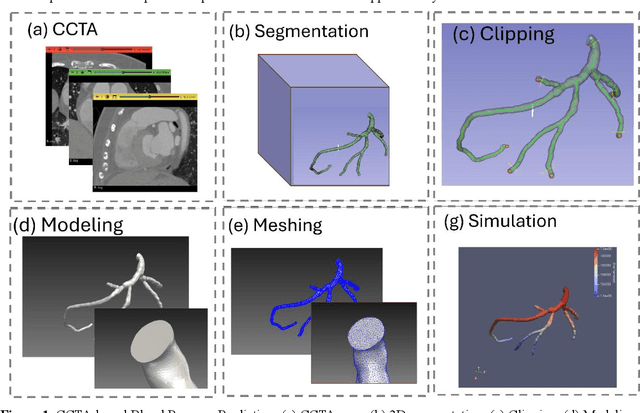
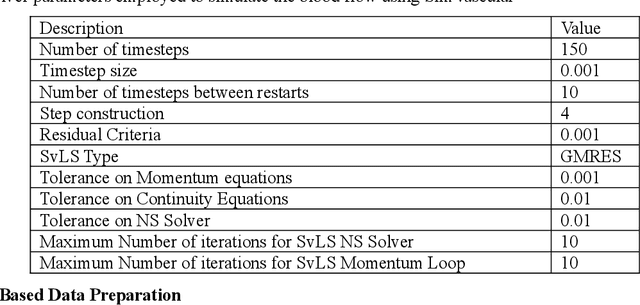
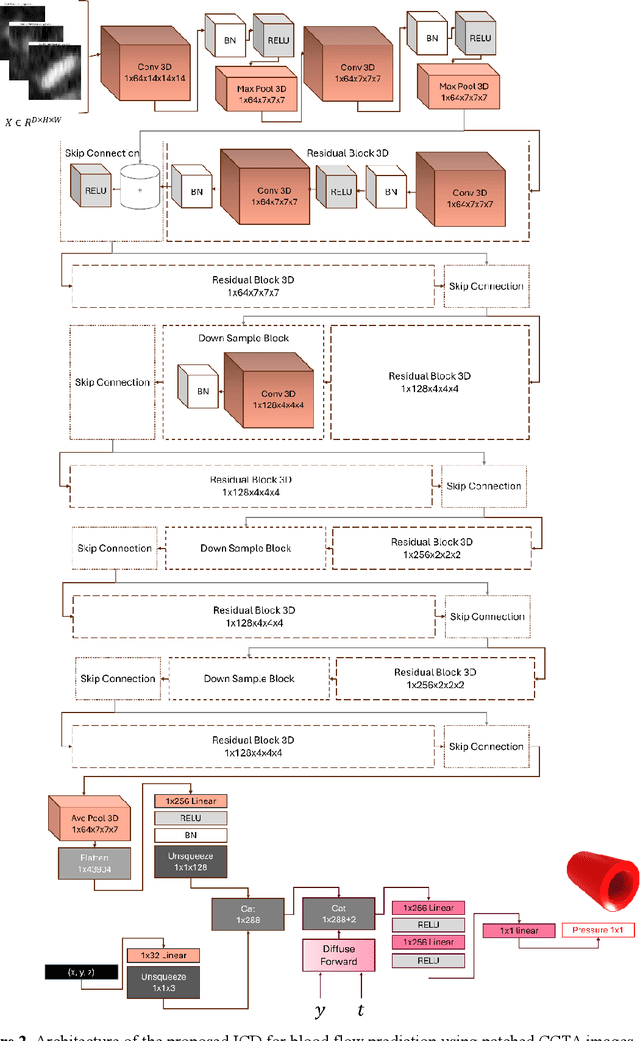
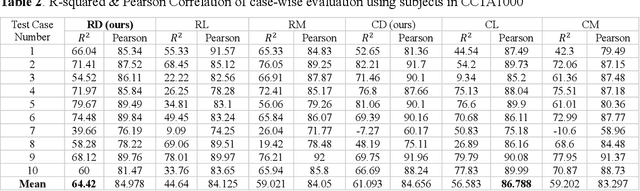
Computational fluid dynamics (CFD) based simulation of coronary blood flow provides valuable hemodynamic markers, such as pressure gradients, for diagnosing coronary artery disease (CAD). However, CFD is computationally expensive, time-consuming, and difficult to integrate into large-scale clinical workflows. These limitations restrict the availability of labeled hemodynamic data for training AI models and hinder broad adoption of non-invasive, physiology based CAD assessment. To address these challenges, we develop an end to end pipeline that automates coronary geometry extraction from coronary computed tomography angiography (CCTA), streamlines simulation data generation, and enables efficient learning of coronary blood pressure distributions. The pipeline reduces the manual burden associated with traditional CFD workflows while producing consistent training data. We further introduce a diffusion-based regression model designed to predict coronary blood pressure directly from CCTA derived features, bypassing the need for slow CFD computation during inference. Evaluated on a dataset of simulated coronary hemodynamics, the proposed model achieves state of the art performance, with an R2 of 64.42%, a root mean squared error of 0.0974, and a normalized RMSE of 0.154, outperforming several baseline approaches. This work provides a scalable and accessible framework for rapid, non-invasive blood pressure prediction to support CAD diagnosis.
Data-Balanced Curriculum Learning for Audio Question Answering
Jul 09, 2025Audio question answering (AQA) requires models to understand acoustic content and perform complex reasoning. Current models struggle with dataset imbalances and unstable training dynamics. This work combines curriculum learning with statistical data balancing to address these challenges. The method labels question difficulty using language models, then trains progressively from easy to hard examples. Statistical filtering removes overrepresented audio categories, and guided decoding constrains outputs to valid multiple-choice formats. Experiments on the DCASE 2025 training set and five additional public datasets show that data curation improves accuracy by 11.7% over baseline models, achieving 64.2% on the DCASE 2025 benchmark.
AudSemThinker: Enhancing Audio-Language Models through Reasoning over Semantics of Sound
May 20, 2025Audio-language models have shown promising results in various sound understanding tasks, yet they remain limited in their ability to reason over the fine-grained semantics of sound. In this paper, we present AudSemThinker, a model whose reasoning is structured around a framework of auditory semantics inspired by human cognition. To support this, we introduce AudSem, a novel dataset specifically curated for semantic descriptor reasoning in audio-language models. AudSem addresses the persistent challenge of data contamination in zero-shot evaluations by providing a carefully filtered collection of audio samples paired with captions generated through a robust multi-stage pipeline. Our experiments demonstrate that AudSemThinker outperforms state-of-the-art models across multiple training settings, highlighting its strength in semantic audio reasoning. Both AudSemThinker and the AudSem dataset are released publicly.
Audio-Language Datasets of Scenes and Events: A Survey
Jul 09, 2024


Audio-language models (ALMs) process sounds to provide a linguistic description of sound-producing events and scenes. Recent advances in computing power and dataset creation have led to significant progress in this domain. This paper surveys existing datasets used for training audio-language models, emphasizing the recent trend towards using large, diverse datasets to enhance model performance. Key sources of these datasets include the Freesound platform and AudioSet that have contributed to the field's rapid growth. Although prior surveys primarily address techniques and training details, this survey categorizes and evaluates a wide array of datasets, addressing their origins, characteristics, and use cases. It also performs a data leak analysis to ensure dataset integrity and mitigate bias between datasets. This survey was conducted by analyzing research papers up to and including December 2023, and does not contain any papers after that period.
Hyper Association Graph Matching with Uncertainty Quantification for Coronary Artery Semantic Labeling
Aug 20, 2023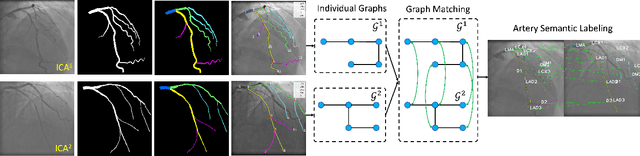

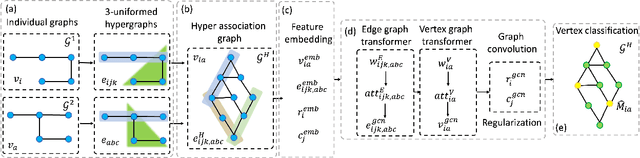
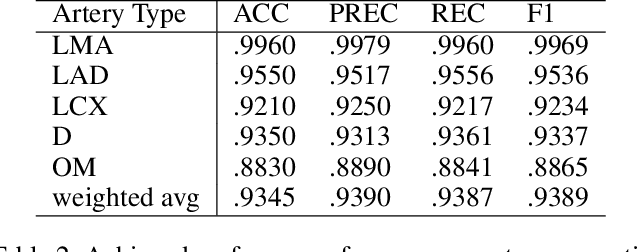
Coronary artery disease (CAD) is one of the primary causes leading to death worldwide. Accurate extraction of individual arterial branches on invasive coronary angiograms (ICA) is important for stenosis detection and CAD diagnosis. However, deep learning-based models face challenges in generating semantic segmentation for coronary arteries due to the morphological similarity among different types of coronary arteries. To address this challenge, we propose an innovative approach using the hyper association graph-matching neural network with uncertainty quantification (HAGMN-UQ) for coronary artery semantic labeling on ICAs. The graph-matching procedure maps the arterial branches between two individual graphs, so that the unlabeled arterial segments are classified by the labeled segments, and the coronary artery semantic labeling is achieved. By incorporating the anatomical structural loss and uncertainty, our model achieved an accuracy of 0.9345 for coronary artery semantic labeling with a fast inference speed, leading to an effective and efficient prediction in real-time clinical decision-making scenarios.
AGMN: Association Graph-based Graph Matching Network for Coronary Artery Semantic Labeling on Invasive Coronary Angiograms
Jan 11, 2023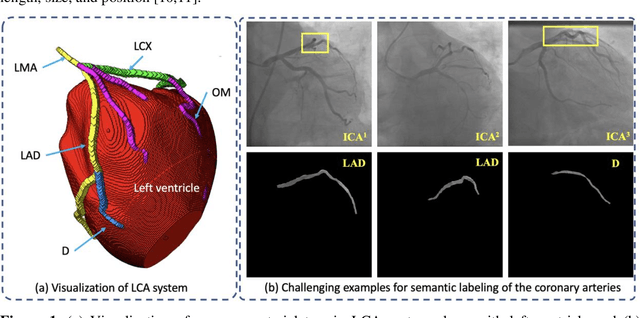
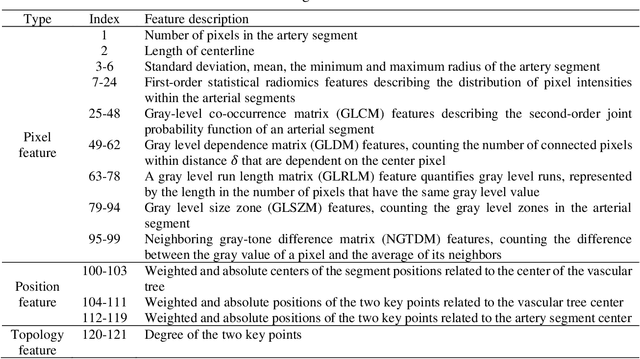

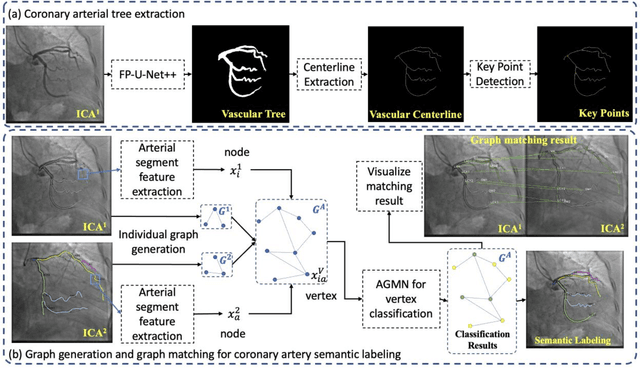
Semantic labeling of coronary arterial segments in invasive coronary angiography (ICA) is important for automated assessment and report generation of coronary artery stenosis in the computer-aided diagnosis of coronary artery disease (CAD). Inspired by the training procedure of interventional cardiologists for interpreting the structure of coronary arteries, we propose an association graph-based graph matching network (AGMN) for coronary arterial semantic labeling. We first extract the vascular tree from invasive coronary angiography (ICA) and convert it into multiple individual graphs. Then, an association graph is constructed from two individual graphs where each vertex represents the relationship between two arterial segments. Using the association graph, the AGMN extracts the vertex features by the embedding module, aggregates the features from adjacent vertices and edges by graph convolution network, and decodes the features to generate the semantic mappings between arteries. By learning the mapping of arterial branches between two individual graphs, the unlabeled arterial segments are classified by the labeled segments to achieve semantic labeling. A dataset containing 263 ICAs was employed to train and validate the proposed model, and a five-fold cross-validation scheme was performed. Our AGMN model achieved an average accuracy of 0.8264, an average precision of 0.8276, an average recall of 0.8264, and an average F1-score of 0.8262, which significantly outperformed existing coronary artery semantic labeling methods. In conclusion, we have developed and validated a new algorithm with high accuracy, interpretability, and robustness for coronary artery semantic labeling on ICAs.