 Add to Chrome
 Add to Firefox
 Add to Edge
Dual-domain U-Nets with embedded back projection operators for motion-resolved 4D CBCT reconstruction
Aug 04, 2026
Four-dimensional cone beam CT (4D CBCT) is important for image-guided radiation therapy of thoracic cancers, but its use is limited by long scan times, causing high patient dose and motion/sparse-sampling artifacts. We propose a deep learning method for motion-resolved 4D CBCT reconstruction from conventional free-breathing scans, without a respiratory signal or explicit projection binning. Our CNN takes free-breathing 3D CBCT projections as input and predicts a static volume at maximum inhalation plus ten displacement vector fields (DVFs) spanning a breathing cycle. The network extends U-Net: the encoder acts on filtered projection stacks, the decoder acts in the volume domain, and skip connections are replaced with non-trainable back-projection functions at multiple resolutions to transfer features between domains. The model is trained on simulated CBCT scans and evaluated on 11 unseen simulated patients and 13 clinical free-breathing scans. Two additional models (60 s and 6 s scans) were evaluated by clinical experts on three and two scans, comparing single phases of our 4D reconstruction to reference 3D SART-TV images for tumor and esophagus visibility. Experts preferred our method for tumor visibility (59% vs. 36% no preference, 5% reference) and esophagus visibility (47% vs. 42%, 11%). On simulated data, image quality matched SART-TV (mean RMSE: -1.19 HU, PSNR: +0.09 dB, SSIM: -0.009) while enabling 4D reconstruction. On clinical scans, our method showed sharper dynamic structures (e.g., diaphragm) and fewer motion streak artifacts than traditional reconstruction. This non-patient-specific CNN predicts static volumes and full 4D respiratory motion models from a single free-breathing scan, without a respiratory surrogate or projection binning, reducing motion artifacts while adding motion-modeling capability.

Optimized data exploration applied to the simulation of a chemical process
Feb 18, 2019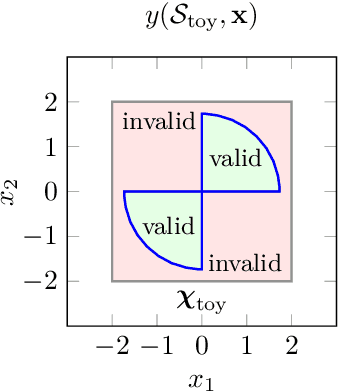
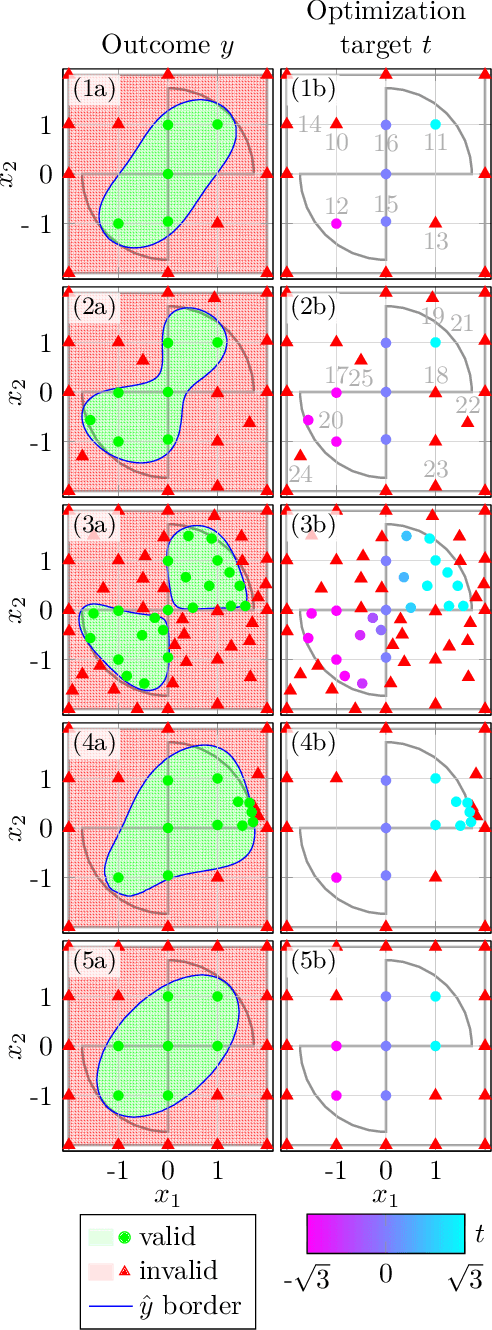
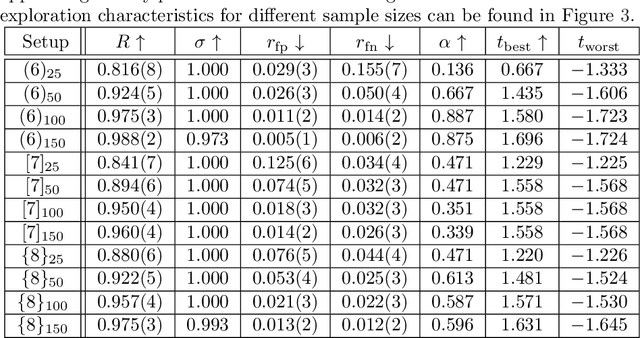
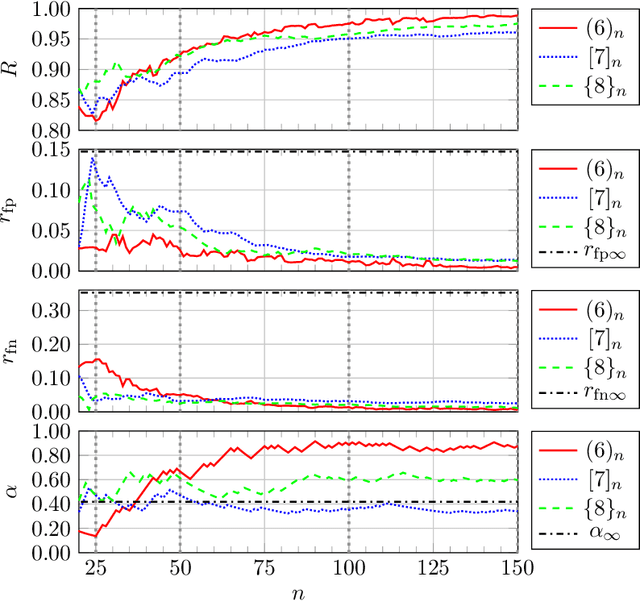
In complex simulation environments, certain parameter space regions may result in non-convergent or unphysical outcomes. All parameters can therefore be labeled with a binary class describing whether or not they lead to valid results. In general, it can be very difficult to determine feasible parameter regions, especially without previous knowledge. We propose a novel algorithm to explore such an unknown parameter space and improve its feasibility classification in an iterative way. Moreover, we include an additional optimization target in the algorithm to guide the exploration towards regions of interest and to improve the classification therein. In our method we make use of well-established concepts from the field of machine learning like kernel support vector machines and kernel ridge regression. From a comparison with a Kriging-based exploration approach based on recently published results we can show the advantages of our algorithm in a binary feasibility classification scenario with a discrete feasibility constraint violation. In this context, we also propose an improvement of the Kriging-based exploration approach. We apply our novel method to a fully realistic, industrially relevant chemical process simulation to demonstrate its practical usability and find a comparably good approximation of the data space topology from relatively few data points.
* 45 pages, 6 figures