 Add to Chrome
 Add to Firefox
 Add to Edge
Align AI to Dynamic Human-AI Workflows
Jul 15, 2026
Current alignment approaches typically focus on emulating human behavior using static representations of human preferences, failing to capture the dynamic, context-dependent nature of real-world human-AI interactions. In this paper, we argue for a shift from static and emulative to interactive and complementary alignment, where preferences emerge through interaction and alignment is defined not by satisfying preferences alone. We first formalize this gap by contrasting existing alignment with a trajectory-level view in which human and model behavior co-evolve over time. Because these interaction dynamics have not been adequately captured within existing ML formulations, we ground this perspective in insights from an interdisciplinary workshop. We draw on lessons from social-science accounts of human-human collaboration and then argue that human-AI systems amplify these dynamics, introducing new asymmetries that make reasoning about uncertainty harder and introduce new coordination challenges. Based on these lessons and new challenges, we conclude by outlining a research agenda for developing AI systems that align with humans in interaction, requiring an interdisciplinary synthesis of machine learning and the social and decision sciences.

Contact Area Detector using Cross View Projection Consistency for COVID-19 Projects
Aug 18, 2020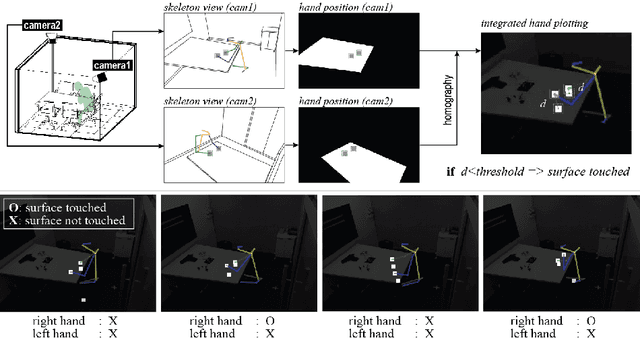
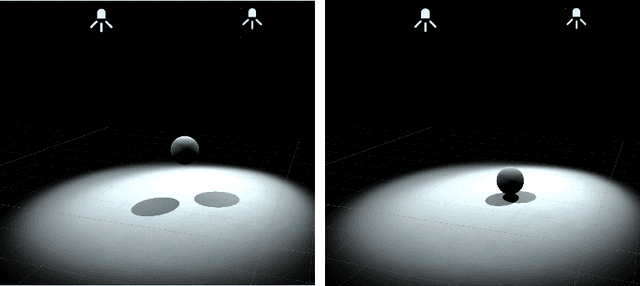
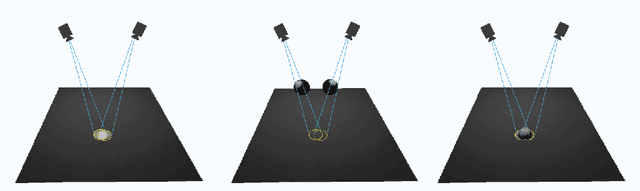
The ability to determine what parts of objects and surfaces people touch as they go about their daily lives would be useful in understanding how the COVID-19 virus spreads. To determine whether a person has touched an object or surface using visual data, images, or videos, is a hard problem. Computer vision 3D reconstruction approaches project objects and the human body from the 2D image domain to 3D and perform 3D space intersection directly. However, this solution would not meet the accuracy requirement in applications due to projection error. Another standard approach is to train a neural network to infer touch actions from the collected visual data. This strategy would require significant amounts of training data to generalize over scale and viewpoint variations. A different approach to this problem is to identify whether a person has touched a defined object. In this work, we show that the solution to this problem can be straightforward. Specifically, we show that the contact between an object and a static surface can be identified by projecting the object onto the static surface through two different viewpoints and analyzing their 2D intersection. The object contacts the surface when the projected points are close to each other; we call this cross view projection consistency. Instead of doing 3D scene reconstruction or transfer learning from deep networks, a mapping from the surface in the two camera views to the surface space is the only requirement. For planar space, this mapping is the Homography transformation. This simple method can be easily adapted to real-life applications. In this paper, we apply our method to do office occupancy detection for studying the COVID-19 transmission pattern from an office desk in a meeting room using the contact information.