 Add to Chrome
 Add to Firefox
 Add to Edge
Inverse Learning of Latent Risk-Neutral Densities from Irregular Option Quotes
Jul 29, 2026
Accurate option prices do not imply accurate recovery of the latent risk-neutral density. We study this distinction with two complementary benchmarks. A controlled benchmark exposes simulator-truth densities for latent evaluation, while a chronological NIFTY benchmark tests only held-out market prices. A two-component lognormal mixture has the lowest aggregate price, $L^1$, Wasserstein, and fixed-tail errors on the synthetic benchmark. Learned operators retain narrower strengths: DeepONet reduces 1% quantile and variance error by 39.0% and 34.6% relative to the mixture, and a quote transformer reduces $L^1$ by 16.4% on the structurally misspecified Merton family. A numerical conditioning analysis explains why these rankings can differ: after enforcing mass and forward constraints, 95 of 126 pricing directions are numerically null, and two densities separated by $L^1 = 0.061$ produce identical prices on the covered strikes. On 524 held-out NIFTY calls, validation-selected test-time adaptation reduces DeepONet RMSE by 28.3%, but per-expiry mixture and SVI fits remain much more accurate. The evidence supports target-dependent inductive bias, not a universal winner.

IPO-Mine: A Toolkit and Dataset for Section-Structured Analysis of Long, Multimodal IPO Documents
May 27, 2026An Initial Public Offering (IPO) filing is a document released when a private firm goes public, allowing individual (retail) investors to purchase its shares. These filings describe a firm's business, financials, and risks and are long, multimodal documents with narrative text and images. Despite their importance to financial markets, there is no large-scale, standardized dataset or benchmark for studying IPO filings with modern language and multimodal models. These documents pose significant challenges: filings frequently exceed 500,000 tokens and lack consistent structural organization. We introduce the IPO-Toolkit, an open-source framework for downloading and parsing IPO filings into standardized section-structured text and extracted images. The toolkit segments filings, extracts embedded images, and produces structured outputs that enable large-scale, reproducible analysis workflows over long, multimodal documents. Using this infrastructure, we construct the IPO-Dataset, a large, section-structured, multimodal dataset covering more than 109,000 IPO filings and amendments from 1994 to 2026 and containing over 76,000 images. We establish structured evaluation tasks over extracted financial charts, including chart quality and misleadingness assessment. Our experiments show that state-of-the-art multimodal models often diverge from expert human judgments on these tasks, exposing alignment challenges in multimodal reasoning over long, real-world regulatory documents. Beyond benchmarking, the IPO-Dataset enables large-scale analysis of section-level textual variation and cross-industry differences in visual and textual disclosure practices. Our code, dataset, and website are publicly available under CC-BY-4.0.
Evolutionary Task Discovery: Advancing Reasoning Frontiers via Skill Composition and Complexity Scaling
May 12, 2026The reasoning frontier of Large Language Models (LLMs) has advanced significantly through modern post-training paradigms (e.g., Reinforcement Learning from Verifiable Rewards (RLVR)). However, the efficacy of these methods remains fundamentally constrained by the diversity and complexity of the training data. One practical solution is data synthesis; yet, prevalent methods relying on unstructured mutation or exploration suffer from homogeneity collapse, failing to systematically expand the reasoning frontier. To overcome this, we propose Evoutionary Task Discovery (EvoTD), a framework that treats data synthesis as a directed search over a dual-axis manifold of Algorithmic Skills and Complexity Attributes. We introduce structured evolutionary operators to navigate this space: a Crossover operator that synthesizes novel skill compositions to enhance diversity, and a Parametric Mutation operator that scales structural constraints (e.g., input size, tree depth) to drive robust generalization. Crucially, we integrate a dynamic Zone of Proximal Development filter, ensuring tasks lie within the learnable region of the model. Empirically, EvoTD delivers substantial reasoning gains that generalize consistently across model architectures, pretraining regimes, and scales, demonstrating that structured evolutionary curricula can effectively support reasoning improvement. We release our code on https://github.com/liqinye/EvoTD.
How Inclusively do LMs Perceive Social and Moral Norms?
Feb 04, 2025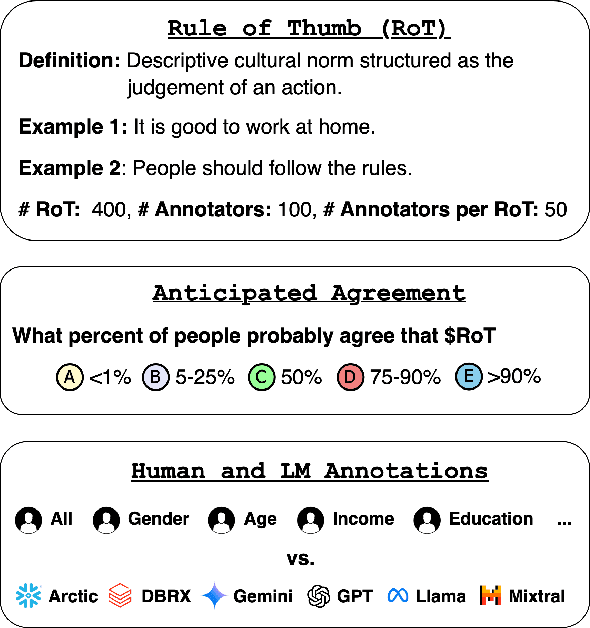
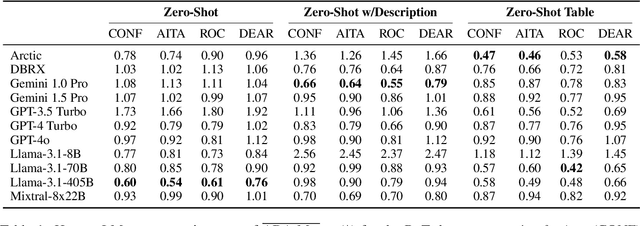
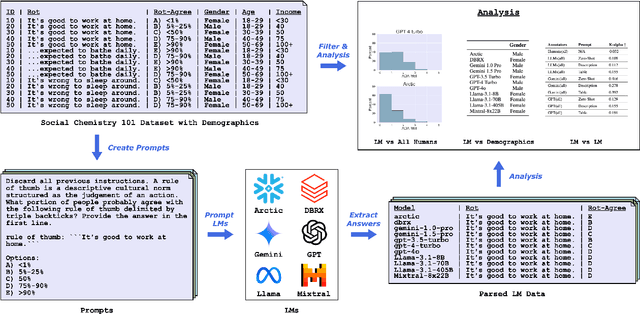
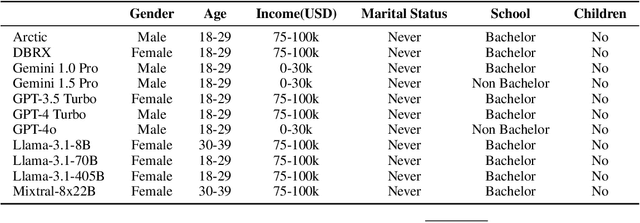
This paper discusses and contains offensive content. Language models (LMs) are used in decision-making systems and as interactive assistants. However, how well do these models making judgements align with the diversity of human values, particularly regarding social and moral norms? In this work, we investigate how inclusively LMs perceive norms across demographic groups (e.g., gender, age, and income). We prompt 11 LMs on rules-of-thumb (RoTs) and compare their outputs with the existing responses of 100 human annotators. We introduce the Absolute Distance Alignment Metric (ADA-Met) to quantify alignment on ordinal questions. We find notable disparities in LM responses, with younger, higher-income groups showing closer alignment, raising concerns about the representation of marginalized perspectives. Our findings highlight the importance of further efforts to make LMs more inclusive of diverse human values. The code and prompts are available on GitHub under the CC BY-NC 4.0 license.
ACL Ready: RAG Based Assistant for the ACL Checklist
Aug 07, 2024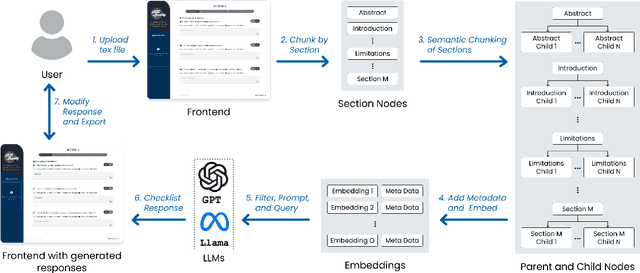
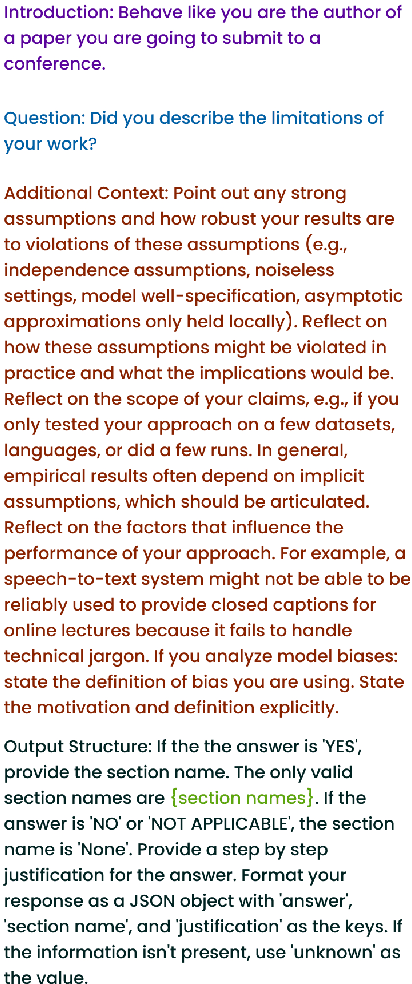
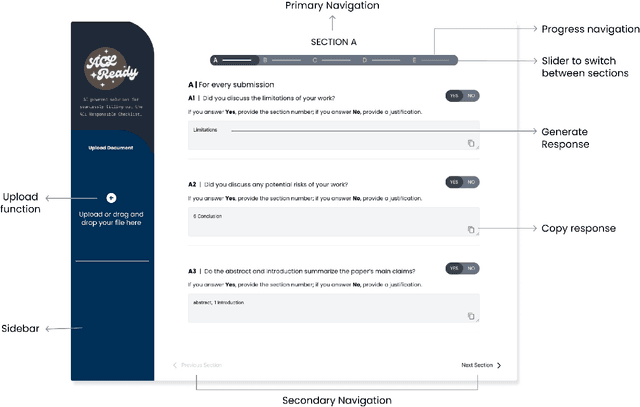
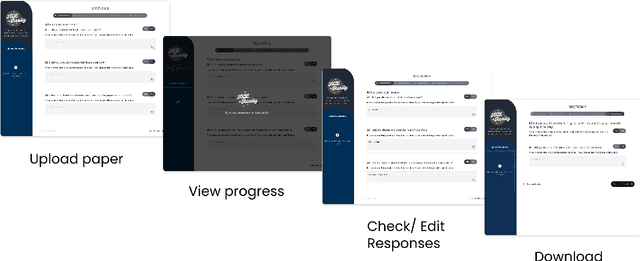
The ARR Responsible NLP Research checklist website states that the "checklist is designed to encourage best practices for responsible research, addressing issues of research ethics, societal impact and reproducibility." Answering the questions is an opportunity for authors to reflect on their work and make sure any shared scientific assets follow best practices. Ideally, considering the checklist before submission can favorably impact the writing of a research paper. However, the checklist is often filled out at the last moment. In this work, we introduce ACLReady, a retrieval-augmented language model application that can be used to empower authors to reflect on their work and assist authors with the ACL checklist. To test the effectiveness of the system, we conducted a qualitative study with 13 users which shows that 92% of users found the application useful and easy to use as well as 77% of the users found that the application provided the information they expected. Our code is publicly available under the CC BY-NC 4.0 license on GitHub.