 Add to Chrome
 Add to Firefox
 Add to Edge
INDEQS: Informed Neural controlled Differential EQuationS
Jun 17, 2026
Neural Controlled Differential Equations (NCDE) provide a powerful continuous-time framework for forecasting time series, but standard graph-based extensions typically learn spatial structure purely from data, even in settings where a directed graph structure is known a priori. We introduce Informed Neural controlled Differential EQuationS (INDEQS), a graph-based NCDE forecasting method that incorporates prior knowledge of a directed graph at distinct architectural positions. INDEQS separates inner mixing of hidden states across graph nodes from outer mixing between vector field and control, and offers both a lightweight graph-constrained variant and a more expressive variant, learning additional graph connections from data via adaptive graph convolutions. To systematically study when graph informedness is beneficial in forecasting, we devise a continuous advection simulation on directed graphs, yielding synthetic spatio-temporal datasets with known ground-truth flow structure. We then evaluate INDEQS on two real-world tasks: river discharge forecasting on a hydrological network and traffic flow prediction on PeMS08. Across these synthetic and real-world benchmarks, outer informedness consistently improves mean absolute error over an uninformed NCDE with comparable parameter count, particularly on larger graphs, while inner informedness offers a more parameter-efficient alternative when strict adherence to a known adjacency is desired. A comparison of discrete convolutional and continuous-time decoders further shows that continuous decoders yield better accuracy and greater temporal flexibility on real-world tasks. An implementation of INDEQS and the advection simulation is available at https://github.com/Mitchi1/indeqs.

Synthetic Datasets for Machine Learning on Spatio-Temporal Graphs using PDEs
Feb 06, 2025Many physical processes can be expressed through partial differential equations (PDEs). Real-world measurements of such processes are often collected at irregularly distributed points in space, which can be effectively represented as graphs; however, there are currently only a few existing datasets. Our work aims to make advancements in the field of PDE-modeling accessible to the temporal graph machine learning community, while addressing the data scarcity problem, by creating and utilizing datasets based on PDEs. In this work, we create and use synthetic datasets based on PDEs to support spatio-temporal graph modeling in machine learning for different applications. More precisely, we showcase three equations to model different types of disasters and hazards in the fields of epidemiology, atmospheric particles, and tsunami waves. Further, we show how such created datasets can be used by benchmarking several machine learning models on the epidemiological dataset. Additionally, we show how pre-training on this dataset can improve model performance on real-world epidemiological data. The presented methods enable others to create datasets and benchmarks customized to individual requirements. The source code for our methodology and the three created datasets can be found on https://github.com/github-usr-ano/Temporal_Graph_Data_PDEs.
Spatial Shortcuts in Graph Neural Controlled Differential Equations
Oct 25, 2024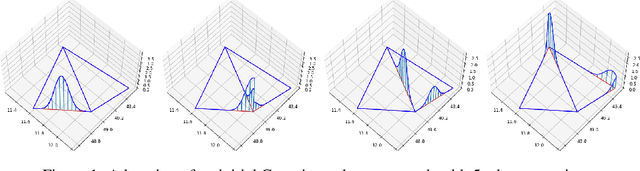
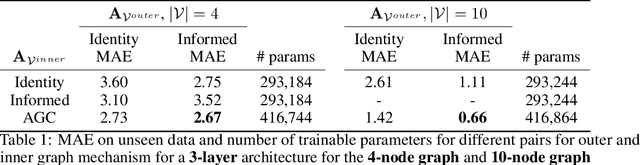
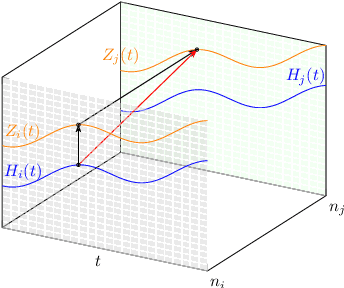
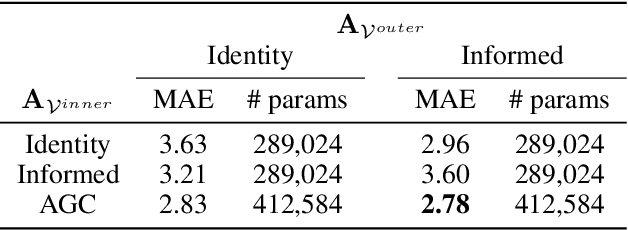
We incorporate prior graph topology information into a Neural Controlled Differential Equation (NCDE) to predict the future states of a dynamical system defined on a graph. The informed NCDE infers the future dynamics at the vertices of simulated advection data on graph edges with a known causal graph, observed only at vertices during training. We investigate different positions in the model architecture to inform the NCDE with graph information and identify an outer position between hidden state and control as theoretically and empirically favorable. Our such informed NCDE requires fewer parameters to reach a lower Mean Absolute Error (MAE) compared to previous methods that do not incorporate additional graph topology information.
Generative Fractional Diffusion Models
Oct 26, 2023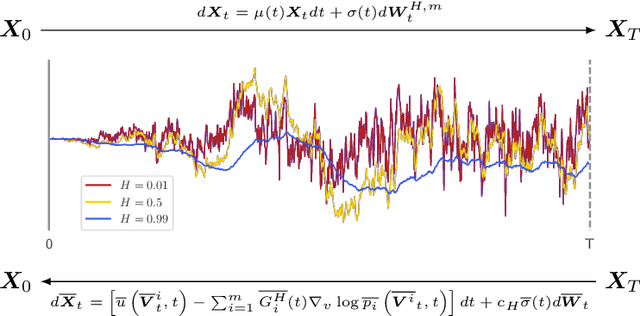
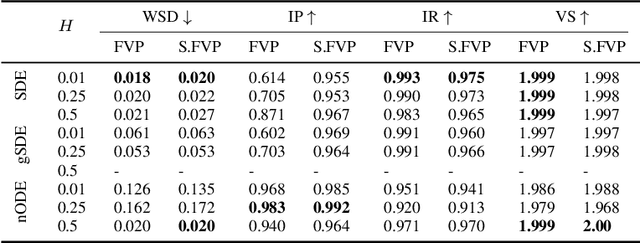
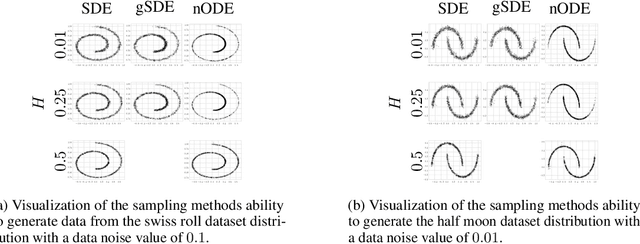
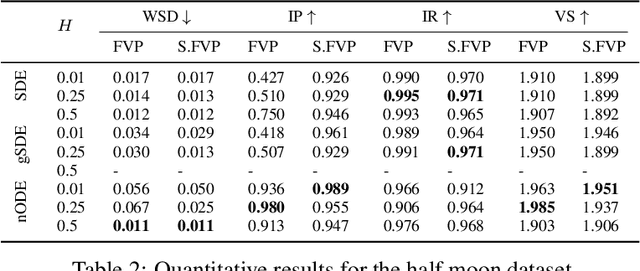
We generalize the continuous time framework for score-based generative models from an underlying Brownian motion (BM) to an approximation of fractional Brownian motion (FBM). We derive a continuous reparameterization trick and the reverse time model by representing FBM as a stochastic integral over a family of Ornstein-Uhlenbeck processes to define generative fractional diffusion models (GFDM) with driving noise converging to a non-Markovian process of infinite quadratic variation. The Hurst index $H\in(0,1)$ of FBM enables control of the roughness of the distribution transforming path. To the best of our knowledge, this is the first attempt to build a generative model upon a stochastic process with infinite quadratic variation.