 Add to Chrome
 Add to Firefox
 Add to Edge
Open-H-Embodiment: A Large-Scale Dataset for Enabling Foundation Models in Medical Robotics
Apr 22, 2026
Autonomous medical robots hold promise to improve patient outcomes, reduce provider workload, democratize access to care, and enable superhuman precision. However, autonomous medical robotics has been limited by a fundamental data problem: existing medical robotic datasets are small, single-embodiment, and rarely shared openly, restricting the development of foundation models that the field needs to advance. We introduce Open-H-Embodiment, the largest open dataset of medical robotic video with synchronized kinematics to date, spanning more than 49 institutions and multiple robotic platforms including the CMR Versius, Intuitive Surgical's da Vinci, da Vinci Research Kit (dVRK), Rob Surgical BiTrack, Virtual Incision's MIRA, Moon Surgical Maestro, and a variety of custom systems, spanning surgical manipulation, robotic ultrasound, and endoscopy procedures. We demonstrate the research enabled by this dataset through two foundation models. GR00T-H is the first open foundation vision-language-action model for medical robotics, which is the only evaluated model to achieve full end-to-end task completion on a structured suturing benchmark (25% of trials vs. 0% for all others) and achieves 64% average success across a 29-step ex vivo suturing sequence. We also train Cosmos-H-Surgical-Simulator, the first action-conditioned world model to enable multi-embodiment surgical simulation from a single checkpoint, spanning nine robotic platforms and supporting in silico policy evaluation and synthetic data generation for the medical domain. These results suggest that open, large-scale medical robot data collection can serve as critical infrastructure for the research community, enabling advances in robot learning, world modeling, and beyond.

SimuScope: Realistic Endoscopic Synthetic Dataset Generation through Surgical Simulation and Diffusion Models
Dec 03, 2024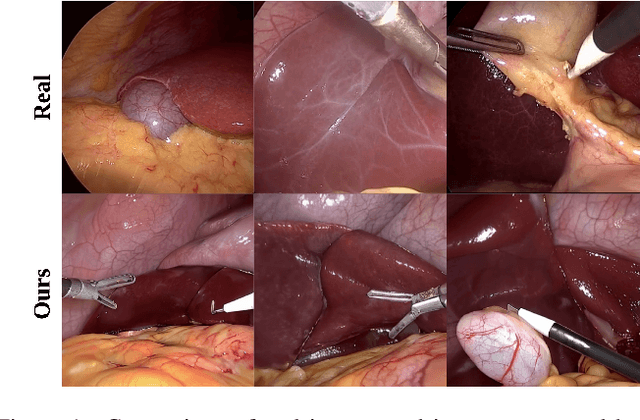

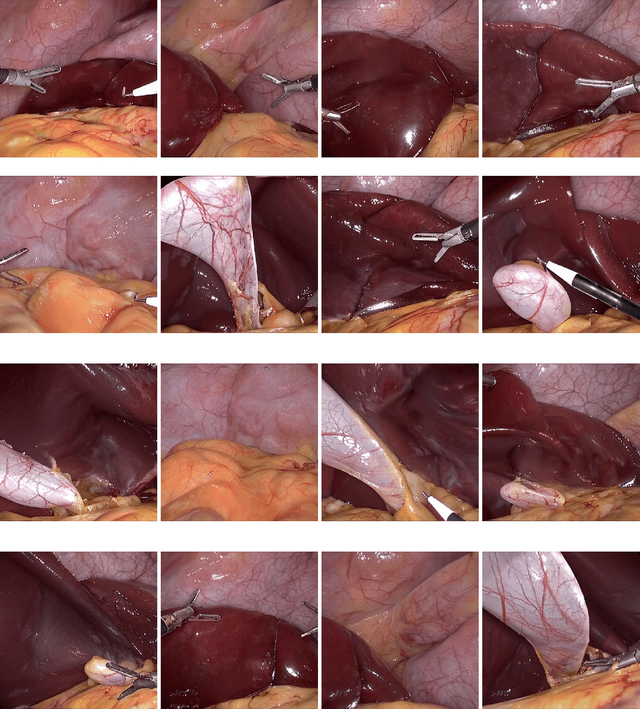
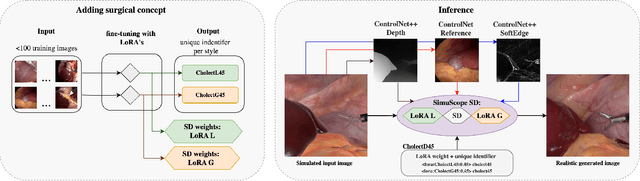
Computer-assisted surgical (CAS) systems enhance surgical execution and outcomes by providing advanced support to surgeons. These systems often rely on deep learning models trained on complex, challenging-to-annotate data. While synthetic data generation can address these challenges, enhancing the realism of such data is crucial. This work introduces a multi-stage pipeline for generating realistic synthetic data, featuring a fully-fledged surgical simulator that automatically produces all necessary annotations for modern CAS systems. This simulator generates a wide set of annotations that surpass those available in public synthetic datasets. Additionally, it offers a more complex and realistic simulation of surgical interactions, including the dynamics between surgical instruments and deformable anatomical environments, outperforming existing approaches. To further bridge the visual gap between synthetic and real data, we propose a lightweight and flexible image-to-image translation method based on Stable Diffusion (SD) and Low-Rank Adaptation (LoRA). This method leverages a limited amount of annotated data, enables efficient training, and maintains the integrity of annotations generated by our simulator. The proposed pipeline is experimentally validated and can translate synthetic images into images with real-world characteristics, which can generalize to real-world context, thereby improving both training and CAS guidance. The code and the dataset are available at https://github.com/SanoScience/SimuScope.