 Add to Chrome
 Add to Firefox
 Add to Edge
Asymptotically-Bounded 3D Frontier Exploration enhanced with Bayesian Information Gain
Apr 03, 2026
Robotic exploration in large-scale environments is computationally demanding due to the high overhead of processing extensive frontiers. This article presents an OctoMap-based frontier exploration algorithm with predictable, asymptotically bounded performance. Unlike conventional methods whose complexity scales with environment size, our approach maintains a complexity of $\mathcal{O}(|\mathcal{F}|)$, where $|\mathcal{F}|$ is the number of frontiers. This is achieved through strategic forward and inverse sensor modeling, which enables approximate yet efficient frontier detection and maintenance. To further enhance performance, we integrate a Bayesian regressor to estimate information gain, circumventing the need to explicitly count unknown voxels when prioritizing viewpoints. Simulations show the proposed method is more computationally efficient than the existing OctoMap-based methods and achieves computational efficiency comparable to baselines that are independent of OctoMap. Specifically, the Bayesian-enhanced framework achieves up to a $54\%$ improvement in total exploration time compared to standard deterministic frontier-based baselines across varying spatial scales, while guaranteeing task completion. Real-world experiments confirm the computational bounds as well as the effectiveness of the proposed enhancement.

Enhancing Multi-Robot Exploration Using Probabilistic Frontier Prioritization with Dirichlet Process Gaussian Mixtures
Apr 03, 2026Multi-agent autonomous exploration is essential for applications such as environmental monitoring, search and rescue, and industrial-scale surveillance. However, effective coordination under communication constraints remains a significant challenge. Frontier exploration algorithms analyze the boundary between the known and unknown regions to determine the next-best view that maximizes exploratory gain. This article proposes an enhancement to existing frontier-based exploration algorithms by introducing a probabilistic approach to frontier prioritization. By leveraging Dirichlet process Gaussian mixture model (DP-GMM) and a probabilistic formulation of information gain, the method improves the quality of frontier prioritization. The proposed enhancement, integrated into two state-of-the-art multi-agent exploration algorithms, consistently improves performance across environments of varying clutter, communication constraints, and team sizes. Simulations showcase an average gain of $10\%$ and $14\%$ for the two algorithms across all combinations. Successful deployment in real-world experiments with a dual-drone system further corroborates these findings.
Robust Cooperative Localization in Featureless Environments: A Comparative Study of DCL, StCL, CCL, CI, and Standard-CL
Mar 12, 2026Cooperative localization (CL) enables accurate position estimation in multi-robot systems operating in GPS-denied environments. This paper presents a comparative study of five CL approaches: Centralized Cooperative Localization (CCL), Decentralized Cooperative Localization (DCL), Sequential Cooperative Localization (StCL), Covariance Intersection (CI), and Standard Cooperative Localization (Standard-CL). All methods are implemented in ROS and evaluated through Monte Carlo simulations under two conditions: weak data association and robust detection. Our analysis reveals fundamental trade-offs among the methods. StCL and Standard-CL achieve the lowest position errors but exhibit severe filter inconsistency, making them unsuitable for safety-critical applications. DCL demonstrates remarkable stability under challenging conditions due to its measurement stride mechanism, which provides implicit regularization against outliers. CI emerges as the most balanced approach, achieving near-optimal consistency while maintaining competitive accuracy. CCL provides theoretically optimal estimation but shows sensitivity to measurement outliers. These findings offer practical guidance for selecting CL algorithms based on application requirements.
Unsupervised LiDAR-Based Multi-UAV Detection and Tracking Under Extreme Sparsity
Mar 12, 2026Non-repetitive solid-state LiDAR scanning leads to an extremely sparse measurement regime for detecting airborne UAVs: a small quadrotor at 10-25 m typically produces only 1-2 returns per scan, which is far below the point densities assumed by most existing detection approaches and inadequate for robust multi-target data association. We introduce an unsupervised, LiDAR-only pipeline that addresses both detection and tracking without the need for labeled training data. The detector integrates range-adaptive DBSCAN clustering with a three-stage temporal consistency check and is benchmarked on real-world air-to-air flight data under eight different parameter configurations. The best setup attains 0.891 precision, 0.804 recall, and 0.63 m RMSE, and a systematic minPts sweep verifies that most scans contain at most 1-2 target points, directly quantifying the sparsity regime. For multi-target tracking, we compare deterministic Hungarian assignment with joint probabilistic data association (JPDA), each coupled with Interacting Multiple Model filtering, in four simulated scenarios with increasing levels of ambiguity. JPDA cuts identity switches by 64% with negligible impact on MOTA, demonstrating that probabilistic association is advantageous when UAV trajectories approach one another closely. A two-environment evaluation strategy, combining real-world detection with RTK-GPS ground truth and simulation-based tracking with identity-annotated ground truth, overcomes the limitations of GNSS-only evaluation at inter-UAV distances below 2 m.
Distributed Kalman--Consensus Filtering with Adaptive Uncertainty Weighting for Multi-Object Tracking in Mobile Robot Networks
Mar 11, 2026This paper presents an implementation and evaluation of a Distributed Kalman--Consensus Filter (DKCF) for Multi-Object Tracking (MOT) in mobile robot networks operating under partial observability and heterogeneous localization uncertainty. A key challenge in such systems is the fusion of information from agents with differing localization quality, where frame misalignment can lead to inconsistent estimates, track duplication, and ghost tracks. To address this issue, we build upon the MOTLEE framework and retain its frame-alignment methodology, which uses consistently tracked dynamic objects as transient landmarks to improve relative pose estimates between robots. On top of this framework, we propose an uncertainty-aware adaptive consensus weighting mechanism that dynamically adjusts the influence of neighbor information based on the covariance of the transmitted estimates, thereby reducing the impact of unreliable data during distributed fusion. Local tracking is performed using a Kalman Filter (KF) with a Constant Velocity Model (CVM) and Global Nearest Neighbor (GNN) data association. simulation results demonstrate that adaptive weighting effectively protects local estimates from inconsistent data, yielding a MOTA improvement of 0.09 for agents suffering from localization drift, although system performance remains constrained by communication latency.
Lightweight 3D LiDAR-Based UAV Tracking: An Adaptive Extended Kalman Filtering Approach
Mar 10, 2026Accurate relative positioning is crucial for swarm aerial robotics, enabling coordinated flight and collision avoidance. Although vision-based tracking has been extensively studied, 3D LiDAR-based methods remain underutilized despite their robustness under varying lighting conditions. Existing systems often rely on bulky, power-intensive sensors, making them impractical for small UAVs with strict payload and energy constraints. This paper presents a lightweight LiDAR-based UAV tracking system incorporating an Adaptive Extended Kalman Filter (AEKF) framework. Our approach effectively addresses the challenges posed by sparse, noisy, and nonuniform point cloud data generated by non-repetitive scanning 3D LiDARs, ensuring reliable tracking while remaining suitable for small drones with strict payload constraints. Unlike conventional filtering techniques, the proposed method dynamically adjusts the noise covariance matrices using innovation and residual statistics, thereby enhancing tracking accuracy under real-world conditions. Additionally, a recovery mechanism ensures continuity of tracking during temporary detection failures caused by scattered LiDAR returns or occlusions. Experimental validation was performed using a Livox Mid-360 LiDAR mounted on a DJI F550 UAV in real-world flight scenarios. The proposed method demonstrated robust UAV tracking performance under sparse LiDAR returns and intermittent detections, consistently outperforming both standard Kalman filtering and particle filtering approaches during aggressive maneuvers. These results confirm that the framework enables reliable relative positioning in GPS-denied environments without the need for multi-sensor arrays or external infrastructure.
Path Planning Optimisation for SParse, AwaRe and Cooperative Networked Aerial Robot Teams (SpArC-NARTs): Optimisation Tool and Ground Sensing Coverage Use Cases
Feb 15, 2026A networked aerial robot team (NART) comprises a group of agents (e.g., unmanned aerial vehicles (UAVs), ground control stations, etc.) interconnected by wireless links. Inter-agent connectivity, even if intermittent (i.e. sparse), enables data exchanges between agents and supports cooperative behaviours in several NART missions. It can benefit online decentralised decision-making and group resilience, particularly when prior knowledge is inaccurate or incomplete. These requirements can be accounted for in the offline mission planning stages to incentivise cooperative behaviours and improve mission efficiency during the NART deployment. This paper proposes a novel path planning tool for a Sparse, Aware, and Cooperative Networked Aerial Robot Team (SpArC-NART) in exploration missions. It simultaneously considers different levels of prior information regarding the environment, limited agent energy, sensing, and communication, as well as distinct NART constitutions. The communication model takes into account the limitations of user-defined radio technology and physical phenomena. The proposed tool aims to maximise the mission goals (e.g., finding one or multiple targets, covering the full area of the environment, etc.), while cooperating with other agents to reduce agent reporting times, increase their global situational awareness (e.g., their knowledge of the environment), and facilitate mission replanning, if required. The developed cooperation mechanism leverages soft-motion constraints and dynamic rewards based on the Value of Movement and the expected communication availability between the agents at each time step. A ground sensing coverage use case was chosen to illustrate the current capabilities of this tool.
Multitask Reinforcement Learning for Quadcopter Attitude Stabilization and Tracking using Graph Policy
Mar 11, 2025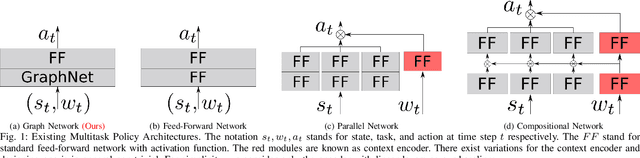
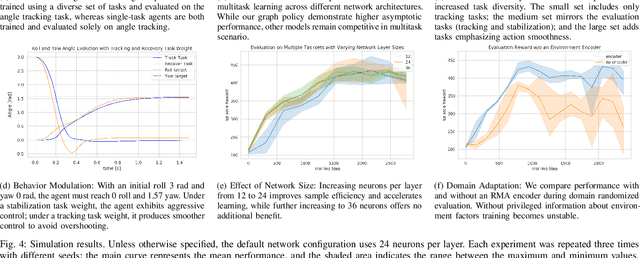
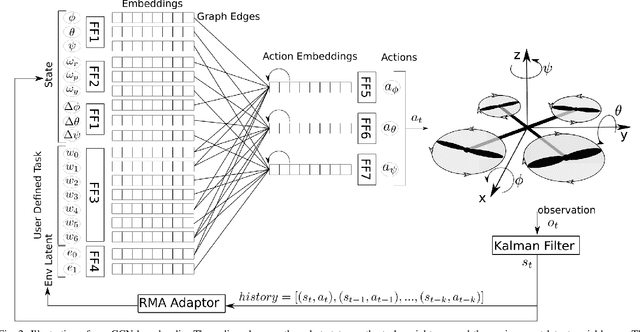
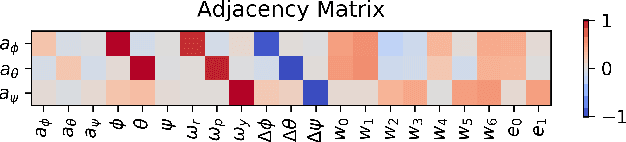
Quadcopter attitude control involves two tasks: smooth attitude tracking and aggressive stabilization from arbitrary states. Although both can be formulated as tracking problems, their distinct state spaces and control strategies complicate a unified reward function. We propose a multitask deep reinforcement learning framework that leverages parallel simulation with IsaacGym and a Graph Convolutional Network (GCN) policy to address both tasks effectively. Our multitask Soft Actor-Critic (SAC) approach achieves faster, more reliable learning and higher sample efficiency than single-task methods. We validate its real-world applicability by deploying the learned policy - a compact two-layer network with 24 neurons per layer - on a Pixhawk flight controller, achieving 400 Hz control without extra computational resources. We provide our code at https://github.com/robot-perception-group/GraphMTSAC\_UAV/.
Frontier Shepherding: A Bio-Mimetic Multi-robot Framework for Large-Scale Exploration
Sep 17, 2024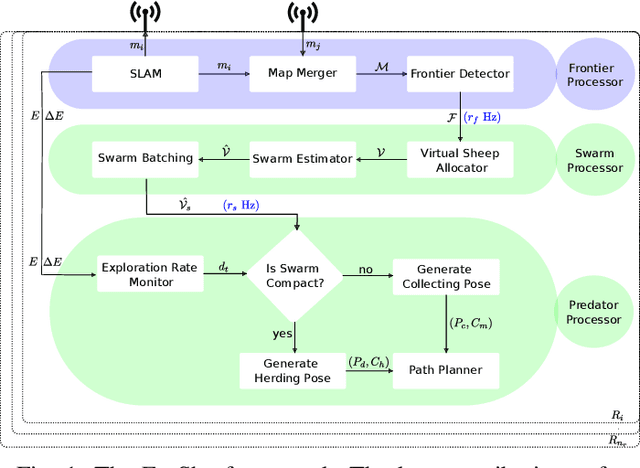
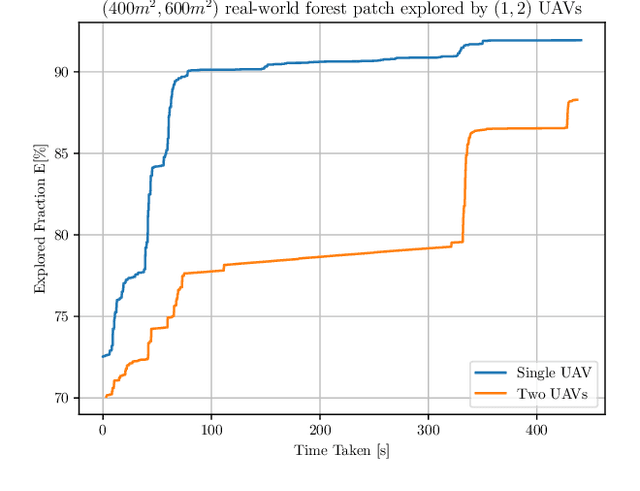
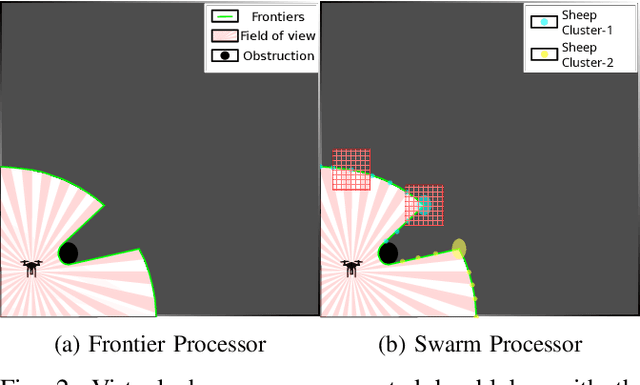
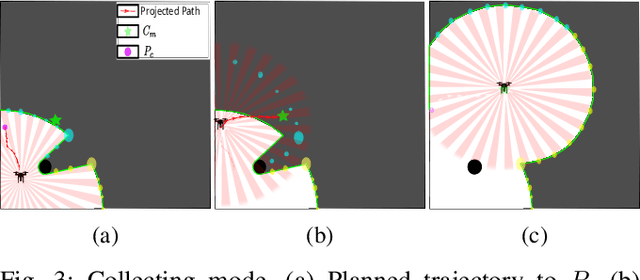
Efficient exploration of large-scale environments remains a critical challenge in robotics, with applications ranging from environmental monitoring to search and rescue operations. This article proposes a bio-mimetic multi-robot framework, \textit{Frontier Shepherding (FroShe)}, for large-scale exploration. The presented bio-inspired framework heuristically models frontier exploration similar to the shepherding behavior of herding dogs. This is achieved by modeling frontiers as a sheep swarm reacting to robots modeled as shepherding dogs. The framework is robust across varying environment sizes and obstacle densities and can be easily deployed across multiple agents. Simulation results showcase that the proposed method consistently performed irrespective of the simulated environment's varying sizes and obstacle densities. With the increase in the number of agents, the proposed method outperforms other state-of-the-art exploration methods, with an average improvement of $20\%$ with the next-best approach(for $3$ UAVs). The proposed technique was implemented and tested in a single and dual drone scenario in a real-world forest-like environment.
BogieCopter: A Multi-Modal Aerial-Ground Vehicle for Long-Endurance Inspection Applications
Mar 03, 2023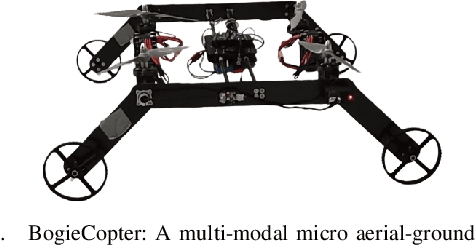
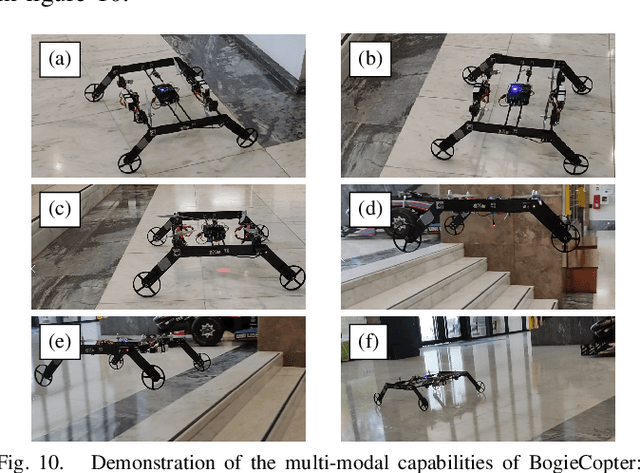
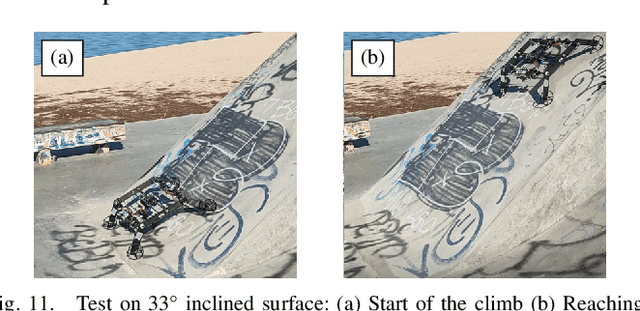

The use of Micro Aerial Vehicles (MAVs) for inspection and surveillance missions has proved to be extremely useful, however, their usability is negatively impacted by the large power requirements and the limited operating time. This work describes the design and development of a novel hybrid aerial-ground vehicle, enabling multi-modal mobility and long operating time, suitable for long-endurance inspection and monitoring applications. The design consists of a MAV with two tiltable axles and four independent passive wheels, allowing it to fly, approach, land and move on flat and inclined surfaces, while using the same set of actuators for all modes of locomotion. In comparison to existing multi-modal designs with passive wheels, the proposed design enables a higher ground locomotion efficiency, provides a higher payload capacity, and presents one of the lowest mass increases due to the ground actuation mechanism. The vehicle's performance is evaluated through a series of real experiments, demonstrating its flying, ground locomotion and wall-climbing capabilities, and the energy consumption for all modes of locomotion is evaluated.