 Add to Chrome
 Add to Firefox
 Add to Edge
DemoPSD: Disagreement-Modulated Policy Self-Distillation
Jul 02, 2026
On-policy self-distillation (OPSD) has emerged as a practical method for training large language models (LLMs) to reason, where a single model acts as both the teacher and the student with different levels of information access. However, recent studies have found that the teacher's dense token-level supervision, conditioned on privileged information, can lead to overfitting to in-domain patterns, suppress exploration, and hurt cross-domain generalization, while also introducing a more fundamental issue: *privileged information leakage*, where the student encodes answer-dependent shortcuts that are unavailable at test time. We introduce **DemoPSD**, a novel framework that resolves such problems through the idea of *selective adoption of teacher guidance*. Instead of fitting the full teacher distribution, DemoPSD steers the student toward a *reverse-KL barycenter target*, a weighted geometric combination of the teacher and student distributions, that naturally balances learning from the teacher with preserving the student's own reasoning capacity. We measure the difference between their distributions and use such a discrepancy to adaptively control the blending at each token position. We provably show that DemoPSD achieves **(1)** *leakage attenuation*, i.e., effective mitigation of privileged information leakage; and **(2)** *exploration preservation*, i.e., preservation of exploration capacity under dense token-level distillation. Extensive experiments on SciKnowEval across four scientific fields show that DemoPSD outperforms both GRPO and SDPO while maintaining higher training entropy and robustly generalizing to out-of-distribution GPQA benchmarks.

ReasonAlloc: Hierarchical Decoding-Time KV Cache Budget Allocation for Reasoning Models
Jun 09, 2026Long chain-of-thought (CoT) trajectories in large language model (LLM) reasoning cause severe inference bottlenecks due to rapid key-value (KV) cache growth. Current decoding-time compression methods mitigate this issue via token eviction, but typically assume a uniform budget distribution across all layers and heads. In contrast, existing non-uniform budget allocation methods are predominantly designed for the static prompt prefill phase, and they do not capture the stepwise context demands of autoregressive reasoning. To bridge this gap, we propose ReasonAlloc, a training-free framework that recasts decoding-time KV compression as a hierarchical budget allocation problem. ReasonAlloc operates at two complementary levels: an offline layer-wise preallocation strategy captures an architecture-driven demand pattern which we call ``\textit{Reasoning Wave}'', while an online head-wise strategy reallocates resources during decoding to information-rich heads based on real-time utility. Evaluations on mathematical reasoning benchmarks (MATH-500, AIME~2024) using DeepSeek-R1-Distill-Llama-8B, DeepSeek-R1-Distill-Qwen-14B, and AceReason-14B show that ReasonAlloc outperforms uniform-budget R-KV, SnapKV, and Pyramid-RKV (a baseline enforcing a static, monotonically decreasing layer budget), with the largest gains at small budgets (128-512 tokens). ReasonAlloc is plug-and-play with existing token-eviction policies and introduces negligible inference-time overhead.
Inference-Time Budget Control for LLM Search Agents
May 07, 2026LLM search agents increasingly rely on tools at inference time, but their trajectories are often constrained by hard limits on both tool calls and generated tokens. Under such dual budgets, better answers require not only stronger models, but also explicit control over which search action should receive the next budget unit and when the accumulated evidence is sufficient to commit a final answer. We study this problem in multi-hop question answering (QA) and formulate it as two-stage inference-time budget control. At search time, our controller assigns each feasible action a task-level Value-of-Information (VOI) score, defined as an operational estimate of marginal task value per unit budget under the current search state and remaining dual budget, and uses this score to choose among retrieval, decomposition, and answer commitment. After search, a selective evidence-grounded finalizer compares the trajectory answer with a refined candidate and rewrites only when the residual error appears to be a low-risk answer-form error. Across four multi-hop QA benchmarks, three LLM backbones, and four budget levels, the method yields positive aggregate gains over four audited baselines under the same hard dual-budget protocol. Ablations show that search-time budget control, especially budget-dependent penalty, provides the main performance gain, while answer-time control helps mainly when the retrieval path is already adequate. These results suggest that inference-time budget control for LLM search agents should govern both how budget is spent during search and how the final answer is committed.
Adaptive Top-K in SGD for Communication-Efficient Distributed Learning
Oct 24, 2022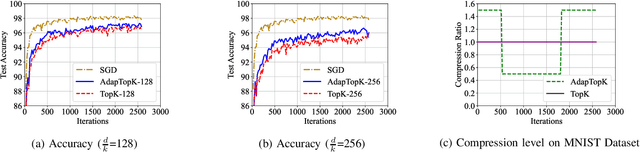
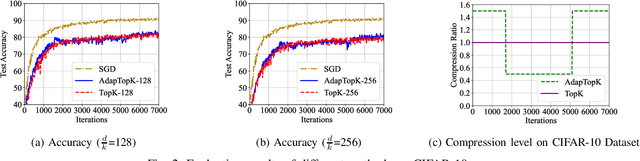
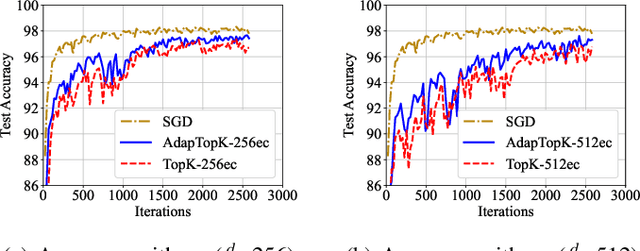
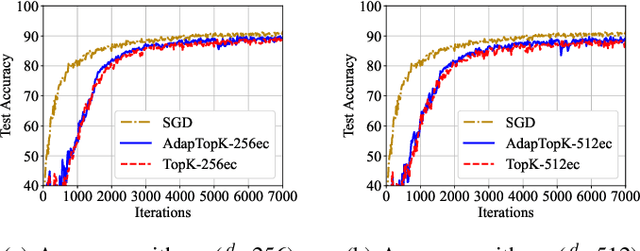
Distributed stochastic gradient descent (SGD) with gradient compression has emerged as a communication-efficient solution to accelerate distributed learning. Top-K sparsification is one of the most popular gradient compression methods that sparsifies the gradient in a fixed degree during model training. However, there lacks an approach to adaptively adjust the degree of sparsification to maximize the potential of model performance or training speed. This paper addresses this issue by proposing a novel adaptive Top-K SGD framework, enabling adaptive degree of sparsification for each gradient descent step to maximize the convergence performance by exploring the trade-off between communication cost and convergence error. Firstly, we derive an upper bound of the convergence error for the adaptive sparsification scheme and the loss function. Secondly, we design the algorithm by minimizing the convergence error under the communication cost constraints. Finally, numerical results show that the proposed adaptive Top-K in SGD achieves a significantly better convergence rate compared with the state-of-the-art methods.