 Add to Chrome
 Add to Firefox
 Add to Edge
Sensing-Assisted LoS/NLoS Identification in Dynamic UAV Positioning Systems
May 13, 2026
In this paper, a sensing-assisted non-line-of-sight (NLoS) identification method for dynamic uncrewed aerial vehicle (UAV) positioning is proposed for the first time. For urban UAV-to-ground scenarios, a new multi-modal sensing-communication integrated dataset is constructed to support line-of-sight (LoS)/NLoS identification, covering two typical urban scenarios and a wide range of flight altitudes. Based on the constructed dataset, a novel dual-input feature fusion network is proposed, which addresses the challenge of heterogeneous representations between RGB images and channel impulse response (CIR) data to enable the joint extraction and fusion of sensing and communication features for LoS/NLoS identification. Simulation results show that the identification accuracy can reach up to 97.69%, while achieving an improvement of at least 3.59% compared to traditional CIR-only and RGB-only methods. Moreover, strong few-shot generalization is observed, as the proposed method stabilizes and approaches full-sample performance with fewer than 200 target samples and exceeds traditional CIR-only and RGB-only methods with fewer than 100 target samples in all cross-scenario and cross-altitude experiments. Even under Gaussian noise with a variance of 0.35 applied to RGB images, the accuracy degradation remains approximately 0.5%. By utilizing the proposed LoS/NLoS identification method, the error of trilateration positioning can be reduced by approximately 70% in a crossroad scenario, verifying the utility of the proposed method.

A Multi-modal Intelligent Channel Model for 6G Multi-UAV-to-Multi-Vehicle Communications
Jan 15, 2025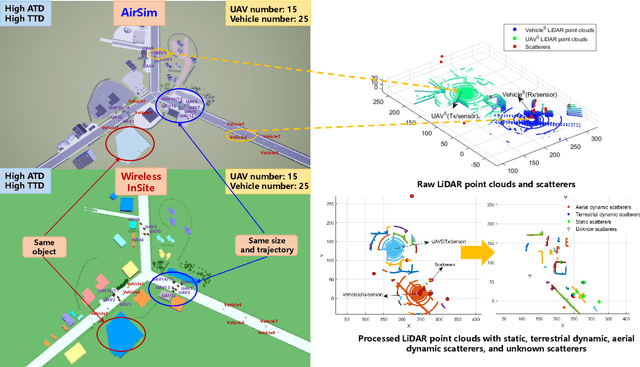
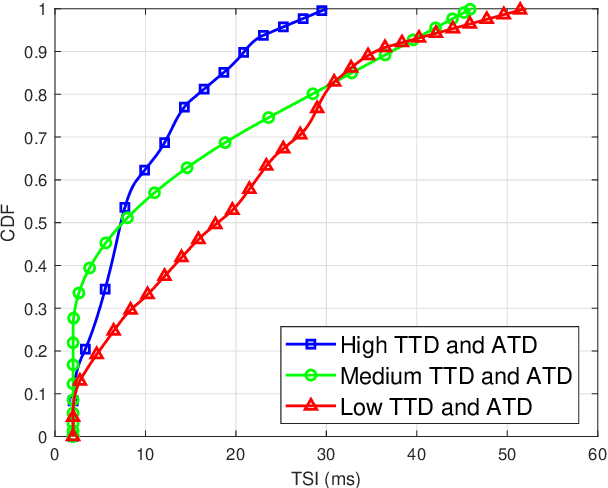
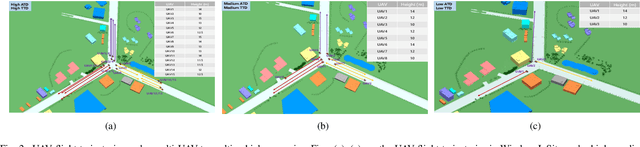
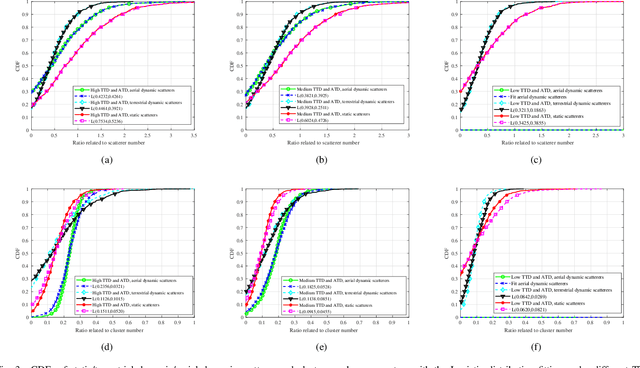
In this paper, a novel multi-modal intelligent channel model for sixth-generation (6G) multiple-unmanned aerial vehicle (multi-UAV)-to-multi-vehicle communications is proposed. To thoroughly explore the mapping relationship between the physical environment and the electromagnetic space in the complex multi-UAV-to-multi-vehicle scenario, two new parameters, i.e., terrestrial traffic density (TTD) and aerial traffic density (ATD), are developed and a new sensing-communication intelligent integrated dataset is constructed in suburban scenario under different TTD and ATD conditions. With the aid of sensing data, i.e., light detection and ranging (LiDAR) point clouds, the parameters of static scatterers, terrestrial dynamic scatterers, and aerial dynamic scatterers in the electromagnetic space, e.g., number, distance, angle, and power, are quantified under different TTD and ATD conditions in the physical environment. In the proposed model, the channel non-stationarity and consistency on the time and space domains and the channel non-stationarity on the frequency domain are simultaneously mimicked. The channel statistical properties, such as time-space-frequency correlation function (TSF-CF), time stationary interval (TSI), and Doppler power spectral density (DPSD), are derived and simulated. Simulation results match ray-tracing (RT) results well, which verifies the accuracy of the proposed multi-UAV-to-multi-vehicle channel model.