 Add to Chrome
 Add to Firefox
 Add to Edge
AMTFV: Agentic Mathematical Tool-Flow Verification for LLM Self-Correction
Jul 31, 2026
Large language models have demonstrated strong mathematical problem-solving capabilities, yet reliably verifying their candidate answers remains challenging. Existing representative methods mainly revise outputs through natural-language reflection or assist verification by directly generating verification programs; the former may not reliably support exact computation, whereas the latter prematurely couples mathematical modeling with low-level implementation. We propose AMTFV (Agentic Mathematical Tool-Flow Verification). By introducing Mathematical Tool Flow (MTF) as an interrupt--execute--resume interface, AMTFV decouples verification modeling from concrete execution and supports exact computation through a mathematical toolbox. Specifically, the verification agent first constructs a verification workflow, encodes the mathematical objects and computational intent requiring reliable execution in an MTF request, and sends it to the mathematical toolbox agent. The latter parses the request, generates executable calls, and dispatches them to the backend for exact computation. Tool outputs then support candidate-answer adjudication, answer revision, and verification-workflow revision. We evaluate AMTFV on five challenging mathematical reasoning datasets with seven model configurations from DeepSeek, GPT, and Gemini. Experimental results show that AMTFV outperforms the representative baselines evaluated in this study overall; under an individual model configuration, it improves average accuracy over the strongest baseline by up to 8.3 percentage points, with larger gains on samples of medium and high verification complexity.

Gradual Vigilance and Interval Communication: Enhancing Value Alignment in Multi-Agent Debates
Dec 18, 2024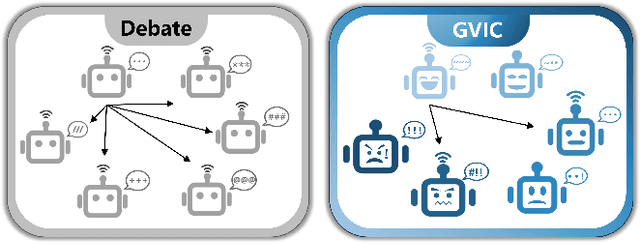
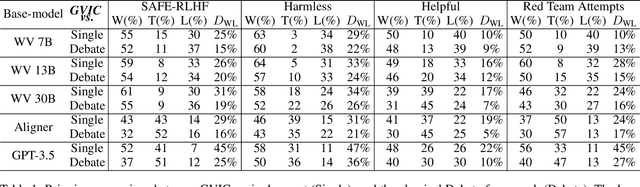
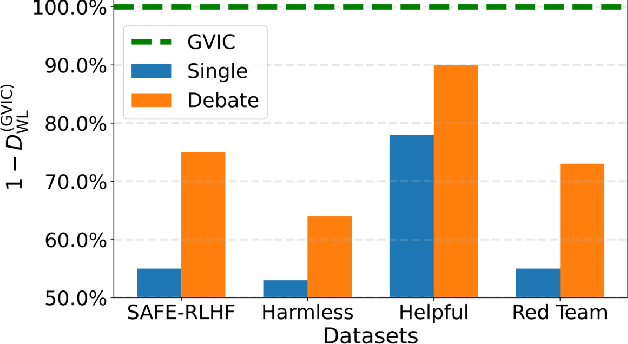
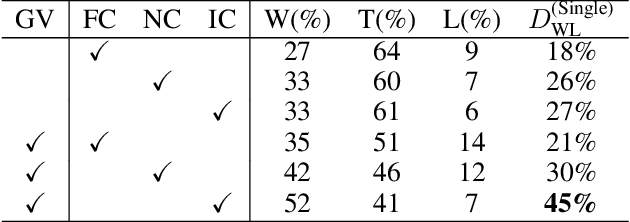
In recent years, large language models have shown exceptional performance in fulfilling diverse human needs. However, their training data can introduce harmful content, underscoring the necessity for robust value alignment. Mainstream methods, which depend on feedback learning and supervised training, are resource-intensive and may constrain the full potential of the models. Multi-Agent Debate (MAD) offers a more efficient and innovative solution by enabling the generation of reliable answers through agent interactions. To apply MAD to value alignment, we examine the relationship between the helpfulness and harmlessness of debate outcomes and individual responses, and propose a MAD based framework Gradual Vigilance and Interval Communication (GVIC). GVIC allows agents to assess risks with varying levels of vigilance and to exchange diverse information through interval communication. We theoretically prove that GVIC optimizes debate efficiency while reducing communication overhead. Experimental results demonstrate that GVIC consistently outperforms baseline methods across various tasks and datasets, particularly excelling in harmfulness mitigation and fraud prevention. Additionally, GVIC exhibits strong adaptability across different base model sizes, including both unaligned and aligned models, and across various task types.