 Add to Chrome
 Add to Firefox
 Add to Edge
RAVEN: Reinforcement-Adaptive Visibility-Graph Planning for Robust Humanoid Navigation with Collision-Free MPC
Jul 17, 2026
Humanoid navigation in dynamic environments requires long-horizon planning while respecting short-horizon dynamic and safety constraints. Classical visibility-graph planners combined with model predictive control (MPC) can efficiently generate collision-free trajectories, but their performance depends on manually tuned parameters and accurate system modeling. In real robotic systems, control delays, state-estimation noise, and locomotion uncertainties can cause overshoot and constraint violations even when the nominal path is geometrically optimal. We propose RAVEN, a hierarchical reinforcement learning (RL)-MPC framework for robust humanoid navigation. Unlike prior approaches that use learning to tune cost weights or replace planning entirely, RAVEN employs RL to adapt the geometric construction of a visibility-graph planner by modifying obstacle inflation and related graph parameters. By directly reshaping the free-space geometry, the learned planner alters the topology of the global path to compensate for delay and tracking imperfections. A collision-free MPC layer then tracks the planned trajectory while explicitly enforcing velocity bounds and obstacle-avoidance constraints. By training under realistic delays and observation noise, RAVEN learns planning adaptations that improve robustness while retaining explicit long-horizon geometric planning and constrained optimization, in contrast to end-to-end learning approaches. We evaluate RAVEN against a manually tuned visibility-graph MPC baseline and a pure RL navigation policy. Results demonstrate reduced overshoot near obstacles, improved robustness in narrow passages, and more reliable navigation under delay and noise. These findings indicate that reinforcement-adaptive graph construction combined with constrained MPC provides an effective and interpretable alternative to end-to-end learning for robust humanoid navigation.

ELAICHI: Enhancing Low-resource TTS by Addressing Infrequent and Low-frequency Character Bigrams
Oct 23, 2024Recent advancements in Text-to-Speech (TTS) technology have led to natural-sounding speech for English, primarily due to the availability of large-scale, high-quality web data. However, many other languages lack access to such resources, relying instead on limited studio-quality data. This scarcity results in synthesized speech that often suffers from intelligibility issues, particularly with low-frequency character bigrams. In this paper, we propose three solutions to address this challenge. First, we leverage high-quality data from linguistically or geographically related languages to improve TTS for the target language. Second, we utilize low-quality Automatic Speech Recognition (ASR) data recorded in non-studio environments, which is refined using denoising and speech enhancement models. Third, we apply knowledge distillation from large-scale models using synthetic data to generate more robust outputs. Our experiments with Hindi demonstrate significant reductions in intelligibility issues, as validated by human evaluators. We propose this methodology as a viable alternative for languages with limited access to high-quality data, enabling them to collectively benefit from shared resources.
IndicVoices-R: Unlocking a Massive Multilingual Multi-speaker Speech Corpus for Scaling Indian TTS
Sep 09, 2024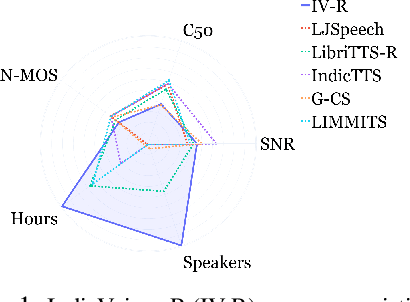
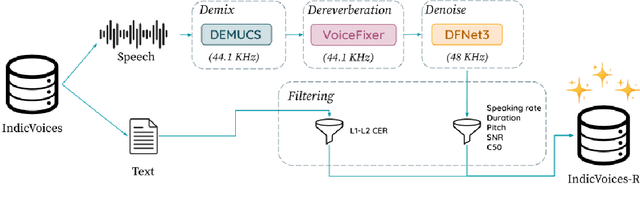
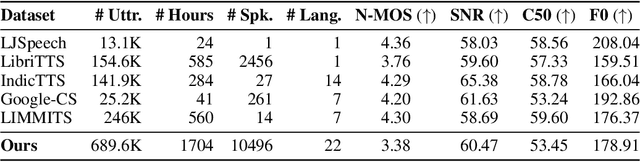
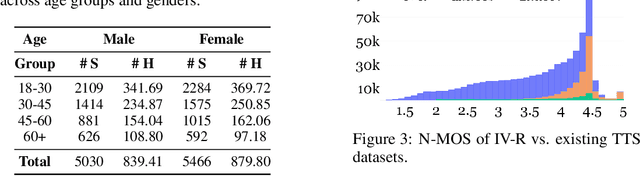
Recent advancements in text-to-speech (TTS) synthesis show that large-scale models trained with extensive web data produce highly natural-sounding output. However, such data is scarce for Indian languages due to the lack of high-quality, manually subtitled data on platforms like LibriVox or YouTube. To address this gap, we enhance existing large-scale ASR datasets containing natural conversations collected in low-quality environments to generate high-quality TTS training data. Our pipeline leverages the cross-lingual generalization of denoising and speech enhancement models trained on English and applied to Indian languages. This results in IndicVoices-R (IV-R), the largest multilingual Indian TTS dataset derived from an ASR dataset, with 1,704 hours of high-quality speech from 10,496 speakers across 22 Indian languages. IV-R matches the quality of gold-standard TTS datasets like LJSpeech, LibriTTS, and IndicTTS. We also introduce the IV-R Benchmark, the first to assess zero-shot, few-shot, and many-shot speaker generalization capabilities of TTS models on Indian voices, ensuring diversity in age, gender, and style. We demonstrate that fine-tuning an English pre-trained model on a combined dataset of high-quality IndicTTS and our IV-R dataset results in better zero-shot speaker generalization compared to fine-tuning on the IndicTTS dataset alone. Further, our evaluation reveals limited zero-shot generalization for Indian voices in TTS models trained on prior datasets, which we improve by fine-tuning the model on our data containing diverse set of speakers across language families. We open-source all data and code, releasing the first TTS model for all 22 official Indian languages.