 Add to Chrome
 Add to Firefox
 Add to Edge
Aero-World: Action-Conditioned Aerial Video Generation from Inertial Controls
May 19, 2026
Foundation video models produce visually impressive results, but their use in embodied AI remains limited because they are primarily trained on natural language rather than low-level control signals. This limitation is especially pronounced for aerial flight, where motion occurs in unconstrained 6-DoF space and small errors in ego-motion can produce large trajectory drift. Generating aerial videos that follow fine-grained inertial actions can support scalable training and evaluation of aerial agents by providing a controllable proxy for real-world or expensive simulation data. To address this problem, we propose \textbf{Aero-World}, a method for converting a pretrained image-to-video diffusion model into a controllable aerial video generator. Aero-World injects sequences of translational acceleration and angular velocity into a pretrained latent diffusion transformer through an action-token stream. A frozen latent-space Physics Probe, trained independently on real video--IMU pairs, provides differentiable inertial-consistency supervision during LoRA finetuning while avoiding computationally expensive video decoding. We further propose \textbf{AeroBench}, a benchmark for evaluating whether generated drone videos adhere to low-level action signals. AeroBench uses Action Alignment Score (AAS) to measure agreement with commanded inertial actions and Physical Consistency Rate (PCR) to measure temporal motion stability. On AeroBench, Aero-World improves mean AAS from 57.7 to 63.6 over action-only finetuning and gives a stronger quality-control trade-off than AirScape, with lower FVD (596.5 vs. 1058.6), higher SSIM (0.595 vs. 0.505), and higher Flow-IMU correlation (0.44 vs. 0.20). These results suggest that frozen Physics Probe supervision is a practical mechanism for adapting pretrained video generators toward more action-aligned aerial motion.

CATS: Curvature Aware Temporal Selection for efficient long video understanding
May 09, 2026Understanding long videos with multimodal large language models (MLLMs) requires selecting a small subset of informative frames under strict computational budgets, where exhaustive processing is infeasible and optimal selection is combinatorial. We propose CATS, a curvature-aware frame selection method that explicitly models the temporal geometry of query-frame relevance to identify salient events and their surrounding context. By leveraging temporal curvature to adapt selection density, CATS captures both abrupt transitions and gradually evolving content while suppressing redundant frames. Under a fixed backbone and frame budget, CATS consistently outperforms prior lightweight approaches such as AKS on LongVideoBench and VideoMME. While multi-stage methods such as MIRA achieve higher absolute accuracy, they incur substantial computational overhead; in contrast, CATS retains approximately 93-95% of MIRA's performance while requiring only 3-4% of its preprocessing cost, yielding a favorable efficiency-accuracy trade-off. Beyond answer accuracy, we evaluate description generation using an LLM-as-a-judge protocol, and the obtained results show that CATS produces more coherent and informative outputs, indicating improved grounding in visual evidence. These results position CATS as a computationally efficient and principled approach to long-video understanding.
From Attention to Frequency: Integration of Vision Transformer and FFT-ReLU for Enhanced Image Deblurring
Nov 13, 2025Image deblurring is vital in computer vision, aiming to recover sharp images from blurry ones caused by motion or camera shake. While deep learning approaches such as CNNs and Vision Transformers (ViTs) have advanced this field, they often struggle with complex or high-resolution blur and computational demands. We propose a new dual-domain architecture that unifies Vision Transformers with a frequency-domain FFT-ReLU module, explicitly bridging spatial attention modeling and frequency sparsity. In this structure, the ViT backbone captures local and global dependencies, while the FFT-ReLU component enforces frequency-domain sparsity to suppress blur-related artifacts and preserve fine details. Extensive experiments on benchmark datasets demonstrate that this architecture achieves superior PSNR, SSIM, and perceptual quality compared to state-of-the-art models. Both quantitative metrics, qualitative comparisons, and human preference evaluations confirm its effectiveness, establishing a practical and generalizable paradigm for real-world image restoration.
Deblurring in the Wild: A Real-World Dataset from Smartphone High-Speed Videos
Jun 24, 2025We introduce the largest real-world image deblurring dataset constructed from smartphone slow-motion videos. Using 240 frames captured over one second, we simulate realistic long-exposure blur by averaging frames to produce blurry images, while using the temporally centered frame as the sharp reference. Our dataset contains over 42,000 high-resolution blur-sharp image pairs, making it approximately 10 times larger than widely used datasets, with 8 times the amount of different scenes, including indoor and outdoor environments, with varying object and camera motions. We benchmark multiple state-of-the-art (SOTA) deblurring models on our dataset and observe significant performance degradation, highlighting the complexity and diversity of our benchmark. Our dataset serves as a challenging new benchmark to facilitate robust and generalizable deblurring models.
Blind Image Deblurring using FFT-ReLU with Deep Learning Pipeline Integration
Jun 12, 2024
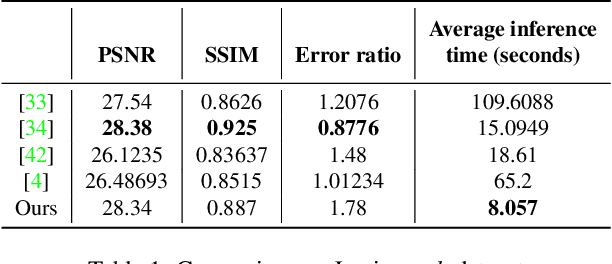
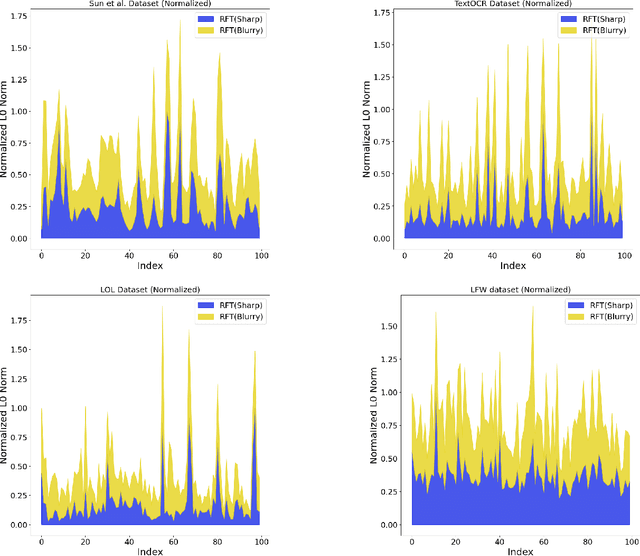
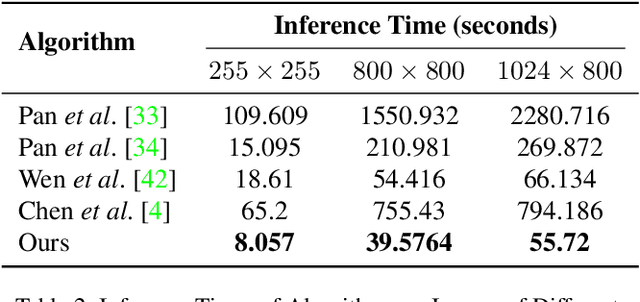
Blind image deblurring is the process of deriving a sharp image and a blur kernel from a blurred image. Blurry images are typically modeled as the convolution of a sharp image with a blur kernel, necessitating the estimation of the unknown blur kernel to perform blind image deblurring effectively. Existing approaches primarily focus on domain-specific features of images, such as salient edges, dark channels, and light streaks. These features serve as probabilistic priors to enhance the estimation of the blur kernel. For improved generality, we propose a novel prior (ReLU sparsity prior) that estimates blur kernel effectively across all distributions of images (natural, facial, text, low-light, saturated etc). Our approach demonstrates superior efficiency, with inference times up to three times faster, while maintaining high accuracy in PSNR, SSIM, and error ratio metrics. We also observe noticeable improvement in the performance of the state-of-the-art architectures (in terms of aforementioned metrics) in deep learning based approaches when our method is used as a post-processing unit.