 Add to Chrome
 Add to Firefox
 Add to Edge
SlideChain: Semantic Provenance for Lecture Understanding via Blockchain Registration
Dec 25, 2025
Modern vision--language models (VLMs) are increasingly used to interpret and generate educational content, yet their semantic outputs remain challenging to verify, reproduce, and audit over time. Inconsistencies across model families, inference settings, and computing environments undermine the reliability of AI-generated instructional material, particularly in high-stakes and quantitative STEM domains. This work introduces SlideChain, a blockchain-backed provenance framework designed to provide verifiable integrity for multimodal semantic extraction at scale. Using the SlideChain Slides Dataset-a curated corpus of 1,117 medical imaging lecture slides from a university course-we extract concepts and relational triples from four state-of-the-art VLMs and construct structured provenance records for every slide. SlideChain anchors cryptographic hashes of these records on a local EVM (Ethereum Virtual Machine)-compatible blockchain, providing tamper-evident auditability and persistent semantic baselines. Through the first systematic analysis of semantic disagreement, cross-model similarity, and lecture-level variability in multimodal educational content, we reveal pronounced cross-model discrepancies, including low concept overlap and near-zero agreement in relational triples on many slides. We further evaluate gas usage, throughput, and scalability under simulated deployment conditions, and demonstrate perfect tamper detection along with deterministic reproducibility across independent extraction runs. Together, these results show that SlideChain provides a practical and scalable step toward trustworthy, verifiable multimodal educational pipelines, supporting long-term auditability, reproducibility, and integrity for AI-assisted instructional systems.

ALIVE: An Avatar-Lecture Interactive Video Engine with Content-Aware Retrieval for Real-Time Interaction
Dec 24, 2025Traditional lecture videos offer flexibility but lack mechanisms for real-time clarification, forcing learners to search externally when confusion arises. Recent advances in large language models and neural avatars provide new opportunities for interactive learning, yet existing systems typically lack lecture awareness, rely on cloud-based services, or fail to integrate retrieval and avatar-delivered explanations in a unified, privacy-preserving pipeline. We present ALIVE, an Avatar-Lecture Interactive Video Engine that transforms passive lecture viewing into a dynamic, real-time learning experience. ALIVE operates fully on local hardware and integrates (1) Avatar-delivered lecture generated through ASR transcription, LLM refinement, and neural talking-head synthesis; (2) A content-aware retrieval mechanism that combines semantic similarity with timestamp alignment to surface contextually relevant lecture segments; and (3) Real-time multimodal interaction, enabling students to pause the lecture, ask questions through text or voice, and receive grounded explanations either as text or as avatar-delivered responses. To maintain responsiveness, ALIVE employs lightweight embedding models, FAISS-based retrieval, and segmented avatar synthesis with progressive preloading. We demonstrate the system on a complete medical imaging course, evaluate its retrieval accuracy, latency characteristics, and user experience, and show that ALIVE provides accurate, content-aware, and engaging real-time support. ALIVE illustrates how multimodal AI-when combined with content-aware retrieval and local deployment-can significantly enhance the pedagogical value of recorded lectures, offering an extensible pathway toward next-generation interactive learning environments.
N-ReLU: Zero-Mean Stochastic Extension of ReLU
Nov 10, 2025Activation functions are fundamental for enabling nonlinear representations in deep neural networks. However, the standard rectified linear unit (ReLU) often suffers from inactive or "dead" neurons caused by its hard zero cutoff. To address this issue, we introduce N-ReLU (Noise-ReLU), a zero-mean stochastic extension of ReLU that replaces negative activations with Gaussian noise while preserving the same expected output. This expectation-aligned formulation maintains gradient flow in inactive regions and acts as an annealing-style regularizer during training. Experiments on the MNIST dataset using both multilayer perceptron (MLP) and convolutional neural network (CNN) architectures show that N-ReLU achieves accuracy comparable to or slightly exceeding that of ReLU, LeakyReLU, PReLU, GELU, and RReLU at moderate noise levels (sigma = 0.05-0.10), with stable convergence and no dead neurons observed. These results demonstrate that lightweight Gaussian noise injection offers a simple yet effective mechanism to enhance optimization robustness without modifying network structures or introducing additional parameters.
TrialDura: Hierarchical Attention Transformer for Interpretable Clinical Trial Duration Prediction
Apr 20, 2024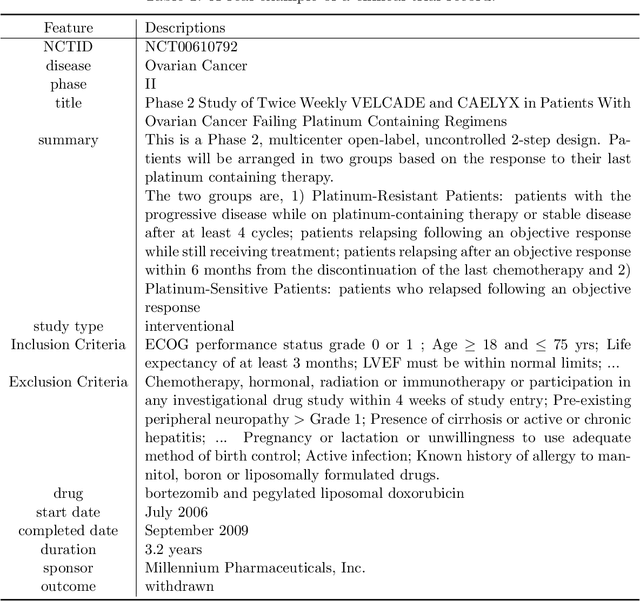
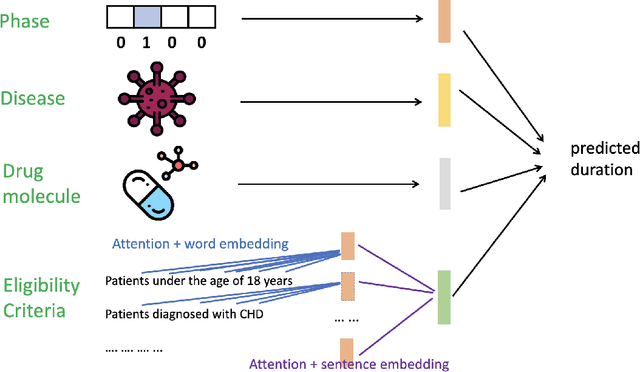

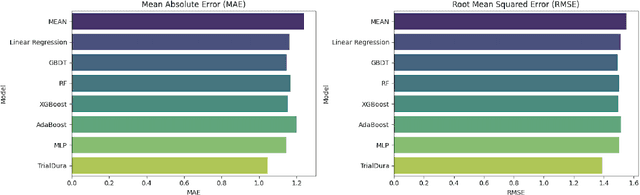
The clinical trial process, also known as drug development, is an indispensable step toward the development of new treatments. The major objective of interventional clinical trials is to assess the safety and effectiveness of drug-based treatment in treating certain diseases in the human body. However, clinical trials are lengthy, labor-intensive, and costly. The duration of a clinical trial is a crucial factor that influences overall expenses. Therefore, effective management of the timeline of a clinical trial is essential for controlling the budget and maximizing the economic viability of the research. To address this issue, We propose TrialDura, a machine learning-based method that estimates the duration of clinical trials using multimodal data, including disease names, drug molecules, trial phases, and eligibility criteria. Then, we encode them into Bio-BERT embeddings specifically tuned for biomedical contexts to provide a deeper and more relevant semantic understanding of clinical trial data. Finally, the model's hierarchical attention mechanism connects all of the embeddings to capture their interactions and predict clinical trial duration. Our proposed model demonstrated superior performance with a mean absolute error (MAE) of 1.04 years and a root mean square error (RMSE) of 1.39 years compared to the other models, indicating more accurate clinical trial duration prediction. Publicly available code can be found at https://anonymous.4open.science/r/TrialDura-F196