 Add to Chrome
 Add to Firefox
 Add to Edge
Frame of Reference: Addressing the Challenges of Common Ground Representation in Situational Dialogs
Jan 14, 2026
Common ground plays a critical role in situated spoken dialogues, where interlocutors must establish and maintain shared references to entities, events, and relations to sustain coherent interaction. For dialog systems, the ability to correctly ground conversational content in order to refer back to it later is particularly important. Prior studies have demonstrated that LLMs are capable of performing grounding acts such as requesting clarification or producing acknowledgments, yet relatively little work has investigated how common ground can be explicitly represented and stored for later use. Without such mechanisms, it remains unclear whether acknowledgment or clarification behaviors truly reflect a grounded understanding. In this work, we evaluate a model's ability to establish and exploit common ground through relational references to entities within the shared context in a situational dialogue. We test multiple methods for representing common ground in situated dialogues and further propose approaches to improve both the establishment of common ground and its subsequent use in the conversation.

Converging Dimensions: Information Extraction and Summarization through Multisource, Multimodal, and Multilingual Fusion
Jun 19, 2024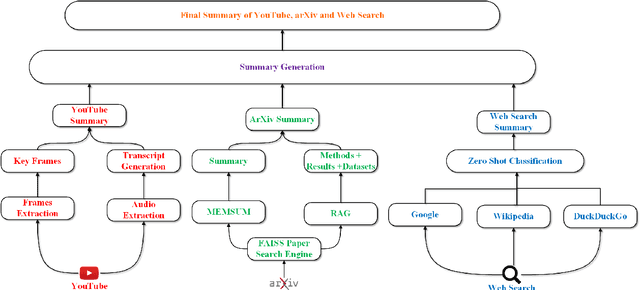
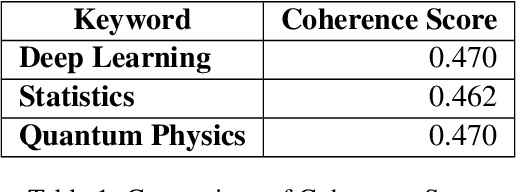
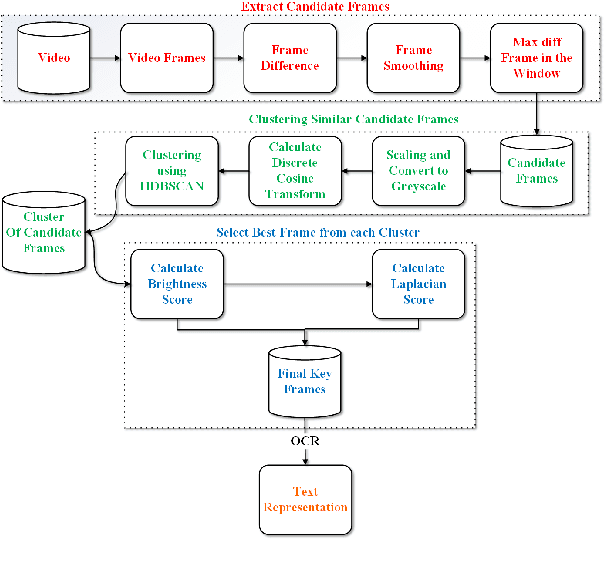
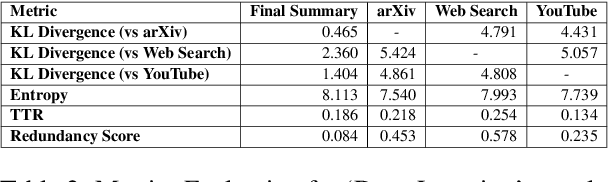
Recent advances in large language models (LLMs) have led to new summarization strategies, offering an extensive toolkit for extracting important information. However, these approaches are frequently limited by their reliance on isolated sources of data. The amount of information that can be gathered is limited and covers a smaller range of themes, which introduces the possibility of falsified content and limited support for multilingual and multimodal data. The paper proposes a novel approach to summarization that tackles such challenges by utilizing the strength of multiple sources to deliver a more exhaustive and informative understanding of intricate topics. The research progresses beyond conventional, unimodal sources such as text documents and integrates a more diverse range of data, including YouTube playlists, pre-prints, and Wikipedia pages. The aforementioned varied sources are then converted into a unified textual representation, enabling a more holistic analysis. This multifaceted approach to summary generation empowers us to extract pertinent information from a wider array of sources. The primary tenet of this approach is to maximize information gain while minimizing information overlap and maintaining a high level of informativeness, which encourages the generation of highly coherent summaries.