 Add to Chrome
 Add to Firefox
 Add to Edge
Context-aware child-directed speech detection from long-form recordings
May 31, 2026
Automatically distinguishing child-directed speech from adult-directed speech in long-form recordings is key to scalable analyses of children's language environments. Existing approaches process utterances in isolation and have been evaluated primarily on English. We address these gaps along three dimensions. First, we fine-tune and evaluate six-self supervised models on a multilingual dataset of 182 children, showing that in-domain pre-training on child-centered recordings substantially outperforms models trained on adult speech. Second, we demonstrate that incorporating surrounding context substantially improves classification, with an absolute gain of 13.8% in average F1-score. Third, we evaluate our model in a realistic end-to-end pipeline, from adult speech detection to addressee classification, showing that performance drops under automatic segmentation but still consistently outperforms a rule-based baseline.

Frame of Reference: Addressing the Challenges of Common Ground Representation in Situational Dialogs
Jan 14, 2026Common ground plays a critical role in situated spoken dialogues, where interlocutors must establish and maintain shared references to entities, events, and relations to sustain coherent interaction. For dialog systems, the ability to correctly ground conversational content in order to refer back to it later is particularly important. Prior studies have demonstrated that LLMs are capable of performing grounding acts such as requesting clarification or producing acknowledgments, yet relatively little work has investigated how common ground can be explicitly represented and stored for later use. Without such mechanisms, it remains unclear whether acknowledgment or clarification behaviors truly reflect a grounded understanding. In this work, we evaluate a model's ability to establish and exploit common ground through relational references to entities within the shared context in a situational dialogue. We test multiple methods for representing common ground in situated dialogues and further propose approaches to improve both the establishment of common ground and its subsequent use in the conversation.
BabyHuBERT: Multilingual Self-Supervised Learning for Segmenting Speakers in Child-Centered Long-Form Recordings
Sep 18, 2025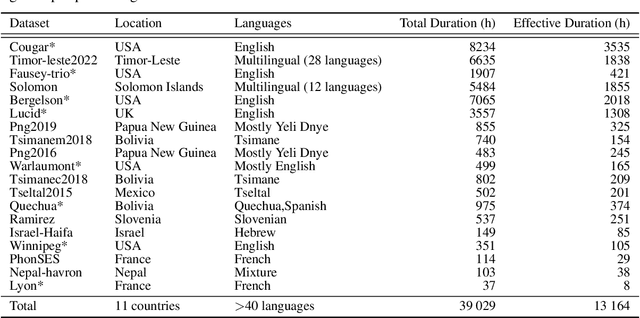
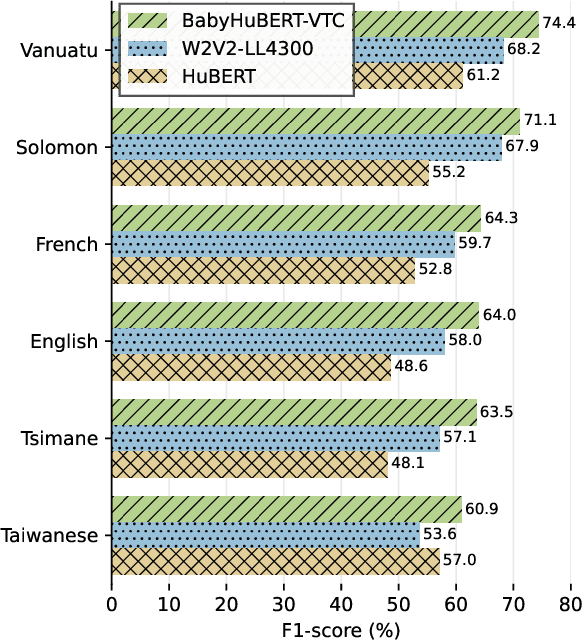
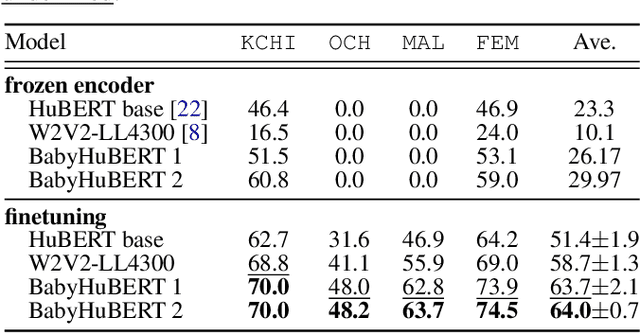
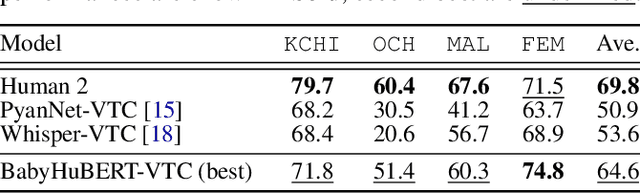
Child-centered long-form recordings are essential for studying early language development, but existing speech models trained on clean adult data perform poorly due to acoustic and linguistic differences. We introduce BabyHuBERT, the first self-supervised speech representation model trained on 13,000 hours of multilingual child-centered long-form recordings spanning over 40 languages. We evaluate BabyHuBERT on speaker segmentation, identifying when target children speak versus female adults, male adults, or other children -- a fundamental preprocessing step for analyzing naturalistic language experiences. BabyHuBERT achieves F1-scores from 52.1% to 74.4% across six diverse datasets, consistently outperforming W2V2-LL4300 (trained on English long-forms) and standard HuBERT (trained on clean adult speech). Notable improvements include 13.2 absolute F1 points over HuBERT on Vanuatu and 15.9 points on Solomon Islands corpora, demonstrating effectiveness on underrepresented languages. By sharing code and models, BabyHuBERT serves as a foundation model for child speech research, enabling fine-tuning on diverse downstream tasks.