 Add to Chrome
 Add to Firefox
 Add to Edge
ZEBRA: Zero-shot Budgeted Resource Allocation for LLM Orchestration
May 19, 2026
As autonomous agents increasingly execute end-to-end tasks under fixed monetary budgets, the pressing open question shifts from whether the budget is respected, to how to spend it effectively. Existing budget-aware methods typically control reasoning step-by-step within a single agent, or learn resource allocation policies via RL. None address how to split a budget across the composing phases of a multi-agent pipeline at inference time. We propose ZEBRA, a zero-shot framework that reduces multi-phase budget allocation to a continuous nonlinear knapsack problem: an LLM controller estimates per-phase utility curves, and a water-filling search on the Lagrange multiplier returns the per-phase split. Additive and multiplicative aggregations are unified under the same solver. On a $150$-task APPS coding benchmark, both ZEBRA variants outperform LLM-direct (budget allocation directly by an LLM) on every aggregate metric. At a budget of $α= 0.5$ of the unconstrained spend, ZEBRA recovers $94.4\%$ of unconstrained quality, versus $88.1\%$ for LLM-direct. The advantage is statistically significant and transfers beyond coding: on a $3$-phase HotpotQA pipeline, ZEBRA beats LLM-direct by $14.3$pp, with allocations empirically robust to curve-estimation noise. On HotpotQA, ZEBRA arrives at a different budget split (near-balanced) compared to the APPS one (skewed towards a refinement phase), showing adaptation to the pipeline structure. More broadly, we show that lightweight algorithmic guidance at inference time can improve the economic behavior of autonomous multi-agent systems.

LM vs LM: Detecting Factual Errors via Cross Examination
May 22, 2023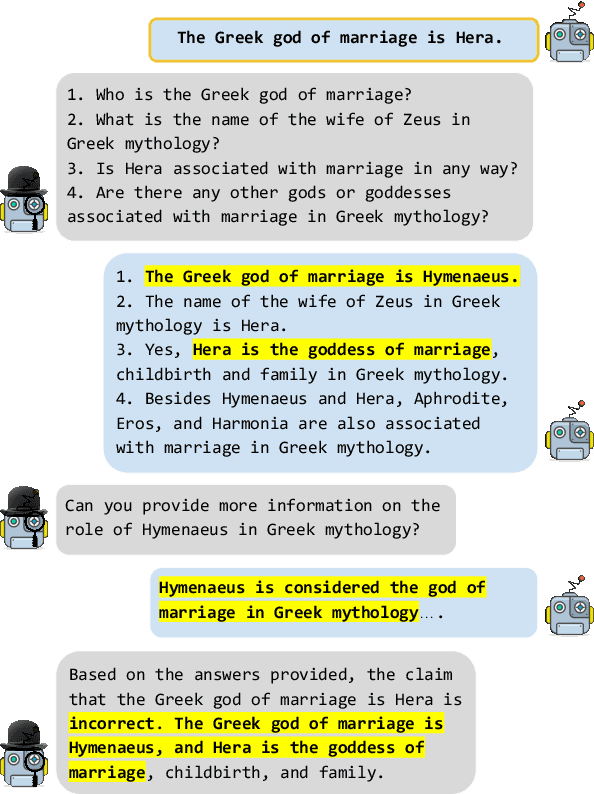
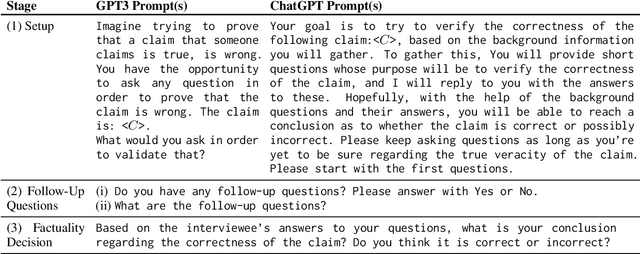
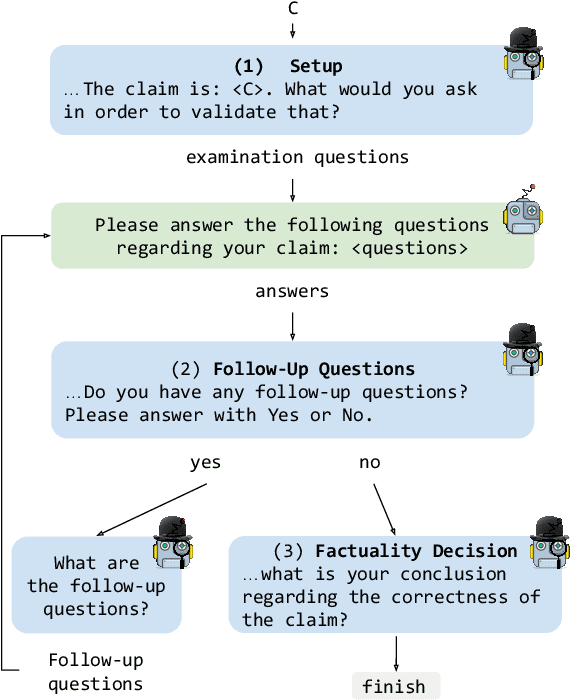
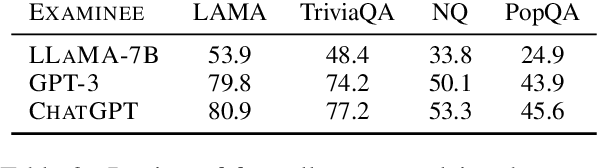
A prominent weakness of modern language models (LMs) is their tendency to generate factually incorrect text, which hinders their usability. A natural question is whether such factual errors can be detected automatically. Inspired by truth-seeking mechanisms in law, we propose a factuality evaluation framework for LMs that is based on cross-examination. Our key idea is that an incorrect claim is likely to result in inconsistency with other claims that the model generates. To discover such inconsistencies, we facilitate a multi-turn interaction between the LM that generated the claim and another LM (acting as an examiner) which introduces questions to discover inconsistencies. We empirically evaluate our method on factual claims made by multiple recent LMs on four benchmarks, finding that it outperforms existing methods and baselines, often by a large gap. Our results demonstrate the potential of using interacting LMs for capturing factual errors.