 Add to Chrome
 Add to Firefox
 Add to Edge
VR-DAgger: Immersive VR for Dexterous Data Collection and Uncertainty-Guided On-Policy Correction
May 26, 2026
Learning from demonstrations is effective for robotic manipulation, but collecting sufficient task-specific data remains a major bottleneck. Under distribution shift, small errors compound, performance degrades, and expert time is often spent on redundant, low-value corrections instead of the few critical failure cases.

ViserDex: Visual Sim-to-Real for Robust Dexterous In-hand Reorientation
Apr 13, 2026In-hand object reorientation requires precise estimation of the object pose to handle complex task dynamics. While RGB sensing offers rich semantic cues for pose tracking, existing solutions rely on multi-camera setups or costly ray tracing. We present a sim-to-real framework for monocular RGB in-hand reorientation that integrates 3D Gaussian Splatting (3DGS) to bridge the visual sim-to-real gap. Our key insight is performing domain randomization in the Gaussian representation space: by applying physically consistent, pre-rendering augmentations to 3D Gaussians, we generate photorealistic, randomized visual data for object pose estimation. The manipulation policy is trained using curriculum-based reinforcement learning with teacher-student distillation, enabling efficient learning of complex behaviors. Importantly, both perception and control models can be trained independently on consumer-grade hardware, eliminating the need for large compute clusters. Experiments show that the pose estimator trained with 3DGS data outperforms those trained using conventional rendering data in challenging visual environments. We validate the system on a physical multi-fingered hand equipped with an RGB camera, demonstrating robust reorientation of five diverse objects even under challenging lighting conditions. Our results highlight Gaussian splatting as a practical path for RGB-only dexterous manipulation. For videos of the hardware deployments and additional supplementary materials, please refer to the project website: https://rffr.leggedrobotics.com/works/viserdex/
FOCI: Trajectory Optimization on Gaussian Splats
May 13, 2025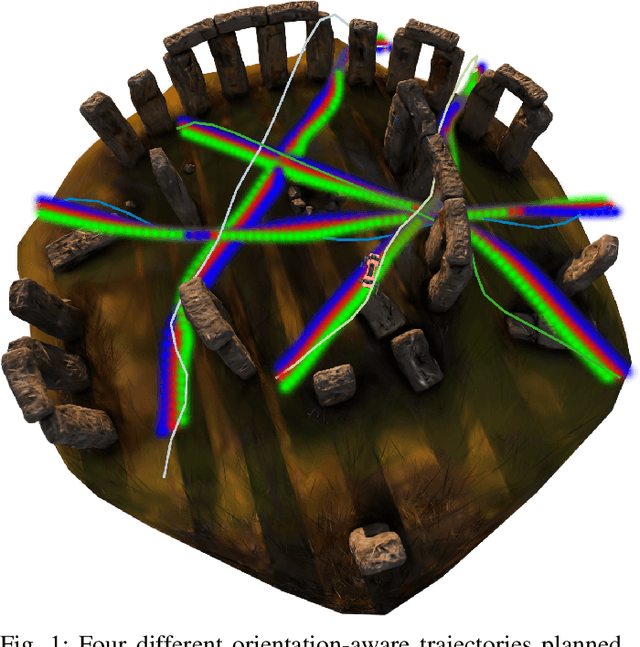
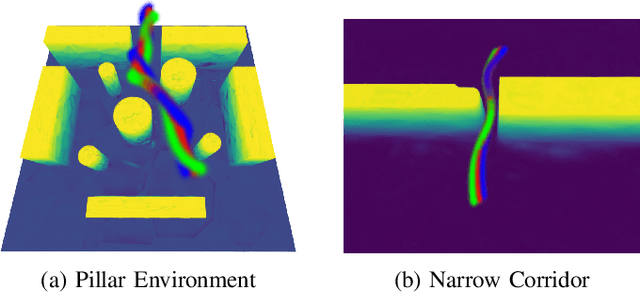
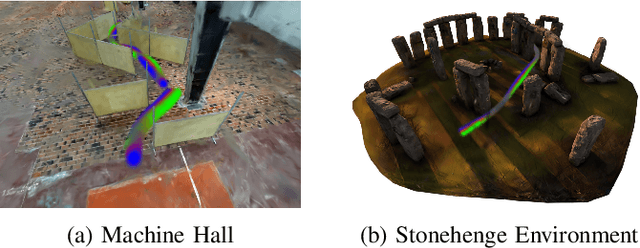
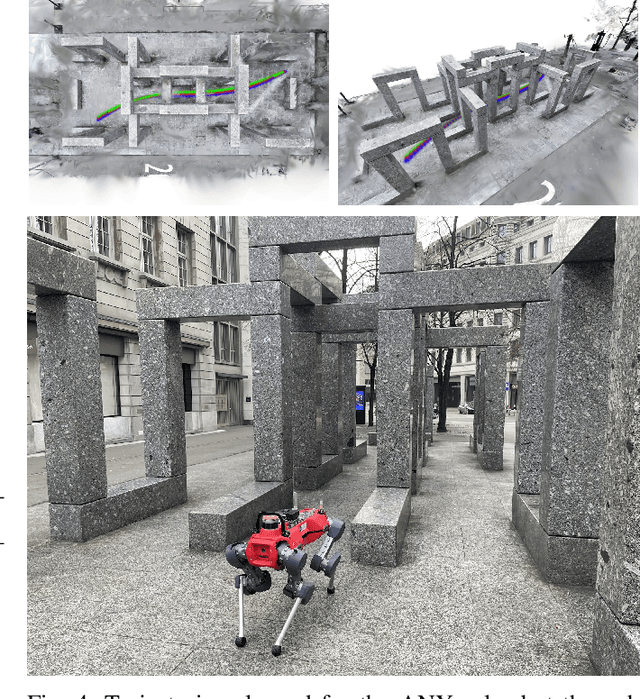
3D Gaussian Splatting (3DGS) has recently gained popularity as a faster alternative to Neural Radiance Fields (NeRFs) in 3D reconstruction and view synthesis methods. Leveraging the spatial information encoded in 3DGS, this work proposes FOCI (Field Overlap Collision Integral), an algorithm that is able to optimize trajectories directly on the Gaussians themselves. FOCI leverages a novel and interpretable collision formulation for 3DGS using the notion of the overlap integral between Gaussians. Contrary to other approaches, which represent the robot with conservative bounding boxes that underestimate the traversability of the environment, we propose to represent the environment and the robot as Gaussian Splats. This not only has desirable computational properties, but also allows for orientation-aware planning, allowing the robot to pass through very tight and narrow spaces. We extensively test our algorithm in both synthetic and real Gaussian Splats, showcasing that collision-free trajectories for the ANYmal legged robot that can be computed in a few seconds, even with hundreds of thousands of Gaussians making up the environment. The project page and code are available at https://rffr.leggedrobotics.com/works/foci/
Radiance Fields for Robotic Teleoperation
Jul 29, 2024Radiance field methods such as Neural Radiance Fields (NeRFs) or 3D Gaussian Splatting (3DGS), have revolutionized graphics and novel view synthesis. Their ability to synthesize new viewpoints with photo-realistic quality, as well as capture complex volumetric and specular scenes, makes them an ideal visualization for robotic teleoperation setups. Direct camera teleoperation provides high-fidelity operation at the cost of maneuverability, while reconstruction-based approaches offer controllable scenes with lower fidelity. With this in mind, we propose replacing the traditional reconstruction-visualization components of the robotic teleoperation pipeline with online Radiance Fields, offering highly maneuverable scenes with photorealistic quality. As such, there are three main contributions to state of the art: (1) online training of Radiance Fields using live data from multiple cameras, (2) support for a variety of radiance methods including NeRF and 3DGS, (3) visualization suite for these methods including a virtual reality scene. To enable seamless integration with existing setups, these components were tested with multiple robots in multiple configurations and were displayed using traditional tools as well as the VR headset. The results across methods and robots were compared quantitatively to a baseline of mesh reconstruction, and a user study was conducted to compare the different visualization methods. For videos and code, check out https://leggedrobotics.github.io/rffr.github.io/.