 Add to Chrome
 Add to Firefox
 Add to Edge
ORCA: A Platform for Open-Source Dexterity Research
Jun 12, 2026
Robotics manipulation research increasingly focuses on two-finger parallel grippers for their effectiveness, affordability, and ease of teleoperation. Grippers are nonetheless limited by their form factor, often requiring bimanual setups even for simple reorientation tasks. Anthropomorphic hands are a more natural platform for dexterous robot learning -- closer to the human hand, and capable of learning from human video -- yet they remain hard to use in learning research: even where open and accessible hand hardware exists, the software for control, simulation, teleoperation, and retargeting is scattered in one-off code bases, and largely disconnected from the robot-learning ecosystem. In this work, we introduce the \orca~learning stack, an open-source research stack for dexterity as a first-class robot learning domain. Our \orca~stack unifies low-level control, simulation, teleoperation from a range of consumer platforms, and hand retargeting, behind a single interface, and integrates natively with popular robot-learning frameworks such as \lerobot, so dexterous hand researchers can leverage the same data, training, and evaluation pipelines used for non-dexterous robot learning. We demonstrate a complete end-to-end workflow, collecting expert demonstrations of an in-hand reorientation task by teleoperation with a consumer-grade VR headset, training an autonomous policy with \lerobot, and evaluating the learned policy in a fully reproducible and observable setup. We open-source the entire stack as a shared, reproducible foundation for dexterous-manipulation research.

ORCA: An Open-Source, Reliable, Cost-Effective, Anthropomorphic Robotic Hand for Uninterrupted Dexterous Task Learning
Apr 05, 2025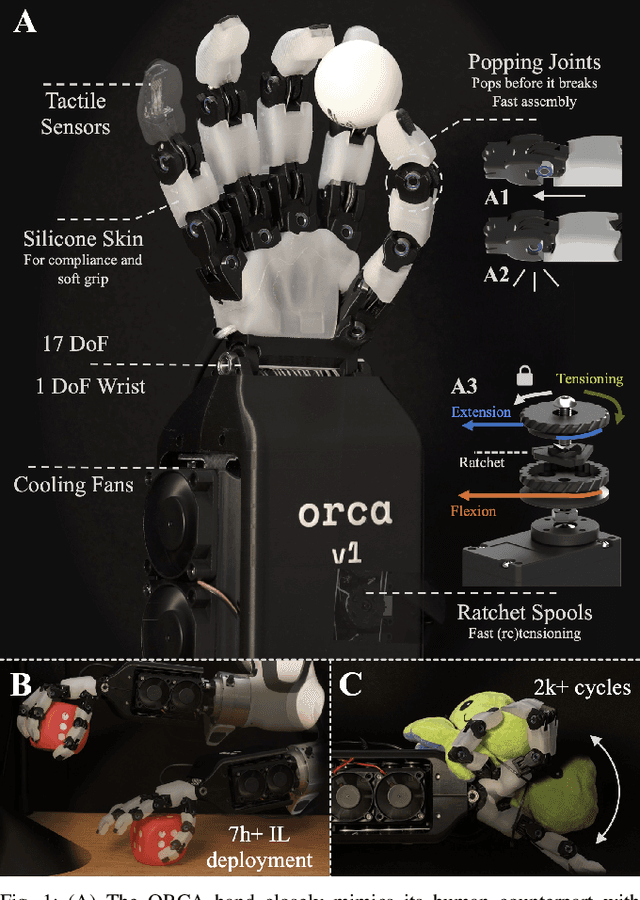
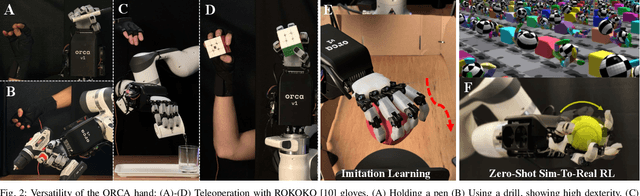
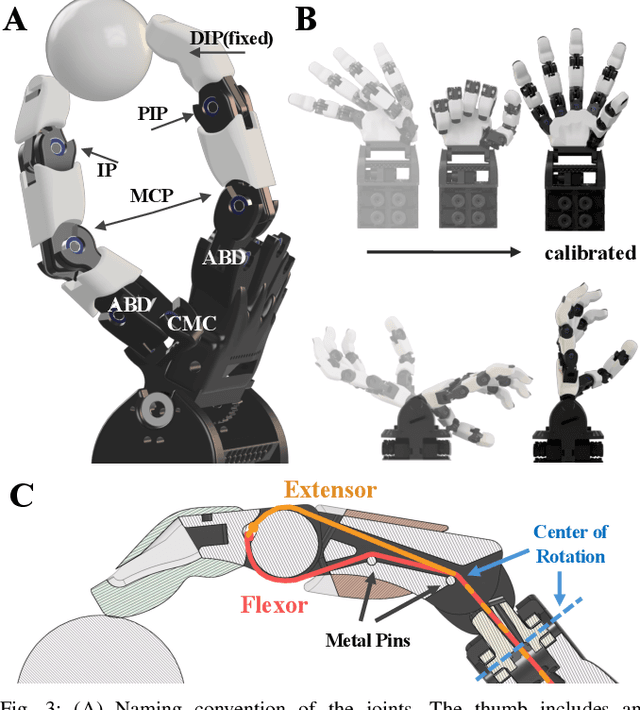
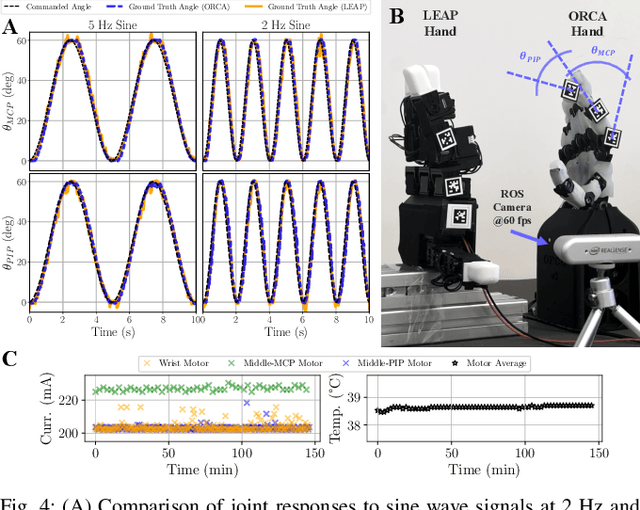
General-purpose robots should possess humanlike dexterity and agility to perform tasks with the same versatility as us. A human-like form factor further enables the use of vast datasets of human-hand interactions. However, the primary bottleneck in dexterous manipulation lies not only in software but arguably even more in hardware. Robotic hands that approach human capabilities are often prohibitively expensive, bulky, or require enterprise-level maintenance, limiting their accessibility for broader research and practical applications. What if the research community could get started with reliable dexterous hands within a day? We present the open-source ORCA hand, a reliable and anthropomorphic 17-DoF tendon-driven robotic hand with integrated tactile sensors, fully assembled in less than eight hours and built for a material cost below 2,000 CHF. We showcase ORCA's key design features such as popping joints, auto-calibration, and tensioning systems that significantly reduce complexity while increasing reliability, accuracy, and robustness. We benchmark the ORCA hand across a variety of tasks, ranging from teleoperation and imitation learning to zero-shot sim-to-real reinforcement learning. Furthermore, we demonstrate its durability, withstanding more than 10,000 continuous operation cycles - equivalent to approximately 20 hours - without hardware failure, the only constraint being the duration of the experiment itself. All design files, source code, and documentation will be available at https://www.orcahand.com/.
High-Frequency Capacitive Sensing for Electrohydraulic Soft Actuators
Apr 08, 2024The need for compliant and proprioceptive actuators has grown more evident in pursuing more adaptable and versatile robotic systems. Hydraulically Amplified Self-Healing Electrostatic (HASEL) actuators offer distinctive advantages with their inherent softness and flexibility, making them promising candidates for various robotic tasks, including delicate interactions with humans and animals, biomimetic locomotion, prosthetics, and exoskeletons. This has resulted in a growing interest in the capacitive self-sensing capabilities of HASEL actuators to create miniature displacement estimation circuitry that does not require external sensors. However, achieving HASEL self-sensing for actuation frequencies above 1 Hz and with miniature high-voltage power supplies has remained limited. In this paper, we introduce the F-HASEL actuator, which adds an additional electrode pair used exclusively for capacitive sensing to a Peano-HASEL actuator. We demonstrate displacement estimation of the F-HASEL during high-frequency actuation up to 20 Hz and during external loading using miniaturized circuitry comprised of low-cost off-the-shelf components and a miniature high-voltage power supply. Finally, we propose a circuitry to estimate the displacement of multiple F-HASELs and demonstrate it in a wearable application to track joint rotations of a virtual reality user in real-time.