 Add to Chrome
 Add to Firefox
 Add to Edge
Learning Robust Dexterous In-Hand Manipulation from Joint Sensors with Proprioceptive Transformer
May 20, 2026
In-hand object manipulation is a fundamental yet challenging capability for dexterous robots. Despite significant progress in dexterous manipulation, existing approaches rely heavily on vision or tactile sensing to track object states, while joint sensing -- the most readily available modality on any robotic hand -- remains largely overlooked, particularly for tendon-driven hands. In this paper, we study how far joint sensing alone can go by asking: (i) whether motor encoders or direct joint sensing provides better proprioceptive feedback, (ii) how to extract environment information from joint measurements, and (iii) whether joint-only control can achieve competitive real-world performance without external perception. We present the Proprioceptive Transformer (PT), an exteroceptive-free approach for continuous cube rotation on a tendon-driven dexterous hand that uses only joint sensing feedback. A teacher policy is first trained via reinforcement learning with privileged object information, then distilled into PT, which operates solely on joint position and velocity histories. The Transformer architecture effectively extracts implicit object state information from temporal patterns in joint sensor readings. Experiments on the real ORCA hand show that our approach achieves 3.1x higher rotation speed than baselines. We also demonstrate that our PT achieves a 23.4% lower RMSE for cube position estimation than the MLP baseline, indicating superior extraction of exteroceptive information from proprioceptive sources.

ORCA: An Open-Source, Reliable, Cost-Effective, Anthropomorphic Robotic Hand for Uninterrupted Dexterous Task Learning
Apr 05, 2025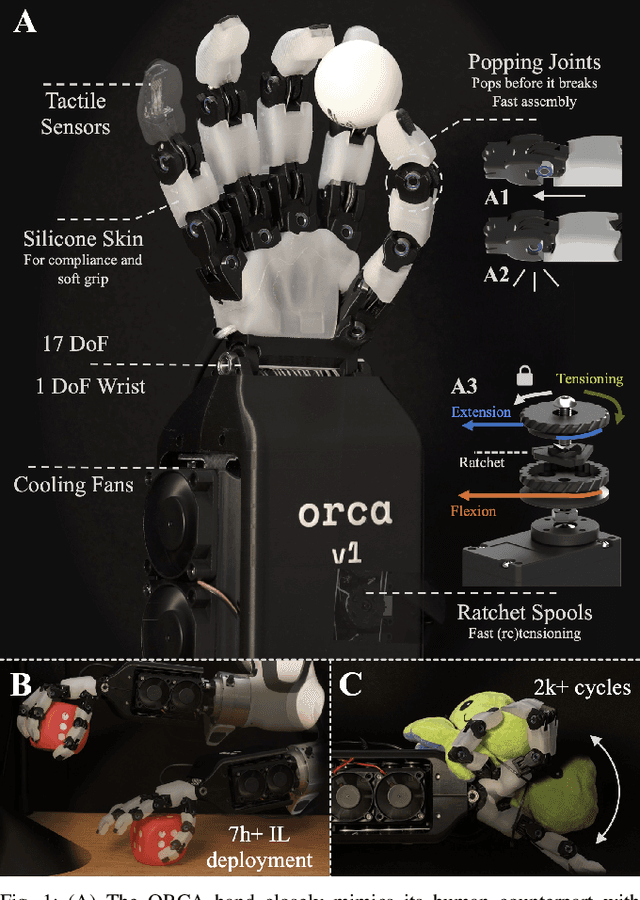
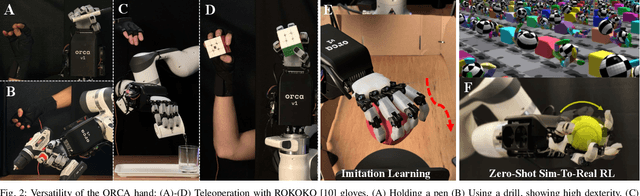
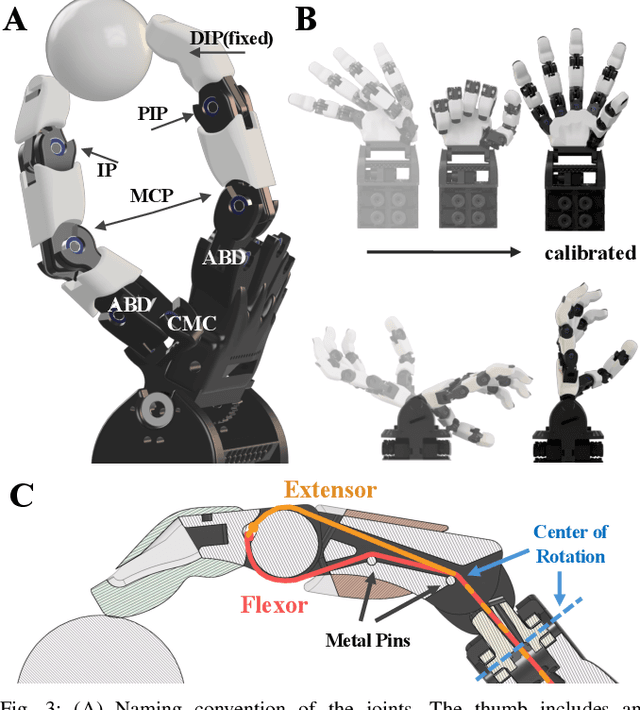
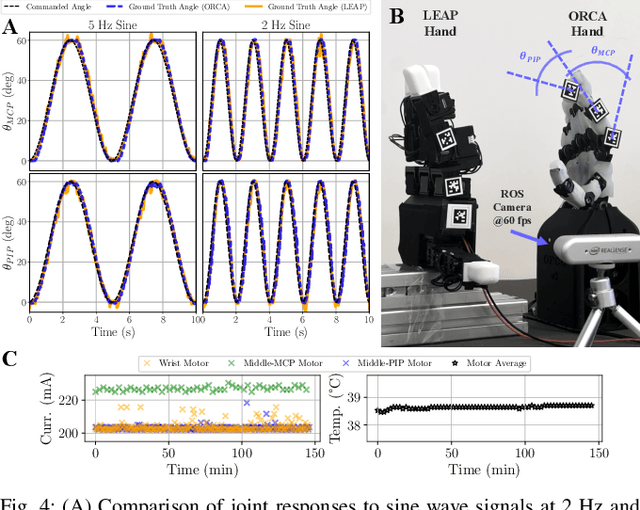
General-purpose robots should possess humanlike dexterity and agility to perform tasks with the same versatility as us. A human-like form factor further enables the use of vast datasets of human-hand interactions. However, the primary bottleneck in dexterous manipulation lies not only in software but arguably even more in hardware. Robotic hands that approach human capabilities are often prohibitively expensive, bulky, or require enterprise-level maintenance, limiting their accessibility for broader research and practical applications. What if the research community could get started with reliable dexterous hands within a day? We present the open-source ORCA hand, a reliable and anthropomorphic 17-DoF tendon-driven robotic hand with integrated tactile sensors, fully assembled in less than eight hours and built for a material cost below 2,000 CHF. We showcase ORCA's key design features such as popping joints, auto-calibration, and tensioning systems that significantly reduce complexity while increasing reliability, accuracy, and robustness. We benchmark the ORCA hand across a variety of tasks, ranging from teleoperation and imitation learning to zero-shot sim-to-real reinforcement learning. Furthermore, we demonstrate its durability, withstanding more than 10,000 continuous operation cycles - equivalent to approximately 20 hours - without hardware failure, the only constraint being the duration of the experiment itself. All design files, source code, and documentation will be available at https://www.orcahand.com/.