 Add to Chrome
 Add to Firefox
 Add to Edge
Wave Focusing in Metamaterials: Tactile Displays Beyond the Diffraction Limit
Jun 04, 2026
We address the challenge of engineering distributed haptic displays capable of reproducing multiple localized, independently addressable vibrations -- representing virtual tactile pixels -- at arbitrary locations on a surface. Our technique is based on the focusing of mechanical waves in a flexural plate using a sparse set of actuators. At tactile frequencies, wave diffraction prevents the formation of localized virtual tactile pixels at spatial scales relevant for multi-digit touch interactions. We overcome this limitation by augmenting the plate with a lattice of mechanical resonators, forming a locally resonant metamaterial plate. Coupling between the plate's dynamic modes and those of the resonators alters the dispersion relation governing wave transmission, introducing a slow-wave branch that enables focusing beyond the diffraction limit imposed by the unmodified plate. We use numerical simulations to engineer the dispersion relation of the metamaterial system for high-resolution focusing at tactile frequencies. We then fabricate a metamaterial tactile display and experimentally demonstrate virtual pixels that are far more localized than those generated on an otherwise identical plate without resonators, resulting in a tenfold reduction in virtual-pixel area. In behavioral experiments, we show that this system can deliver perceptually localized single- and multi-point tactile feedback and moving tactile sources while maintaining independent control over temporal waveforms at multiple display locations. The methods reported here can enable high-resolution haptic displays for widespread applications using a small number of actuated degrees of freedom.

Thermopneumatic Pixels for Fast, Localized, Low-Voltage Touch Feedback
Mar 17, 2026We present thermopneumatic pixels (TPPs), which are tactile actuators designed for rapid fabrication and straightforward integration into compact wearable and surface-based haptic systems. Each TPP converts low-voltage ($\sim$10 V) electrical pulses into transient pressure increases within a sealed cavity, producing out-of-plane forces and displacements suitable for tactile stimulation. The architecture enables scalable fabrication and spatially distributed actuation while maintaining simple electrical interfacing. The TPPs are constructed from inexpensive, readily available materials using straightforward layer-based assembly, facilitating rapid prototyping and integration into interactive devices. Mechanical characterization demonstrates peak forces exceeding 1 N and millimeter displacements. We further present driving electronics for operating multiple TPP modules concurrently and report perceptual study results demonstrating the effectiveness of the resulting tactile feedback. Together, these results establish low-voltage thermopneumatic actuation as an accessible and high-performance approach for embedding tactile feedback into experimental and consumer-facing interfaces.
Haptic Light-Emitting Diodes: Miniature, Luminous Tactile Actuators
Jan 16, 2026We present Haptic Light-Emitting Diodes (HLEDs), luminous thermopneumatic actuators that directly convert pulsed light into mechanical forces and displacements. Each device packages a miniature surface-mount LED in a gas-filled cavity that contains a low-inertia graphite photoabsorber. The cavity is sealed by an elastic membrane, which functions as a working diaphragm. Brief optical pulses heat the photoabsorber, which heats the gas. The resulting rapid pressure increases generate forces and displacements at the working diaphragm. Millimeter-scale HLEDs produce forces exceeding 0.4 N and displacements of 1 mm at low voltages, with 5 to 100 ms response times, making them attractive as actuators providing tactile feedback in human-machine interfaces. Perceptual testing revealed that the strength of tactile feedback increased linearly with optical power. HLEDs devices are mechanically simple and efficient to fabricate. Unusually, these actuators are also light-emitting, as a fraction of optical energy is transmitted through the membrane. These opto-mechanical actuators have many potential applications in tactile displays, human interface engineering, wearable computing, and other areas.
A peristaltic soft, wearable robot for compression and massage therapy
Jun 02, 2022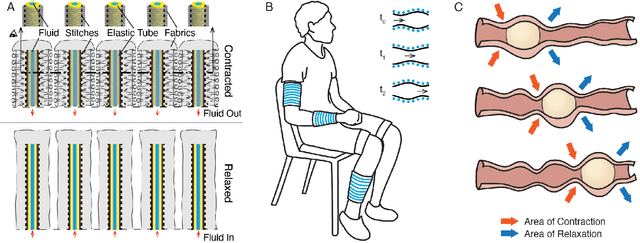
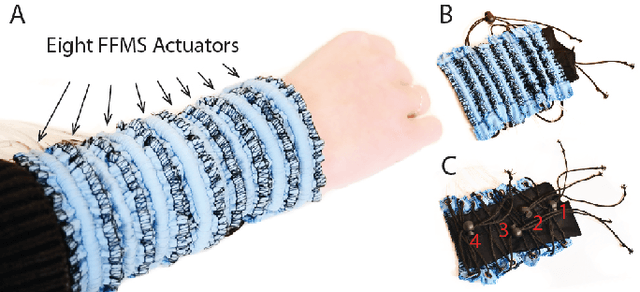
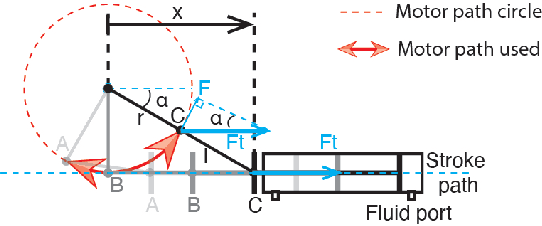
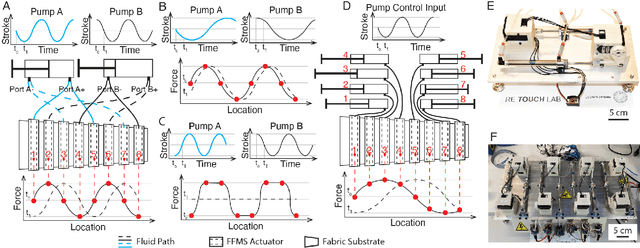
Soft robotics is attractive for wearable applications that require conformal interactions with the human body. Soft wearable robotic garments hold promise for supplying dynamic compression or massage therapies, such as are applied for disorders affecting lymphatic and blood circulation. In this paper, we present a wearable robot capable of supplying dynamic compression and massage therapy via peristaltic motion of finger-sized soft, fluidic actuators. We show that this peristaltic wearable robot can supply dynamic compression pressures exceeding 22 kPa at frequencies of 14 Hz or more, meeting requirements for compression and massage therapy. A large variety of software-programmable compression wave patterns can be generated by varying frequency, amplitude, phase delay, and duration parameters. We first demonstrate the utility of this peristaltic wearable robot for compression therapy, showing fluid transport in a laboratory model of the upper limb. We theoretically and empirically identify driving regimes that optimize fluid transport. We second demonstrate the utility of this garment for dynamic massage therapy. These findings show the potential of such a wearable robot for the treatment of several health disorders associated with lymphatic and blood circulation, such as lymphedema and blood clots.