 Add to Chrome
 Add to Firefox
 Add to Edge
The Missing Touch: Spatially Distributed Tactile Feedback Brings Teleoperation Closer to Human Dexterity
Aug 19, 2026
A fundamental challenge in robotic teleoperation is enabling an operator to control a remote robot as effortlessly and intuitively as their own hands. Despite the growing use of teleoperation to collect demonstration data for training autonomous robot policies, teleoperated robot performance still falls significantly short of human dexterity, even for basic tasks. Here, we present evidence that a key factor contributing to this performance gap is the absence of spatially distributed tactile feedback. Using a two-degree-of-freedom (DoF) bilateral force-feedback telemanipulator paired with a 32-DoF tactile fingertip display, we show that operator performance improves significantly when localized deformations on the remote manipulator are faithfully reproduced on the operator's fingertip. In a series of teleoperation tasks, reproducing distributed contact information not only accelerated task performance but also brought teleoperated movements closer to natural human behavior by minimizing corrective actions and task completion steps, thereby reducing the deviation between teleoperated and natural trajectories by 29$\unicode{x2013}$79%. Furthermore, we found that increasing the resolution of the tactile feedback$\unicode{x2014}$by refining how finely the measured displacements were quantized for reproduction$\unicode{x2014}$compressed the state-space distribution of teleoperated motions, which has been associated with improved training outcomes for autonomous robot policies. Together, these results suggest that spatially distributed tactile feedback is essential for closing the gap between human and teleoperated dexterity and training the next generation of autonomous robots.

Wave Focusing in Metamaterials: Tactile Displays Beyond the Diffraction Limit
Jun 04, 2026We address the challenge of engineering distributed haptic displays capable of reproducing multiple localized, independently addressable vibrations -- representing virtual tactile pixels -- at arbitrary locations on a surface. Our technique is based on the focusing of mechanical waves in a flexural plate using a sparse set of actuators. At tactile frequencies, wave diffraction prevents the formation of localized virtual tactile pixels at spatial scales relevant for multi-digit touch interactions. We overcome this limitation by augmenting the plate with a lattice of mechanical resonators, forming a locally resonant metamaterial plate. Coupling between the plate's dynamic modes and those of the resonators alters the dispersion relation governing wave transmission, introducing a slow-wave branch that enables focusing beyond the diffraction limit imposed by the unmodified plate. We use numerical simulations to engineer the dispersion relation of the metamaterial system for high-resolution focusing at tactile frequencies. We then fabricate a metamaterial tactile display and experimentally demonstrate virtual pixels that are far more localized than those generated on an otherwise identical plate without resonators, resulting in a tenfold reduction in virtual-pixel area. In behavioral experiments, we show that this system can deliver perceptually localized single- and multi-point tactile feedback and moving tactile sources while maintaining independent control over temporal waveforms at multiple display locations. The methods reported here can enable high-resolution haptic displays for widespread applications using a small number of actuated degrees of freedom.
Tactile Displays Driven by Projected Light
Oct 07, 2024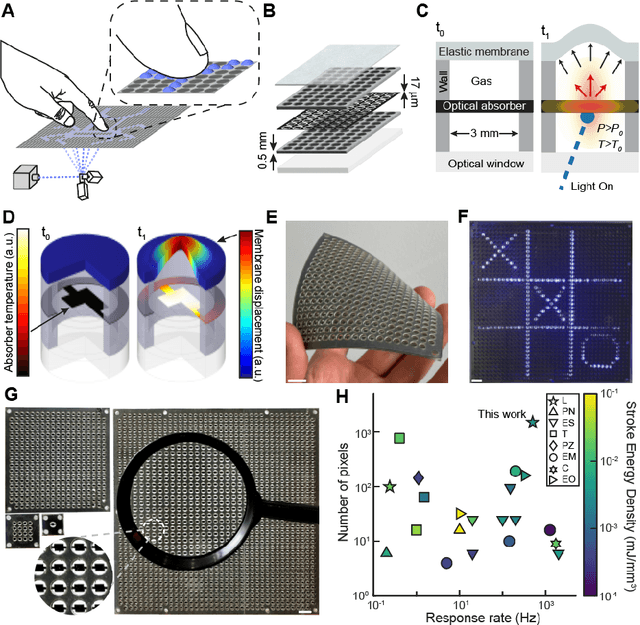
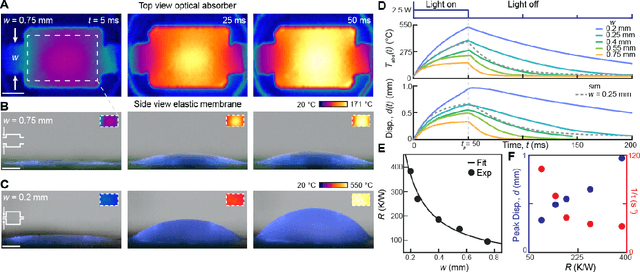
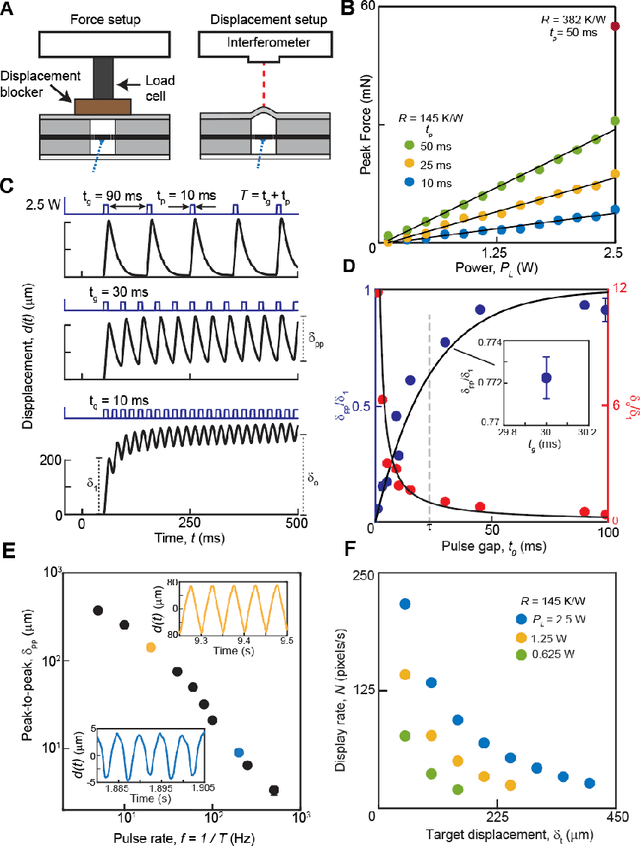
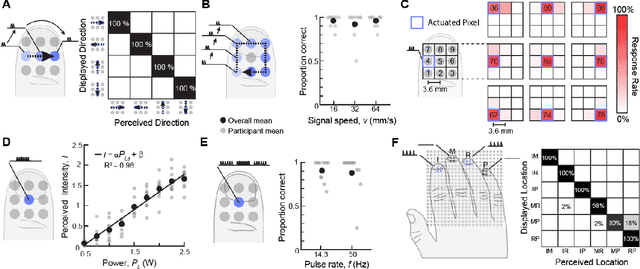
Tactile displays that lend tangible form to digital content could profoundly transform how we interact with computers, much like visual displays have driven successive revolutions in computing over the past 60 years. However, creating tactile displays with the actuation speeds, dynamic ranges, and resolutions that are required for perceptual fidelity has proved challenging. Here, we present a tactile display that directly converts projected light into visible tactile patterns using an energetically passive, photomechanical surface populated with arrays of millimeter-scale optotactile pixels. The pixels transduce incident light into mechanical displacements through rapid, light-stimulated thermal gas expansion, yielding displacements of up to 1 millimeter and response times of 2 to 100 milliseconds. Our use of projected light for power transmission and addressing enables these displays to be scaled in size and resolution at sustainable cost and complexity. We demonstrate devices with up to 1,511 independently addressable pixels. Perceptual studies confirm the capacity of the display to accurately reproduce tactile patterns in location, timing, frequency, and structure. This research establishes a foundation for practical, versatile high-resolution tactile displays driven by light.