 Add to Chrome
 Add to Firefox
 Add to Edge
Real-Time Hard Negative Sampling via LLM-based Clustering for Large-Scale Two-Tower Retrieval
Jul 01, 2026
The two-tower model has been widely used for large-scale recommendation systems, particularly in the retrieval stage. Industry standards for training two-tower models typically involve in-batch and/or out-of-batch negative sampling. However, these methods often produce easy negatives that models can quickly learn, failing to sufficiently challenge the model. To address this issue, a novel self-supervised hard negative sampling technique is proposed that leverages a large language model (LLM) to generate hard negatives from the same cluster during model training. By utilizing the LLM to learn media representations, the proposed approach ensures that the generated negatives are more challenging and informative. This real-time sampling framework is designed for seamless integration into production models, capable of handling billions of training data points with minimal computational complexity. Experiments on public datasets, along with deployment to a large-scale online system, demonstrate that the proposed negative sampling technique outperforms widely used industry methods. Furthermore, analysis in industrial applications reveals that this sampling method can help break inherent feedback loops in recommendations and significantly reduce popularity bias.

Speculative Decoding in Decentralized LLM Inference: Turning Communication Latency into Computation Throughput
Nov 13, 2025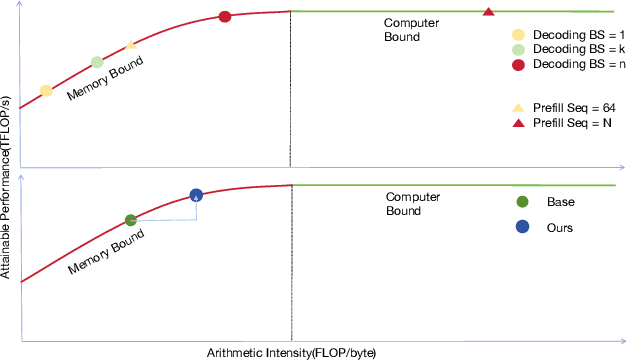
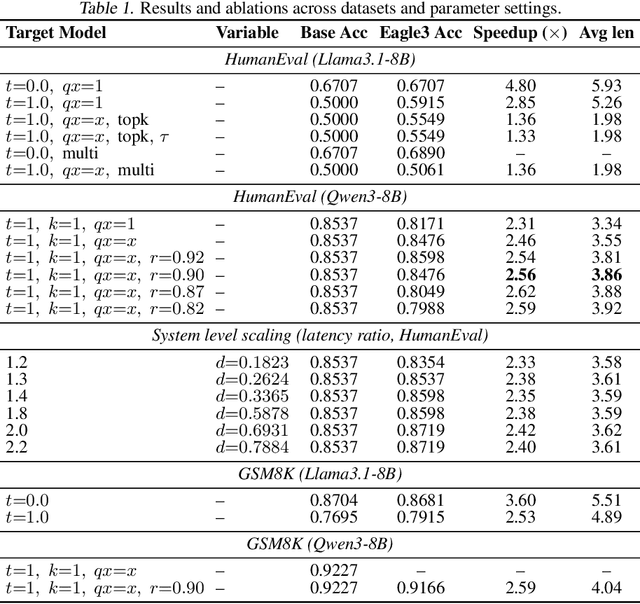
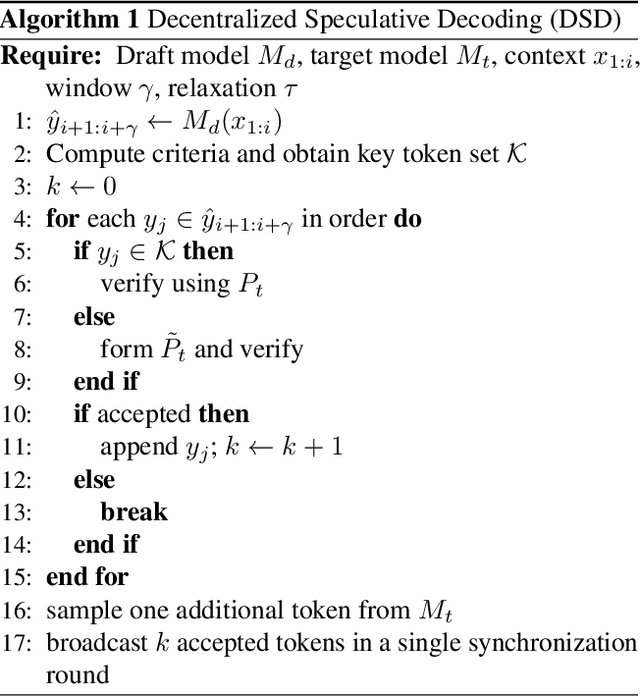
Speculative decoding accelerates large language model (LLM) inference by using a lightweight draft model to propose tokens that are later verified by a stronger target model. While effective in centralized systems, its behavior in decentralized settings, where network latency often dominates compute, remains under-characterized. We present Decentralized Speculative Decoding (DSD), a plug-and-play framework for decentralized inference that turns communication delay into useful computation by verifying multiple candidate tokens in parallel across distributed nodes. We further introduce an adaptive speculative verification strategy that adjusts acceptance thresholds by token-level semantic importance, delivering an additional 15% to 20% end-to-end speedup without retraining. In theory, DSD reduces cross-node communication cost by approximately (N-1)t1(k-1)/k, where t1 is per-link latency and k is the average number of tokens accepted per round. In practice, DSD achieves up to 2.56x speedup on HumanEval and 2.59x on GSM8K, surpassing the Eagle3 baseline while preserving accuracy. These results show that adapting speculative decoding for decentralized execution provides a system-level optimization that converts network stalls into throughput, enabling faster distributed LLM inference with no model retraining or architectural changes.