 Add to Chrome
 Add to Firefox
 Add to Edge
Efficient and Scalable Provenance Tracking for LLM-Generated Code Snippets
May 27, 2026
Large language models (LLMs) for code completion and generation are increasingly used in software development, yet they may reproduce training examples verbatim and without authorship attribution, raising legal and ethical concerns around plagiarism and license compliance. Classical fingerprint-based plagiarism detectors based on fingerprinting, such as Winnowing, remain highly effective, yet the inspection requires comparing fragments of code to the entire training set, and their linear-time search makes them impractical for the billion-scale corpora used to train modern code LLMs. To bridge this gap, we introduce SOURCETRACKER, a 300M-parameter encoder tailored for code retrieval, together with a hybrid two-stage provenance-tracking pipeline HYBRIDSOURCETRACKER (HST). HST first narrows down a small set of candidate snippets via vector search, then re-ranks those candidates using Winnowing on exact fingerprints. We train and evaluate our system on a 10M-snippet subset of the THESTACKV2 dataset, with both verbatim and adapted snippets that emulate realistic identifier renaming. On an in vitro 100k-snippet search space with adapted queries, our hybrid approach reaches a mean reciprocal rank on par with Winnowing for 30-token fragments. Then, starting from windows >= 60 tokens, it consistently over-performs by up to 5.4% while preserving logarithmic-time query complexity. In a complementary evaluation using an LLM-based judge, we find that many retrieved snippets not labeled as ground truth are still highly similar to the expected sources, particularly with longer context windows, and thus remain useful for end users. Overall, our results demonstrate that integrating vector search with fingerprinting enables scalable, high-precision provenance tracking for code produced by LLMs.

Improving Diffusion Posterior Samplers with Lagged Temporal Corrections for Image Restoration
May 12, 2026Diffusion-based posterior sampling (PS) is a leading framework for imaging inverse problems, combining learned priors with measurement constraints. Yet, its standard formulations rely on instantaneous data-consistent estimates, which induce temporal variability in the reverse dynamics. We reinterpret PS from a dynamical perspective, showing that the standard PS update corresponds to a first-order discretization of the diffusion dynamics plus a residual correction capturing the mismatch between the denoised prediction and the data-consistent estimate. A second-order discretization, however, naturally introduces a temporal correction based on the variation of consecutive estimates. Building on this, we propose LAMP, combining the second-order update with the residual correction characterizing a PS technique. LAMP thus inherits a lagged temporal correction, and it can be implemented as a modular plug-in over the PS backbone. We show that LAMP preserves the structure of a posterior sampler, and we perform a one-step risk analysis to characterize when LAMP improves the reverse transition via a bias-variance trade-off. Experiments across multiple imaging tasks demonstrate consistent improvements over strong baselines such as DiffPIR and DDRM, without increasing the number of denoising evaluations.
Mechanistic Interpretability of Cognitive Complexity in LLMs via Linear Probing using Bloom's Taxonomy
Feb 19, 2026The black-box nature of Large Language Models necessitates novel evaluation frameworks that transcend surface-level performance metrics. This study investigates the internal neural representations of cognitive complexity using Bloom's Taxonomy as a hierarchical lens. By analyzing high-dimensional activation vectors from different LLMs, we probe whether different cognitive levels, ranging from basic recall (Remember) to abstract synthesis (Create), are linearly separable within the model's residual streams. Our results demonstrate that linear classifiers achieve approximately 95% mean accuracy across all Bloom levels, providing strong evidence that cognitive level is encoded in a linearly accessible subspace of the model's representations. These findings provide evidence that the model resolves the cognitive difficulty of a prompt early in the forward pass, with representations becoming increasingly separable across layers.
Learning Factors in AI-Augmented Education: A Comparative Study of Middle and High School Students
Dec 24, 2025The increasing integration of AI tools in education has led prior research to explore their impact on learning processes. Nevertheless, most existing studies focus on higher education and conventional instructional contexts, leaving open questions about how key learning factors are related in AI-mediated learning environments and how these relationships may vary across different age groups. Addressing these gaps, our work investigates whether four critical learning factors, experience, clarity, comfort, and motivation, maintain coherent interrelationships in AI-augmented educational settings, and how the structure of these relationships differs between middle and high school students. The study was conducted in authentic classroom contexts where students interacted with AI tools as part of programming learning activities to collect data on the four learning factors and students' perceptions. Using a multimethod quantitative analysis, which combined correlation analysis and text mining, we revealed markedly different dimensional structures between the two age groups. Middle school students exhibit strong positive correlations across all dimensions, indicating holistic evaluation patterns whereby positive perceptions in one dimension generalise to others. In contrast, high school students show weak or near-zero correlations between key dimensions, suggesting a more differentiated evaluation process in which dimensions are assessed independently. These findings reveal that perception dimensions actively mediate AI-augmented learning and that the developmental stage moderates their interdependencies. This work establishes a foundation for the development of AI integration strategies that respond to learners' developmental levels and account for age-specific dimensional structures in student-AI interactions.
Optimizing the Training Diet: Data Mixture Search for Robust Time Series Forecasting
Dec 12, 2025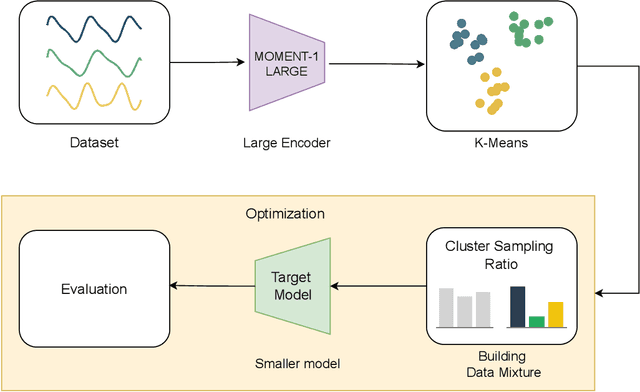
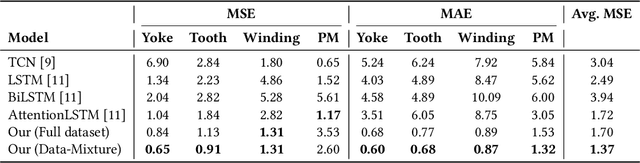
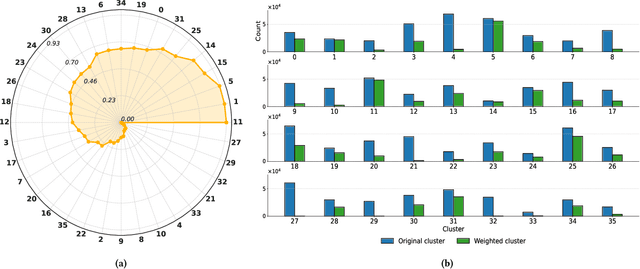
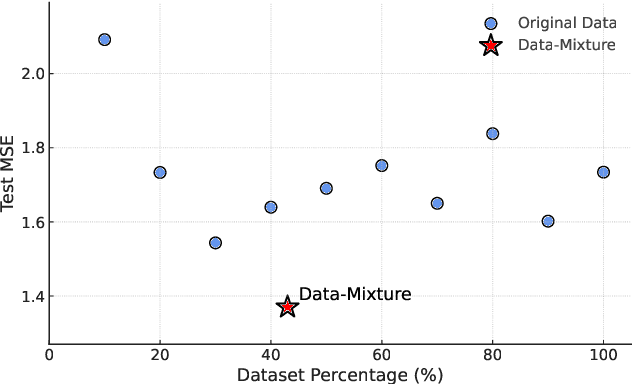
The standard paradigm for training deep learning models on sensor data assumes that more data is always better. However, raw sensor streams are often imbalanced and contain significant redundancy, meaning that not all data points contribute equally to model generalization. In this paper, we show that, in some cases, "less is more" when considering datasets. We do this by reframing the data selection problem: rather than tuning model hyperparameters, we fix the model and optimize the composition of the training data itself. We introduce a framework for discovering the optimal "training diet" from a large, unlabeled time series corpus. Our framework first uses a large-scale encoder and k-means clustering to partition the dataset into distinct, behaviorally consistent clusters. These clusters represent the fundamental 'ingredients' available for training. We then employ the Optuna optimization framework to search the high-dimensional space of possible data mixtures. For each trial, Optuna proposes a specific sampling ratio for each cluster, and a new training set is constructed based on this recipe. A smaller target model is then trained and evaluated. Our experiments reveal that this data-centric search consistently discovers data mixtures that yield models with significantly higher performance compared to baselines trained on the entire dataset. Specifically - evaluated on PMSM dataset - our method improved performance from a baseline MSE of 1.70 to 1.37, a 19.41% improvement.
A Computational Model of Inclusive Pedagogy: From Understanding to Application
May 02, 2025Human education transcends mere knowledge transfer, it relies on co-adaptation dynamics -- the mutual adjustment of teaching and learning strategies between agents. Despite its centrality, computational models of co-adaptive teacher-student interactions (T-SI) remain underdeveloped. We argue that this gap impedes Educational Science in testing and scaling contextual insights across diverse settings, and limits the potential of Machine Learning systems, which struggle to emulate and adaptively support human learning processes. To address this, we present a computational T-SI model that integrates contextual insights on human education into a testable framework. We use the model to evaluate diverse T-SI strategies in a realistic synthetic classroom setting, simulating student groups with unequal access to sensory information. Results show that strategies incorporating co-adaptation principles (e.g., bidirectional agency) outperform unilateral approaches (i.e., where only the teacher or the student is active), improving the learning outcomes for all learning types. Beyond the testing and scaling of context-dependent educational insights, our model enables hypothesis generation in controlled yet adaptable environments. This work bridges non-computational theories of human education with scalable, inclusive AI in Education systems, providing a foundation for equitable technologies that dynamically adapt to learner needs.
One Model to Train them All: Hierarchical Self-Distillation for Enhanced Early Layer Embeddings
Mar 04, 2025Deploying language models often requires handling model size vs. performance trade-offs to satisfy downstream latency constraints while preserving the model's usefulness. Model distillation is commonly employed to reduce model size while maintaining acceptable performance. However, distillation can be inefficient since it involves multiple training steps. In this work, we introduce MODULARSTARENCODER, a modular multi-exit encoder with 1B parameters, useful for multiple tasks within the scope of code retrieval. MODULARSTARENCODER is trained with a novel self-distillation mechanism that significantly improves lower-layer representations-allowing different portions of the model to be used while still maintaining a good trade-off in terms of performance. Our architecture focuses on enhancing text-to-code and code-to-code search by systematically capturing syntactic and semantic structures across multiple levels of representation. Specific encoder layers are targeted as exit heads, allowing higher layers to guide earlier layers during training. This self-distillation effect improves intermediate representations, increasing retrieval recall at no extra training cost. In addition to the multi-exit scheme, our approach integrates a repository-level contextual loss that maximally utilizes the training context window, further enhancing the learned representations. We also release a new dataset constructed via code translation, seamlessly expanding traditional text-to-code benchmarks with code-to-code pairs across diverse programming languages. Experimental results highlight the benefits of self-distillation through multi-exit supervision.
Affordably Fine-tuned LLMs Provide Better Answers to Course-specific MCQs
Jan 10, 2025


In education, the capability of generating human-like text of Large Language Models (LLMs) inspired work on how they can increase the efficiency of learning and teaching. We study the affordability of these models for educators and students by investigating how LLMs answer multiple-choice questions (MCQs) with respect to hardware constraints and refinement techniques. We explore this space by using generic pre-trained LLMs (the 7B, 13B, and 70B variants of LLaMA-2) to answer 162 undergraduate-level MCQs from a course on Programming Languages (PL) -- the MCQ dataset is a contribution of this work, which we make publicly available. Specifically, we dissect how different factors, such as using readily-available material -- (parts of) the course's textbook -- for fine-tuning and quantisation (to decrease resource usage) can change the accuracy of the responses. The main takeaway is that smaller textbook-based fine-tuned models outperform generic larger ones (whose pre-training requires conspicuous resources), making the usage of LLMs for answering MCQs resource- and material-wise affordable.
Multimodal Side-Tuning for Document Classification
Jan 23, 2023


In this paper, we propose to exploit the side-tuning framework for multimodal document classification. Side-tuning is a methodology for network adaptation recently introduced to solve some of the problems related to previous approaches. Thanks to this technique it is actually possible to overcome model rigidity and catastrophic forgetting of transfer learning by fine-tuning. The proposed solution uses off-the-shelf deep learning architectures leveraging the side-tuning framework to combine a base model with a tandem of two side networks. We show that side-tuning can be successfully employed also when different data sources are considered, e.g. text and images in document classification. The experimental results show that this approach pushes further the limit for document classification accuracy with respect to the state of the art.
On the evaluation of (meta-)solver approaches
Feb 17, 2022


Meta-solver approaches exploits a number of individual solvers to potentially build a better solver. To assess the performance of meta-solvers, one can simply adopt the metrics typically used for individual solvers (e.g., runtime or solution quality), or employ more specific evaluation metrics (e.g., by measuring how close the meta-solver gets to its virtual best performance). In this paper, based on some recently published works, we provide an overview of different performance metrics for evaluating (meta-)solvers, by underlying their strengths and weaknesses.