 Add to Chrome
 Add to Firefox
 Add to Edge
ABRA: Teleporting Fine-Tuned Knowledge Across Domains for Open-Vocabulary Object Detection
Mar 12, 2026
Although recent Open-Vocabulary Object Detection architectures, such as Grounding DINO, demonstrate strong zero-shot capabilities, their performance degrades significantly under domain shifts. Moreover, many domains of practical interest, such as nighttime or foggy scenes, lack large annotated datasets, preventing direct fine-tuning. In this paper, we introduce Aligned Basis Relocation for Adaptation(ABRA), a method that transfers class-specific detection knowledge from a labeled source domain to a target domain where no training images containing these classes are accessible. ABRA formulates this adaptation as a geometric transport problem in the weight space of a pretrained detector, aligning source and target domain experts to transport class-specific knowledge. Extensive experiments across challenging domain shifts demonstrate that ABRA successfully teleports class-level specialization under multiple adverse conditions. Our code will be made public upon acceptance.

Is Multiple Object Tracking a Matter of Specialization?
Nov 01, 2024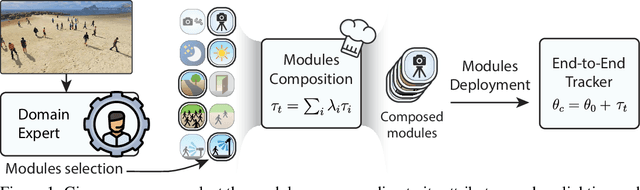
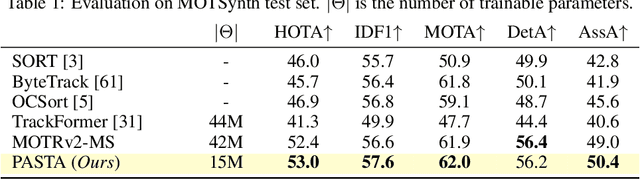

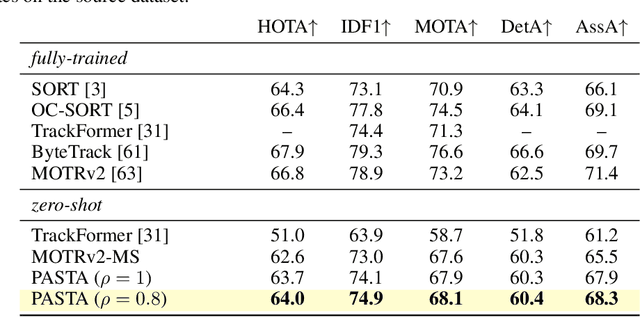
End-to-end transformer-based trackers have achieved remarkable performance on most human-related datasets. However, training these trackers in heterogeneous scenarios poses significant challenges, including negative interference - where the model learns conflicting scene-specific parameters - and limited domain generalization, which often necessitates expensive fine-tuning to adapt the models to new domains. In response to these challenges, we introduce Parameter-efficient Scenario-specific Tracking Architecture (PASTA), a novel framework that combines Parameter-Efficient Fine-Tuning (PEFT) and Modular Deep Learning (MDL). Specifically, we define key scenario attributes (e.g, camera-viewpoint, lighting condition) and train specialized PEFT modules for each attribute. These expert modules are combined in parameter space, enabling systematic generalization to new domains without increasing inference time. Extensive experiments on MOTSynth, along with zero-shot evaluations on MOT17 and PersonPath22 demonstrate that a neural tracker built from carefully selected modules surpasses its monolithic counterpart. We release models and code.