 Add to Chrome
 Add to Firefox
 Add to Edge
Fluids You Can Trust: Property-Preserving Operator Learning for Incompressible Flows
Feb 17, 2026
We present a novel property-preserving kernel-based operator learning method for incompressible flows governed by the incompressible Navier-Stokes equations. Traditional numerical solvers incur significant computational costs to respect incompressibility. Operator learning offers efficient surrogate models, but current neural operators fail to exactly enforce physical properties such as incompressibility, periodicity, and turbulence. Our method maps input functions to expansion coefficients of output functions in a property-preserving kernel basis, ensuring that predicted velocity fields analytically and simultaneously preserve the aforementioned physical properties. We evaluate the method on challenging 2D and 3D, laminar and turbulent, incompressible flow problems. Our method achieves up to six orders of magnitude lower relative $\ell_2$ errors upon generalization and trains up to five orders of magnitude faster compared to neural operators. Moreover, while our method enforces incompressibility analytically, neural operators exhibit very large deviations. Our results show that our method provides an accurate and efficient surrogate for incompressible flows.

Kernel Neural Operators (KNOs) for Scalable, Memory-efficient, Geometrically-flexible Operator Learning
Jun 30, 2024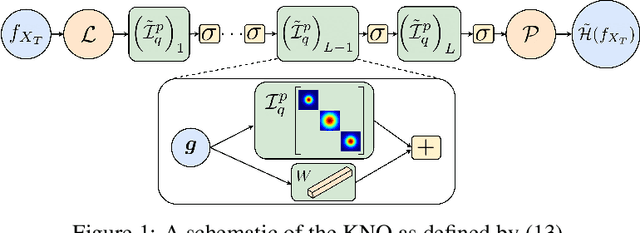
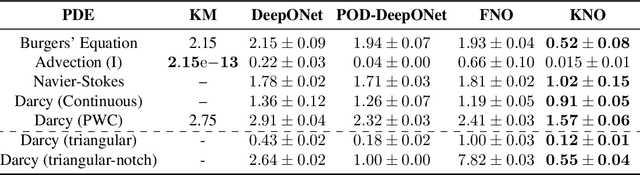
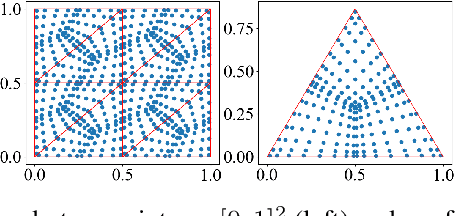
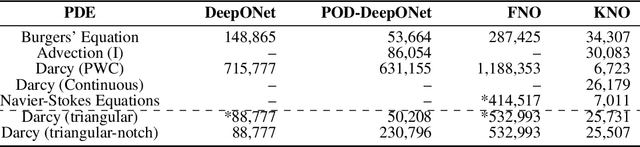
This paper introduces the Kernel Neural Operator (KNO), a novel operator learning technique that uses deep kernel-based integral operators in conjunction with quadrature for function-space approximation of operators (maps from functions to functions). KNOs use parameterized, closed-form, finitely-smooth, and compactly-supported kernels with trainable sparsity parameters within the integral operators to significantly reduce the number of parameters that must be learned relative to existing neural operators. Moreover, the use of quadrature for numerical integration endows the KNO with geometric flexibility that enables operator learning on irregular geometries. Numerical results demonstrate that on existing benchmarks the training and test accuracy of KNOs is higher than popular operator learning techniques while using at least an order of magnitude fewer trainable parameters. KNOs thus represent a new paradigm of low-memory, geometrically-flexible, deep operator learning, while retaining the implementation simplicity and transparency of traditional kernel methods from both scientific computing and machine learning.