 Add to Chrome
 Add to Firefox
 Add to Edge
Enabling Real-Time Training of a Wildfire-to-Smoke Map with Multilinear Operators
May 05, 2026
Wildfires are a major producer of fine particulate matter, impacting human health and the electrical grid. Accurately forecasting smoke impacts over long time scales incorporates fuel treatment strategies, natural fuel succession, and stochastic events like lightning strikes. However, predicting smoke for each fuel distribution with a forward simulation of a coupled fire-atmosphere model is computationally infeasible. Moreover, relatively simple fire models are tractable to run in many long-time scenarios but do not capture smoke transport. We use data-driven multilinear operators to predict a smoke concentration field from knowledge of the time since ignition for two quantities of interest: aerosol optical depth and smoke detection. Our method first computes the principal components of time-since-ignition and smoke concentration fields and then learns a map from powers of the input coefficients to the output coefficients. We apply our learned operator to smoke prediction in the Upper Rio Grande Watershed. After collecting training data, learning the approximation weights on a CPU takes less than 30 seconds, and each forward call takes less than 1 ms. On a proxy for aerosol optical depth, we obtain equal accuracy to Monte Carlo sampling with fewer than half as many coupled model calls. For smoke detection, we obtain an intersection-over-union (IoU) of 65% and an area under the receiver operating characteristic curve (AUC) of 0.95 on holdout data. Our method is significantly more accurate than the most similar published smoke classifier, which obtains an IoU and AUC of 0.15 and 0.61, respectively, on a 2015 bushfire in Australia.

Kernel Neural Operators (KNOs) for Scalable, Memory-efficient, Geometrically-flexible Operator Learning
Jun 30, 2024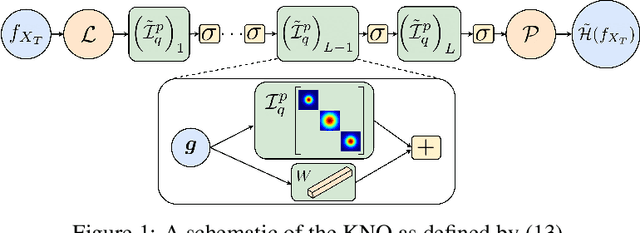
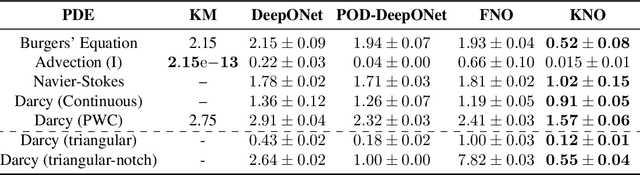
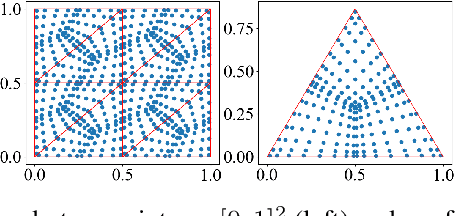
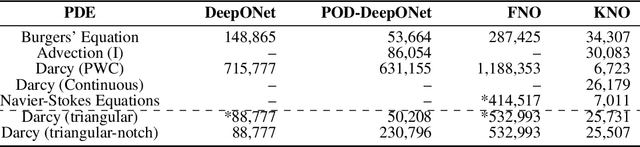
This paper introduces the Kernel Neural Operator (KNO), a novel operator learning technique that uses deep kernel-based integral operators in conjunction with quadrature for function-space approximation of operators (maps from functions to functions). KNOs use parameterized, closed-form, finitely-smooth, and compactly-supported kernels with trainable sparsity parameters within the integral operators to significantly reduce the number of parameters that must be learned relative to existing neural operators. Moreover, the use of quadrature for numerical integration endows the KNO with geometric flexibility that enables operator learning on irregular geometries. Numerical results demonstrate that on existing benchmarks the training and test accuracy of KNOs is higher than popular operator learning techniques while using at least an order of magnitude fewer trainable parameters. KNOs thus represent a new paradigm of low-memory, geometrically-flexible, deep operator learning, while retaining the implementation simplicity and transparency of traditional kernel methods from both scientific computing and machine learning.