 Add to Chrome
 Add to Firefox
 Add to Edge
Cosmo-FOLD: Fast generation and upscaling of field-level cosmological maps with overlap latent diffusion
Jan 20, 2026
We demonstrate the capabilities of probabilistic diffusion models to reduce dramatically the computational cost of expensive hydrodynamical simulations to study the relationship between observable baryonic cosmological probes and dark matter at field level and well into the non-linear regime. We introduce a novel technique, Cosmo-FOLD (Cosmological Fields via Overlap Latent Diffusion) to rapidly generate accurate and arbitrarily large cosmological and astrophysical 3-dimensional fields, conditioned on a given input field. We are able to generate TNG300-2 dark matter density and gas temperature fields from a model trained only on ~1% of the volume (a process we refer to as `upscaling'), reproducing both large scale coherent dark matter filaments and power spectra to within 10% for wavenumbers k <= 5 h Mpc^-1. These results are obtained within a small fraction of the original simulation cost and produced on a single GPU. Beyond one and two points statistics, the bispectrum is also faithfully reproduced through the inclusion of positional encodings. Finally, we demonstrate Cosmo-FOLD's generalisation capabilities by upscaling a CAMELS volume of 25 (Mpc h^-1)^3 to a full TNG300-2 volume of 205 (Mpc h^-1)^3$ with no fine-tuning. Cosmo-FOLD opens the door to full field-level simulation-based inference on cosmological scale.

The Denario project: Deep knowledge AI agents for scientific discovery
Oct 30, 2025We present Denario, an AI multi-agent system designed to serve as a scientific research assistant. Denario can perform many different tasks, such as generating ideas, checking the literature, developing research plans, writing and executing code, making plots, and drafting and reviewing a scientific paper. The system has a modular architecture, allowing it to handle specific tasks, such as generating an idea, or carrying out end-to-end scientific analysis using Cmbagent as a deep-research backend. In this work, we describe in detail Denario and its modules, and illustrate its capabilities by presenting multiple AI-generated papers generated by it in many different scientific disciplines such as astrophysics, biology, biophysics, biomedical informatics, chemistry, material science, mathematical physics, medicine, neuroscience and planetary science. Denario also excels at combining ideas from different disciplines, and we illustrate this by showing a paper that applies methods from quantum physics and machine learning to astrophysical data. We report the evaluations performed on these papers by domain experts, who provided both numerical scores and review-like feedback. We then highlight the strengths, weaknesses, and limitations of the current system. Finally, we discuss the ethical implications of AI-driven research and reflect on how such technology relates to the philosophy of science. We publicly release the code at https://github.com/AstroPilot-AI/Denario. A Denario demo can also be run directly on the web at https://huggingface.co/spaces/astropilot-ai/Denario, and the full app will be deployed on the cloud.
The CAMELS project: public data release
Jan 04, 2022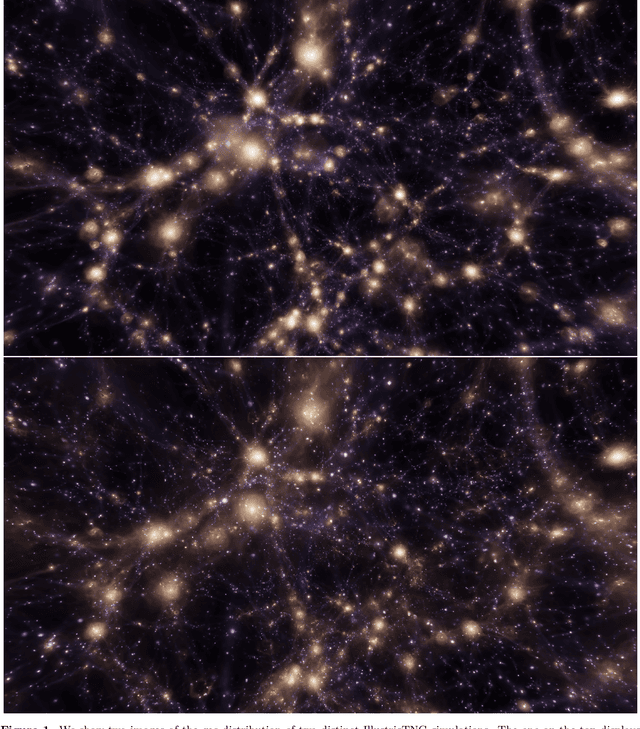
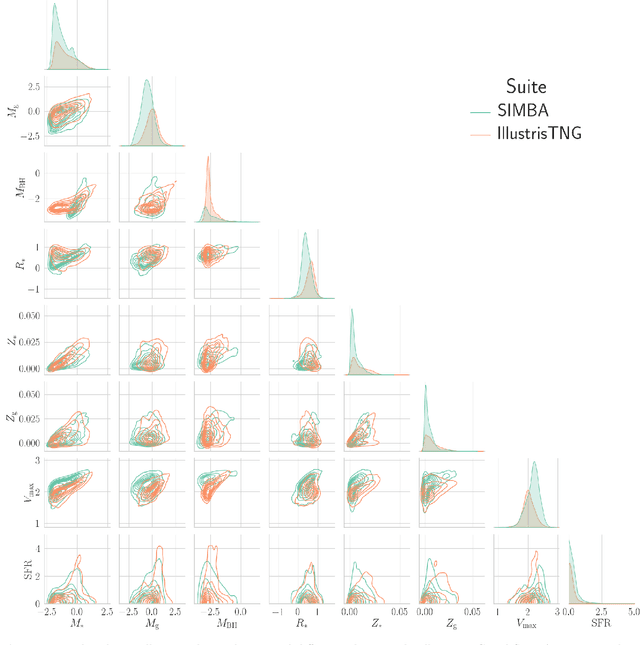
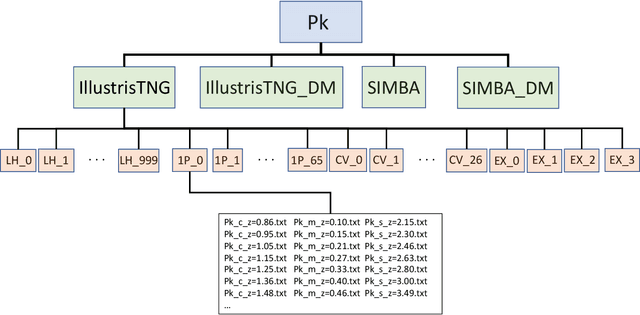
The Cosmology and Astrophysics with MachinE Learning Simulations (CAMELS) project was developed to combine cosmology with astrophysics through thousands of cosmological hydrodynamic simulations and machine learning. CAMELS contains 4,233 cosmological simulations, 2,049 N-body and 2,184 state-of-the-art hydrodynamic simulations that sample a vast volume in parameter space. In this paper we present the CAMELS public data release, describing the characteristics of the CAMELS simulations and a variety of data products generated from them, including halo, subhalo, galaxy, and void catalogues, power spectra, bispectra, Lyman-$\alpha$ spectra, probability distribution functions, halo radial profiles, and X-rays photon lists. We also release over one thousand catalogues that contain billions of galaxies from CAMELS-SAM: a large collection of N-body simulations that have been combined with the Santa Cruz Semi-Analytic Model. We release all the data, comprising more than 350 terabytes and containing 143,922 snapshots, millions of halos, galaxies and summary statistics. We provide further technical details on how to access, download, read, and process the data at \url{https://camels.readthedocs.io}.