 Add to Chrome
 Add to Firefox
 Add to Edge
Bending the Scaling Law Curve in Large-Scale Recommendation Systems
Feb 19, 2026
Learning from user interaction history through sequential models has become a cornerstone of large-scale recommender systems. Recent advances in large language models have revealed promising scaling laws, sparking a surge of research into long-sequence modeling and deeper architectures for recommendation tasks. However, many recent approaches rely heavily on cross-attention mechanisms to address the quadratic computational bottleneck in sequential modeling, which can limit the representational power gained from self-attention. We present ULTRA-HSTU, a novel sequential recommendation model developed through end-to-end model and system co-design. By innovating in the design of input sequences, sparse attention mechanisms, and model topology, ULTRA-HSTU achieves substantial improvements in both model quality and efficiency. Comprehensive benchmarking demonstrates that ULTRA-HSTU achieves remarkable scaling efficiency gains -- over 5x faster training scaling and 21x faster inference scaling compared to conventional models -- while delivering superior recommendation quality. Our solution is fully deployed at scale, serving billions of users daily and driving significant 4% to 8% consumption and engagement improvements in real-world production environments.

Adaptive Cross Batch Normalization for Metric Learning
Mar 30, 2023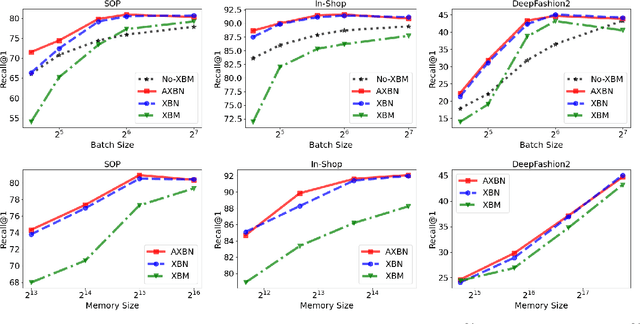
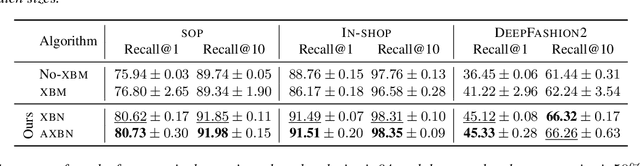
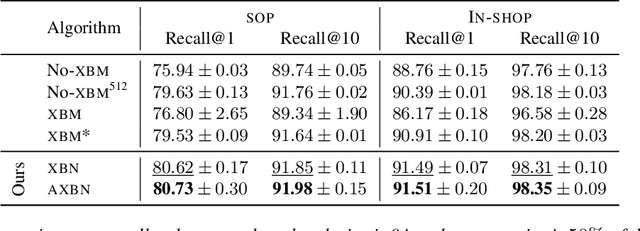
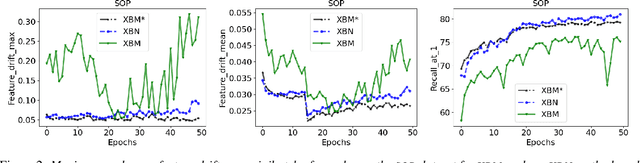
Metric learning is a fundamental problem in computer vision whereby a model is trained to learn a semantically useful embedding space via ranking losses. Traditionally, the effectiveness of a ranking loss depends on the minibatch size, and is, therefore, inherently limited by the memory constraints of the underlying hardware. While simply accumulating the embeddings across minibatches has proved useful (Wang et al. [2020]), we show that it is equally important to ensure that the accumulated embeddings are up to date. In particular, it is necessary to circumvent the representational drift between the accumulated embeddings and the feature embeddings at the current training iteration as the learnable parameters are being updated. In this paper, we model representational drift as distribution misalignment and tackle it using moment matching. The result is a simple method for updating the stored embeddings to match the first and second moments of the current embeddings at each training iteration. Experiments on three popular image retrieval datasets, namely, SOP, In-Shop, and DeepFashion2, demonstrate that our approach significantly improves the performance in all scenarios.