 Add to Chrome
 Add to Firefox
 Add to Edge
Bending the Scaling Law Curve in Large-Scale Recommendation Systems
Feb 19, 2026
Learning from user interaction history through sequential models has become a cornerstone of large-scale recommender systems. Recent advances in large language models have revealed promising scaling laws, sparking a surge of research into long-sequence modeling and deeper architectures for recommendation tasks. However, many recent approaches rely heavily on cross-attention mechanisms to address the quadratic computational bottleneck in sequential modeling, which can limit the representational power gained from self-attention. We present ULTRA-HSTU, a novel sequential recommendation model developed through end-to-end model and system co-design. By innovating in the design of input sequences, sparse attention mechanisms, and model topology, ULTRA-HSTU achieves substantial improvements in both model quality and efficiency. Comprehensive benchmarking demonstrates that ULTRA-HSTU achieves remarkable scaling efficiency gains -- over 5x faster training scaling and 21x faster inference scaling compared to conventional models -- while delivering superior recommendation quality. Our solution is fully deployed at scale, serving billions of users daily and driving significant 4% to 8% consumption and engagement improvements in real-world production environments.

Data-driven stochastic reduced-order modeling of parametrized dynamical systems
Jan 15, 2026Modeling complex dynamical systems under varying conditions is computationally intensive, often rendering high-fidelity simulations intractable. Although reduced-order models (ROMs) offer a promising solution, current methods often struggle with stochastic dynamics and fail to quantify prediction uncertainty, limiting their utility in robust decision-making contexts. To address these challenges, we introduce a data-driven framework for learning continuous-time stochastic ROMs that generalize across parameter spaces and forcing conditions. Our approach, based on amortized stochastic variational inference, leverages a reparametrization trick for Markov Gaussian processes to eliminate the need for computationally expensive forward solvers during training. This enables us to jointly learn a probabilistic autoencoder and stochastic differential equations governing the latent dynamics, at a computational cost that is independent of the dataset size and system stiffness. Additionally, our approach offers the flexibility of incorporating physics-informed priors if available. Numerical studies are presented for three challenging test problems, where we demonstrate excellent generalization to unseen parameter combinations and forcings, and significant efficiency gains compared to existing approaches.
Amortized Reparametrization: Efficient and Scalable Variational Inference for Latent SDEs
Dec 16, 2023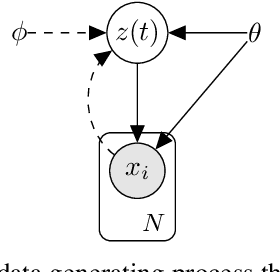
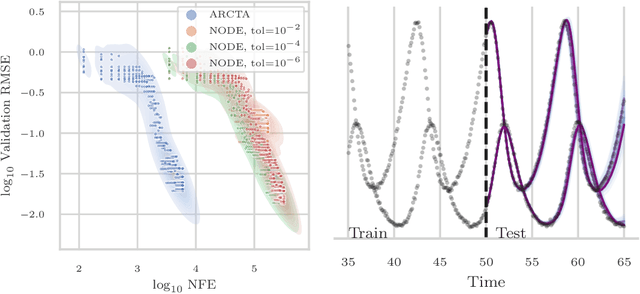
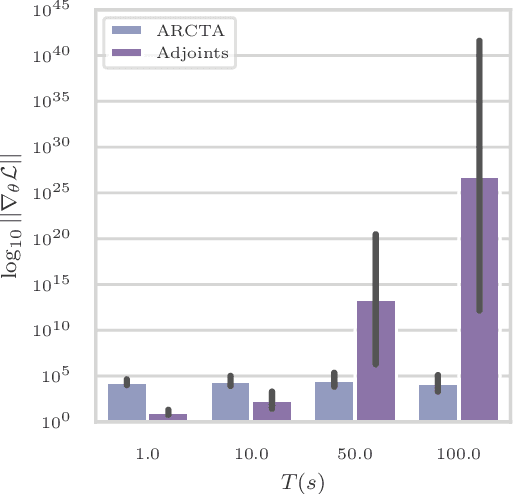
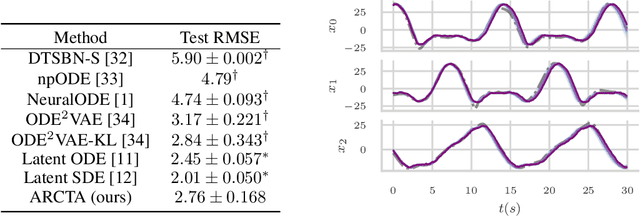
We consider the problem of inferring latent stochastic differential equations (SDEs) with a time and memory cost that scales independently with the amount of data, the total length of the time series, and the stiffness of the approximate differential equations. This is in stark contrast to typical methods for inferring latent differential equations which, despite their constant memory cost, have a time complexity that is heavily dependent on the stiffness of the approximate differential equation. We achieve this computational advancement by removing the need to solve differential equations when approximating gradients using a novel amortization strategy coupled with a recently derived reparametrization of expectations under linear SDEs. We show that, in practice, this allows us to achieve similar performance to methods based on adjoint sensitivities with more than an order of magnitude fewer evaluations of the model in training.