 Add to Chrome
 Add to Firefox
 Add to Edge
Conformal risk control for model-form uncertainty in parametric non-intrusive reduced-order models
Aug 04, 2026
Non-intrusive reduced-order models (NIROMs) have become a standard tool for approximating parametric partial differential equations from computer design of experiments while significantly reducing computational costs. However, assessing the reliability of their predictions remains a major challenge, particularly in extrapolation regimes or under limited training data. In this work, we introduce a framework for quantifying model-form uncertainty in NIROMs by combining a perturbative stochastic representation of reduced bases with distribution-free conformal-type methods. Starting from a deterministic reduced basis constructed from snapshot matrices, we model uncertainty through random perturbations defined on the Stiefel manifold, directed along the discarded modes, yielding stochastic reduced-order approximations whose induced variance reflects the basis-truncation error. A transport approximation gives a closed-form posterior variance that sepa- rates basis-induced from regression-induced uncertainty, without re-training the underlying Gaussian processes. We include this posterior variance within a conformal risk control calibration framework, that provides prediction sets with coordinate miscoverage guarantees. The calibration factor produced by this framework is itself an interpretable, scalar diagnostic of the quality of the uncertainty estimate. The methodology is evaluated on parametric PDE benchmarks and an industrial tire-manufacturing calendering process. Numerical experiments demonstrate reliable, locally informative uncertainty quantification that goes beyond the Gaussian predictive variance.

Learning features from Newton's algorithm: a way to accelerate nonlinear parametrized PDE solvers
Jul 30, 2026It is well known that Newton's method converges faster when the initial guess is closer to a root of a system of nonlinear equations. In this paper, a two-stage Newton initial guess strategy is proposed by learning features from a parameter-space sampling and a database of precomputed solutions. The method uses discrete Newton trajectories to construct two complementary reduced spaces: a solution feature space, built from converged states, and a corrective search direction feature space, built from intermediate Newton increments. For an unseen parameter, a regression model is used to predict a surrogate solution approximation. Then, in a second step, a residual-minimizing correction is computed using a dedicated GMRES-based approach. The resulting state is then used as an initial guess for the high-fidelity Newton method, which completes convergence. The corrective step is computationally inexpensive since it only requires residual evaluations and the solution of a small least-squares problem. The methodology is weakly intrusive once the high-fidelity residual fields and a script-based programming interface are available. This strategy reduces the number of Newton iterations and decreases the overall CPU time. Numerical experiments on representative PDE problems show quantifiable speedups compared with standalone surrogate initialization. Significant speedups are observed. This generic approach can be applied to a broad class of large-scale nonlinear problems.
AK-MCS-C2 : Active Kriging Monte Carlo Simulation method with conformal certification for failure probability estimation
Jun 18, 2026We introduce a novel active-learning framework for failure probability estimation in structural reliability analysis that integrates Active Kriging Monte Carlo simulation with conformal prediction. The proposed approach employs an adaptive cross-conformal strategy specifically designed for small-sample settings and kriging surrogate models using the J+GP conformal estimator. Unlike standard AK-MCS methods, the proposed framework provides distribution-free guarantees on prediction errors, leading to more reliable classification of samples near the limit-state surface. This improved uncertainty quantification enhances both the accuracy and robustness of failure probability estimates, especially for rare-event regimes where such efficiency is crucial. Reproducible numerical results illustrate the effectiveness of the method and also compare it to classical approaches on well-established benchmarks.
Correcting Source Mismatch in Flow Matching with Radial-Angular Transport
Apr 05, 2026Flow Matching is typically built from Gaussian sources and Euclidean probability paths. For heavy-tailed or anisotropic data, however, a Gaussian source induces a structural mismatch already at the level of the radial distribution. We introduce \textit{Radial--Angular Flow Matching (RAFM)}, a framework that explicitly corrects this source mismatch within the standard simulation-free Flow Matching template. RAFM uses a source whose radial law matches that of the data and whose conditional angular distribution is uniform on the sphere, thereby removing the Gaussian radial mismatch by construction. This reduces the remaining transport problem to angular alignment, which leads naturally to conditional paths on scaled spheres defined by spherical geodesic interpolation. The resulting framework yields explicit Flow Matching targets tailored to radial--angular transport without modifying the underlying deterministic training pipeline. We establish the exact density of the matched-radial source, prove a radial--angular KL decomposition that isolates the Gaussian radial penalty, characterize the induced target vector field, and derive a stability result linking Flow Matching error to generation error. We further analyze empirical estimation of the radial law, for which Wasserstein and CDF metrics provide natural guarantees. Empirically, RAFM substantially improves over standard Gaussian Flow Matching and remains competitive with recent non-Gaussian alternatives while preserving a lightweight deterministic training procedure. Overall, RAFM provides a principled source-and-path design for Flow Matching on heavy-tailed and extreme-event data.
Cascaded Transfer: Learning Many Tasks under Budget Constraints
Jan 29, 2026Many-Task Learning refers to the setting where a large number of related tasks need to be learned, the exact relationships between tasks are not known. We introduce the Cascaded Transfer Learning, a novel many-task transfer learning paradigm where information (e.g. model parameters) cascades hierarchically through tasks that are learned by individual models of the same class, while respecting given budget constraints. The cascade is organized as a rooted tree that specifies the order in which tasks are learned and refined. We design a cascaded transfer mechanism deployed over a minimum spanning tree structure that connects the tasks according to a suitable distance measure, and allocates the available training budget along its branches. Experiments on synthetic and real many-task settings show that the resulting method enables more accurate and cost effective adaptation across large task collections compared to alternative approaches.
Multi-Component VAE with Gaussian Markov Random Field
Jul 16, 2025Multi-component datasets with intricate dependencies, like industrial assemblies or multi-modal imaging, challenge current generative modeling techniques. Existing Multi-component Variational AutoEncoders typically rely on simplified aggregation strategies, neglecting critical nuances and consequently compromising structural coherence across generated components. To explicitly address this gap, we introduce the Gaussian Markov Random Field Multi-Component Variational AutoEncoder , a novel generative framework embedding Gaussian Markov Random Fields into both prior and posterior distributions. This design choice explicitly models cross-component relationships, enabling richer representation and faithful reproduction of complex interactions. Empirically, our GMRF MCVAE achieves state-of-the-art performance on a synthetic Copula dataset specifically constructed to evaluate intricate component relationships, demonstrates competitive results on the PolyMNIST benchmark, and significantly enhances structural coherence on the real-world BIKED dataset. Our results indicate that the GMRF MCVAE is especially suited for practical applications demanding robust and realistic modeling of multi-component coherence
Deep Generative Methods and Tire Architecture Design
Jul 15, 2025As deep generative models proliferate across the AI landscape, industrial practitioners still face critical yet unanswered questions about which deep generative models best suit complex manufacturing design tasks. This work addresses this question through a complete study of five representative models (Variational Autoencoder, Generative Adversarial Network, multimodal Variational Autoencoder, Denoising Diffusion Probabilistic Model, and Multinomial Diffusion Model) on industrial tire architecture generation. Our evaluation spans three key industrial scenarios: (i) unconditional generation of complete multi-component designs, (ii) component-conditioned generation (reconstructing architectures from partial observations), and (iii) dimension-constrained generation (creating designs that satisfy specific dimensional requirements). To enable discrete diffusion models to handle conditional scenarios, we introduce categorical inpainting, a mask-aware reverse diffusion process that preserves known labels without requiring additional training. Our evaluation employs geometry-aware metrics specifically calibrated for industrial requirements, quantifying spatial coherence, component interaction, structural connectivity, and perceptual fidelity. Our findings reveal that diffusion models achieve the strongest overall performance; a masking-trained VAE nonetheless outperforms the multimodal variant MMVAE\textsuperscript{+} on nearly all component-conditioned metrics, and within the diffusion family MDM leads in-distribution whereas DDPM generalises better to out-of-distribution dimensional constraints.
OneBatchPAM: A Fast and Frugal K-Medoids Algorithm
Jan 31, 2025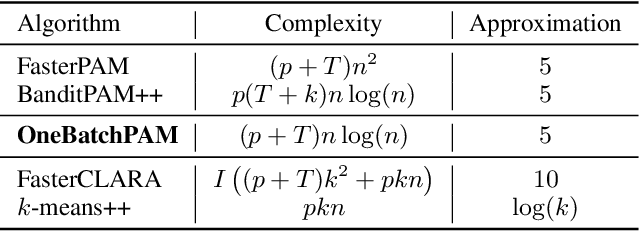

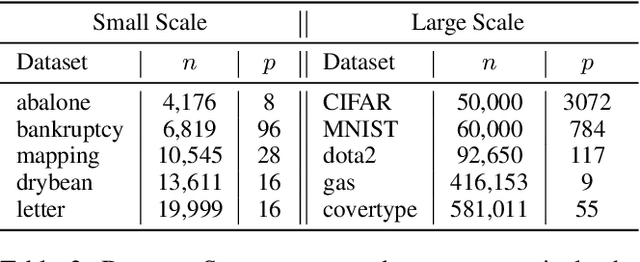
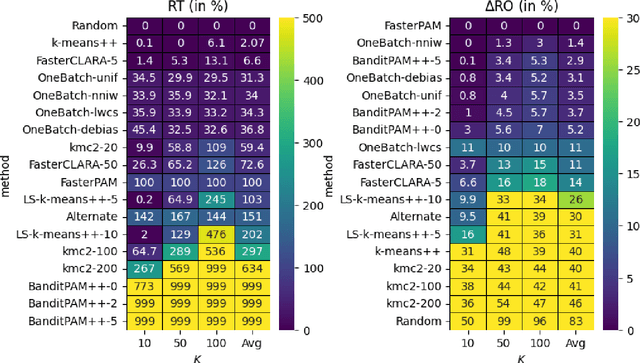
This paper proposes a novel k-medoids approximation algorithm to handle large-scale datasets with reasonable computational time and memory complexity. We develop a local-search algorithm that iteratively improves the medoid selection based on the estimation of the k-medoids objective. A single batch of size m << n provides the estimation, which reduces the required memory size and the number of pairwise dissimilarities computations to O(mn), instead of O(n^2) compared to most k-medoids baselines. We obtain theoretical results highlighting that a batch of size m = O(log(n)) is sufficient to guarantee, with strong probability, the same performance as the original local-search algorithm. Multiple experiments conducted on real datasets of various sizes and dimensions show that our algorithm provides similar performances as state-of-the-art methods such as FasterPAM and BanditPAM++ with a drastically reduced running time.
BN-SCAFFOLD: controlling the drift of Batch Normalization statistics in Federated Learning
Oct 04, 2024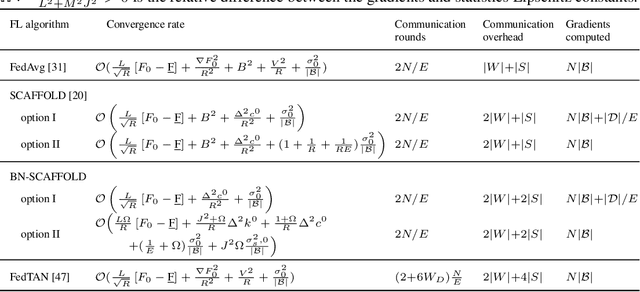
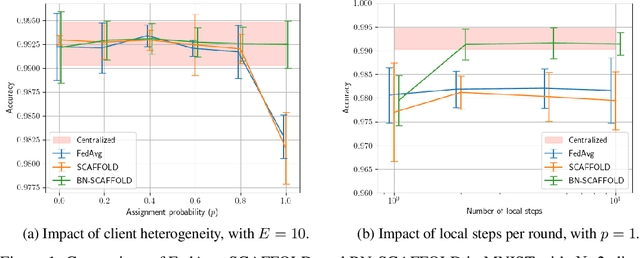
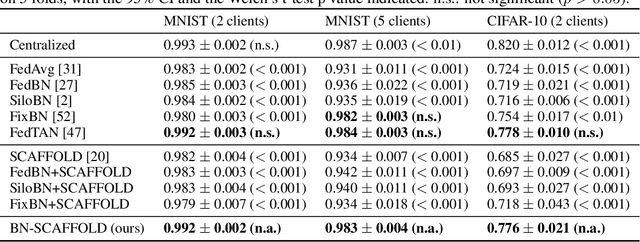
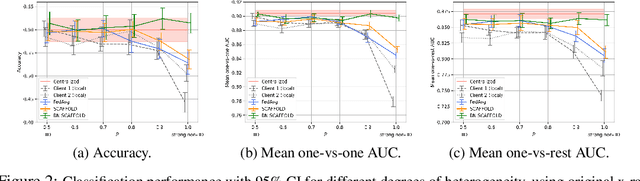
Federated Learning (FL) is gaining traction as a learning paradigm for training Machine Learning (ML) models in a decentralized way. Batch Normalization (BN) is ubiquitous in Deep Neural Networks (DNN), as it improves convergence and generalization. However, BN has been reported to hinder performance of DNNs in heterogeneous FL. Recently, the FedTAN algorithm has been proposed to mitigate the effect of heterogeneity on BN, by aggregating BN statistics and gradients from all the clients. However, it has a high communication cost, that increases linearly with the depth of the DNN. SCAFFOLD is a variance reduction algorithm, that estimates and corrects the client drift in a communication-efficient manner. Despite its promising results in heterogeneous FL settings, it has been reported to underperform for models with BN. In this work, we seek to revive SCAFFOLD, and more generally variance reduction, as an efficient way of training DNN with BN in heterogeneous FL. We introduce a unified theoretical framework for analyzing the convergence of variance reduction algorithms in the BN-DNN setting, inspired of by the work of Wang et al. 2023, and show that SCAFFOLD is unable to remove the bias introduced by BN. We thus propose the BN-SCAFFOLD algorithm, which extends the client drift correction of SCAFFOLD to BN statistics. We prove convergence using the aforementioned framework and validate the theoretical results with experiments on MNIST and CIFAR-10. BN-SCAFFOLD equals the performance of FedTAN, without its high communication cost, outperforming Federated Averaging (FedAvg), SCAFFOLD, and other FL algorithms designed to mitigate BN heterogeneity.
A Markov Random Field Multi-Modal Variational AutoEncoder
Aug 18, 2024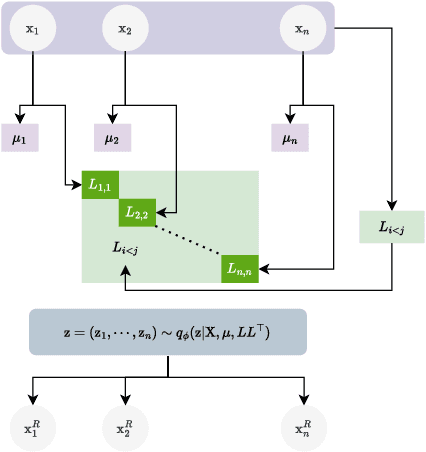
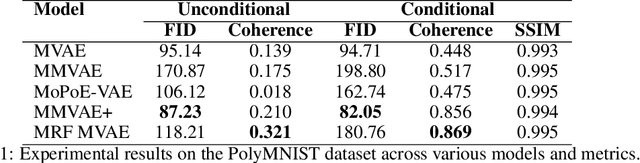
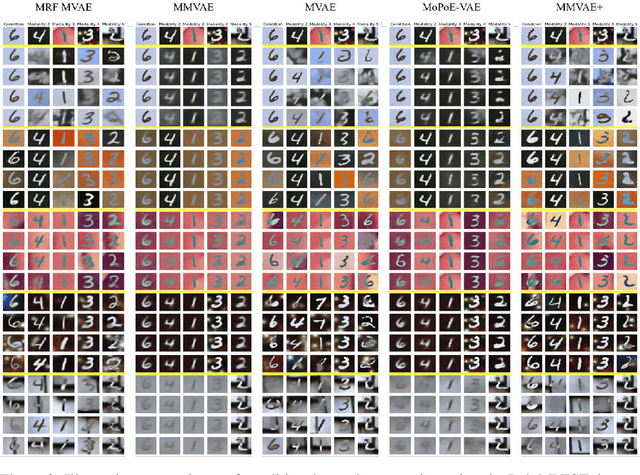
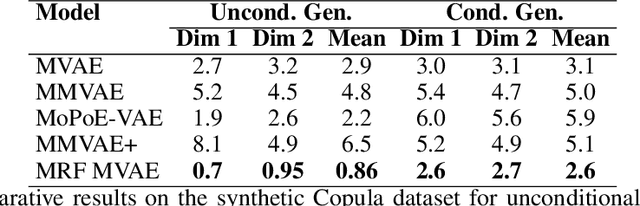
Recent advancements in multimodal Variational AutoEncoders (VAEs) have highlighted their potential for modeling complex data from multiple modalities. However, many existing approaches use relatively straightforward aggregating schemes that may not fully capture the complex dynamics present between different modalities. This work introduces a novel multimodal VAE that incorporates a Markov Random Field (MRF) into both the prior and posterior distributions. This integration aims to capture complex intermodal interactions more effectively. Unlike previous models, our approach is specifically designed to model and leverage the intricacies of these relationships, enabling a more faithful representation of multimodal data. Our experiments demonstrate that our model performs competitively on the standard PolyMNIST dataset and shows superior performance in managing complex intermodal dependencies in a specially designed synthetic dataset, intended to test intricate relationships.