 Add to Chrome
 Add to Firefox
 Add to Edge
Correcting Source Mismatch in Flow Matching with Radial-Angular Transport
Apr 05, 2026
Flow Matching is typically built from Gaussian sources and Euclidean probability paths. For heavy-tailed or anisotropic data, however, a Gaussian source induces a structural mismatch already at the level of the radial distribution. We introduce \textit{Radial--Angular Flow Matching (RAFM)}, a framework that explicitly corrects this source mismatch within the standard simulation-free Flow Matching template. RAFM uses a source whose radial law matches that of the data and whose conditional angular distribution is uniform on the sphere, thereby removing the Gaussian radial mismatch by construction. This reduces the remaining transport problem to angular alignment, which leads naturally to conditional paths on scaled spheres defined by spherical geodesic interpolation. The resulting framework yields explicit Flow Matching targets tailored to radial--angular transport without modifying the underlying deterministic training pipeline. We establish the exact density of the matched-radial source, prove a radial--angular KL decomposition that isolates the Gaussian radial penalty, characterize the induced target vector field, and derive a stability result linking Flow Matching error to generation error. We further analyze empirical estimation of the radial law, for which Wasserstein and CDF metrics provide natural guarantees. Empirically, RAFM substantially improves over standard Gaussian Flow Matching and remains competitive with recent non-Gaussian alternatives while preserving a lightweight deterministic training procedure. Overall, RAFM provides a principled source-and-path design for Flow Matching on heavy-tailed and extreme-event data.

Multi-Component VAE with Gaussian Markov Random Field
Jul 16, 2025Multi-component datasets with intricate dependencies, like industrial assemblies or multi-modal imaging, challenge current generative modeling techniques. Existing Multi-component Variational AutoEncoders typically rely on simplified aggregation strategies, neglecting critical nuances and consequently compromising structural coherence across generated components. To explicitly address this gap, we introduce the Gaussian Markov Random Field Multi-Component Variational AutoEncoder , a novel generative framework embedding Gaussian Markov Random Fields into both prior and posterior distributions. This design choice explicitly models cross-component relationships, enabling richer representation and faithful reproduction of complex interactions. Empirically, our GMRF MCVAE achieves state-of-the-art performance on a synthetic Copula dataset specifically constructed to evaluate intricate component relationships, demonstrates competitive results on the PolyMNIST benchmark, and significantly enhances structural coherence on the real-world BIKED dataset. Our results indicate that the GMRF MCVAE is especially suited for practical applications demanding robust and realistic modeling of multi-component coherence
Deep Generative Methods and Tire Architecture Design
Jul 15, 2025As deep generative models proliferate across the AI landscape, industrial practitioners still face critical yet unanswered questions about which deep generative models best suit complex manufacturing design tasks. This work addresses this question through a complete study of five representative models (Variational Autoencoder, Generative Adversarial Network, multimodal Variational Autoencoder, Denoising Diffusion Probabilistic Model, and Multinomial Diffusion Model) on industrial tire architecture generation. Our evaluation spans three key industrial scenarios: (i) unconditional generation of complete multi-component designs, (ii) component-conditioned generation (reconstructing architectures from partial observations), and (iii) dimension-constrained generation (creating designs that satisfy specific dimensional requirements). To enable discrete diffusion models to handle conditional scenarios, we introduce categorical inpainting, a mask-aware reverse diffusion process that preserves known labels without requiring additional training. Our evaluation employs geometry-aware metrics specifically calibrated for industrial requirements, quantifying spatial coherence, component interaction, structural connectivity, and perceptual fidelity. Our findings reveal that diffusion models achieve the strongest overall performance; a masking-trained VAE nonetheless outperforms the multimodal variant MMVAE\textsuperscript{+} on nearly all component-conditioned metrics, and within the diffusion family MDM leads in-distribution whereas DDPM generalises better to out-of-distribution dimensional constraints.
A Markov Random Field Multi-Modal Variational AutoEncoder
Aug 18, 2024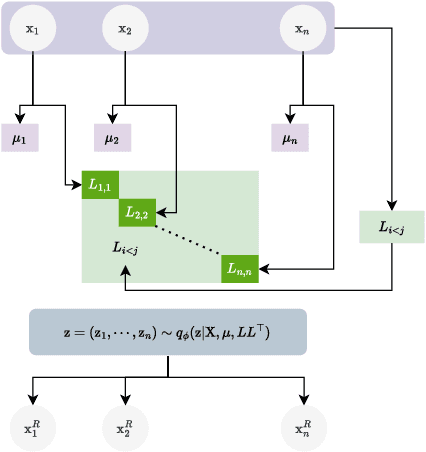
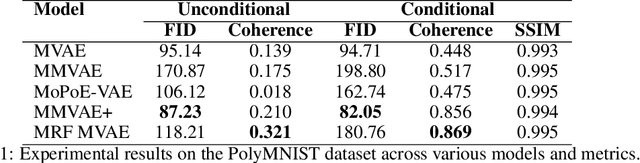
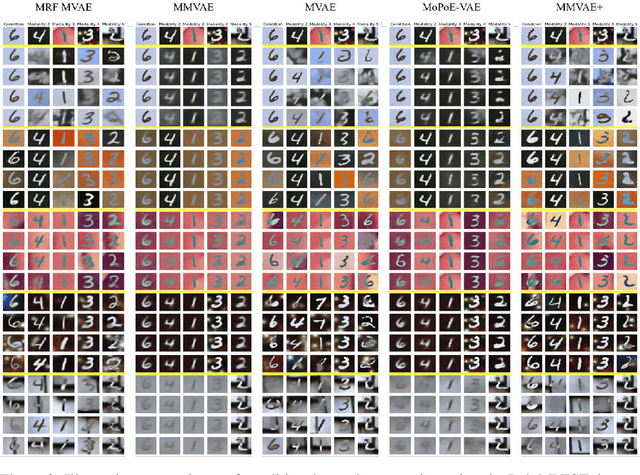
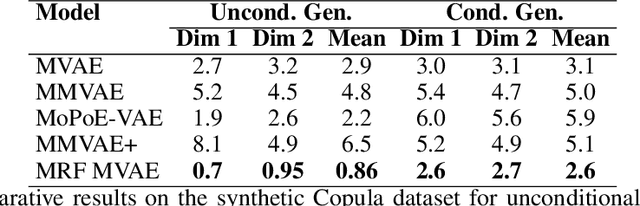
Recent advancements in multimodal Variational AutoEncoders (VAEs) have highlighted their potential for modeling complex data from multiple modalities. However, many existing approaches use relatively straightforward aggregating schemes that may not fully capture the complex dynamics present between different modalities. This work introduces a novel multimodal VAE that incorporates a Markov Random Field (MRF) into both the prior and posterior distributions. This integration aims to capture complex intermodal interactions more effectively. Unlike previous models, our approach is specifically designed to model and leverage the intricacies of these relationships, enabling a more faithful representation of multimodal data. Our experiments demonstrate that our model performs competitively on the standard PolyMNIST dataset and shows superior performance in managing complex intermodal dependencies in a specially designed synthetic dataset, intended to test intricate relationships.
A Meta-Generation framework for Industrial System Generation
Jun 08, 2023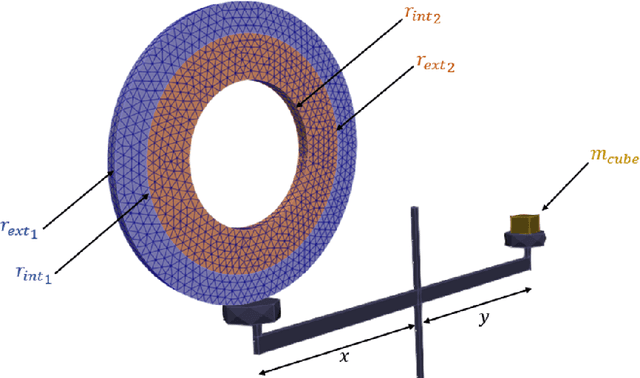
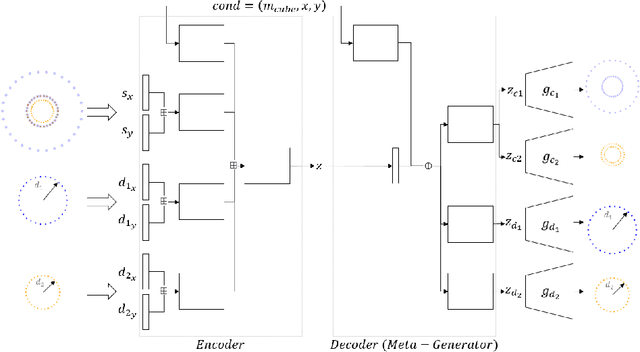
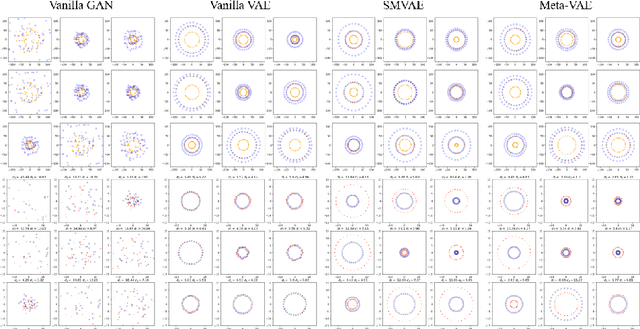
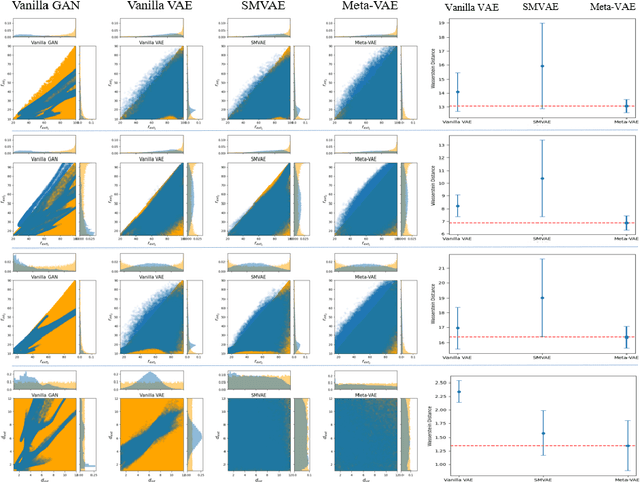
Generative design is an increasingly important tool in the industrial world. It allows the designers and engineers to easily explore vast ranges of design options, providing a cheaper and faster alternative to the trial and failure approaches. Thanks to the flexibility they offer, Deep Generative Models are gaining popularity amongst Generative Design technologies. However, developing and evaluating these models can be challenging. The field lacks accessible benchmarks, in order to evaluate and compare objectively different Deep Generative Models architectures. Moreover, vanilla Deep Generative Models appear to be unable to accurately generate multi-components industrial systems that are controlled by latent design constraints. To address these challenges, we propose an industry-inspired use case that incorporates actual industrial system characteristics. This use case can be quickly generated and used as a benchmark. We propose a Meta-VAE capable of producing multi-component industrial systems and showcase its application on the proposed use case.
A Binded VAE for Inorganic Material Generation
Dec 17, 2021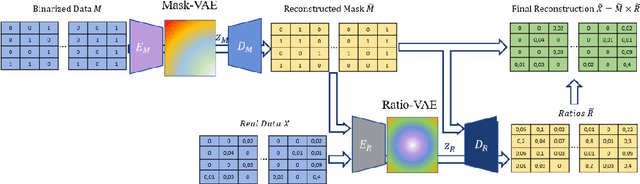
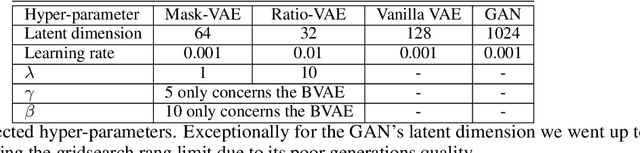
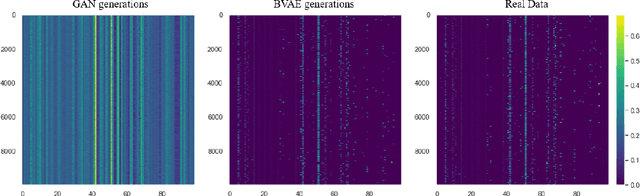
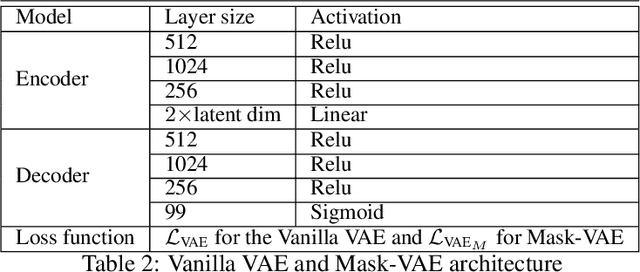
Designing new industrial materials with desired properties can be very expensive and time consuming. The main difficulty is to generate compounds that correspond to realistic materials. Indeed, the description of compounds as vectors of components' proportions is characterized by discrete features and a severe sparsity. Furthermore, traditional generative model validation processes as visual verification, FID and Inception scores are tailored for images and cannot then be used as such in this context. To tackle these issues, we develop an original Binded-VAE model dedicated to the generation of discrete datasets with high sparsity. We validate the model with novel metrics adapted to the problem of compounds generation. We show on a real issue of rubber compound design that the proposed approach outperforms the standard generative models which opens new perspectives for material design optimization.