 Add to Chrome
 Add to Firefox
 Add to Edge
Conformal risk control for model-form uncertainty in parametric non-intrusive reduced-order models
Aug 04, 2026
Non-intrusive reduced-order models (NIROMs) have become a standard tool for approximating parametric partial differential equations from computer design of experiments while significantly reducing computational costs. However, assessing the reliability of their predictions remains a major challenge, particularly in extrapolation regimes or under limited training data. In this work, we introduce a framework for quantifying model-form uncertainty in NIROMs by combining a perturbative stochastic representation of reduced bases with distribution-free conformal-type methods. Starting from a deterministic reduced basis constructed from snapshot matrices, we model uncertainty through random perturbations defined on the Stiefel manifold, directed along the discarded modes, yielding stochastic reduced-order approximations whose induced variance reflects the basis-truncation error. A transport approximation gives a closed-form posterior variance that sepa- rates basis-induced from regression-induced uncertainty, without re-training the underlying Gaussian processes. We include this posterior variance within a conformal risk control calibration framework, that provides prediction sets with coordinate miscoverage guarantees. The calibration factor produced by this framework is itself an interpretable, scalar diagnostic of the quality of the uncertainty estimate. The methodology is evaluated on parametric PDE benchmarks and an industrial tire-manufacturing calendering process. Numerical experiments demonstrate reliable, locally informative uncertainty quantification that goes beyond the Gaussian predictive variance.

AK-MCS-C2 : Active Kriging Monte Carlo Simulation method with conformal certification for failure probability estimation
Jun 18, 2026We introduce a novel active-learning framework for failure probability estimation in structural reliability analysis that integrates Active Kriging Monte Carlo simulation with conformal prediction. The proposed approach employs an adaptive cross-conformal strategy specifically designed for small-sample settings and kriging surrogate models using the J+GP conformal estimator. Unlike standard AK-MCS methods, the proposed framework provides distribution-free guarantees on prediction errors, leading to more reliable classification of samples near the limit-state surface. This improved uncertainty quantification enhances both the accuracy and robustness of failure probability estimates, especially for rare-event regimes where such efficiency is crucial. Reproducible numerical results illustrate the effectiveness of the method and also compare it to classical approaches on well-established benchmarks.
Conformal Approach To Gaussian Process Surrogate Evaluation With Coverage Guarantees
Jan 15, 2024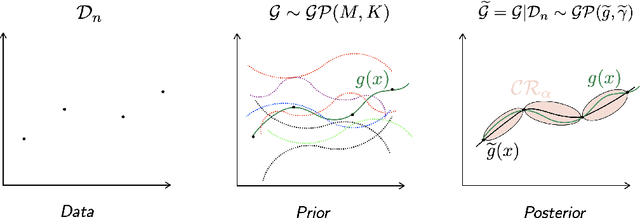

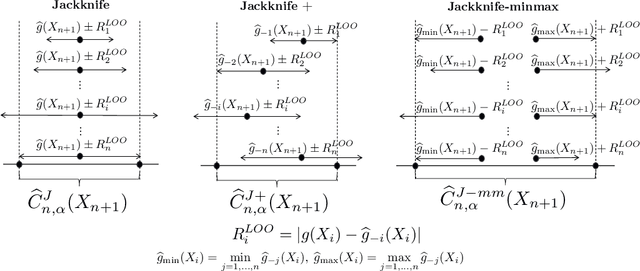
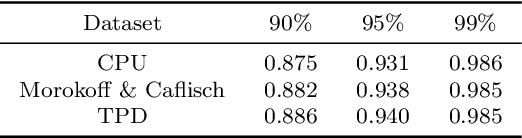
Gaussian processes (GPs) are a Bayesian machine learning approach widely used to construct surrogate models for the uncertainty quantification of computer simulation codes in industrial applications. It provides both a mean predictor and an estimate of the posterior prediction variance, the latter being used to produce Bayesian credibility intervals. Interpreting these intervals relies on the Gaussianity of the simulation model as well as the well-specification of the priors which are not always appropriate. We propose to address this issue with the help of conformal prediction. In the present work, a method for building adaptive cross-conformal prediction intervals is proposed by weighting the non-conformity score with the posterior standard deviation of the GP. The resulting conformal prediction intervals exhibit a level of adaptivity akin to Bayesian credibility sets and display a significant correlation with the surrogate model local approximation error, while being free from the underlying model assumptions and having frequentist coverage guarantees. These estimators can thus be used for evaluating the quality of a GP surrogate model and can assist a decision-maker in the choice of the best prior for the specific application of the GP. The performance of the method is illustrated through a panel of numerical examples based on various reference databases. Moreover, the potential applicability of the method is demonstrated in the context of surrogate modeling of an expensive-to-evaluate simulator of the clogging phenomenon in steam generators of nuclear reactors.