 Add to Chrome
 Add to Firefox
 Add to Edge
Human-in-the-Loop and AI: Crowdsourcing Metadata Vocabulary for Materials Science
Dec 10, 2025
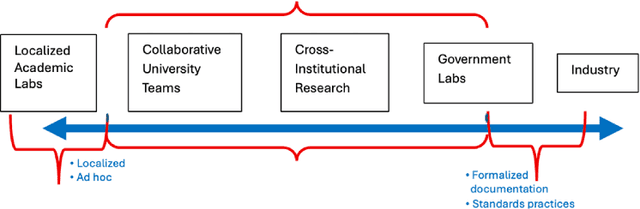
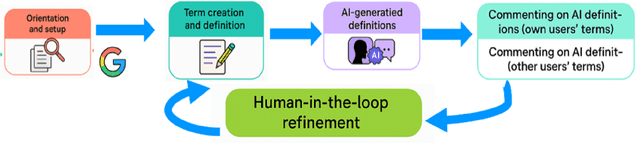
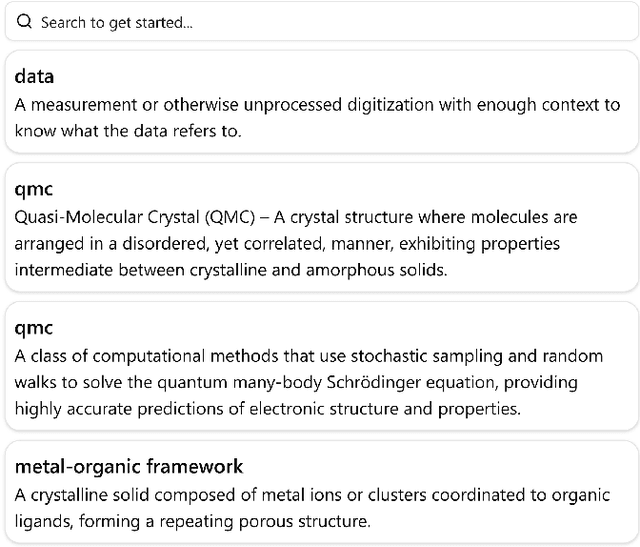
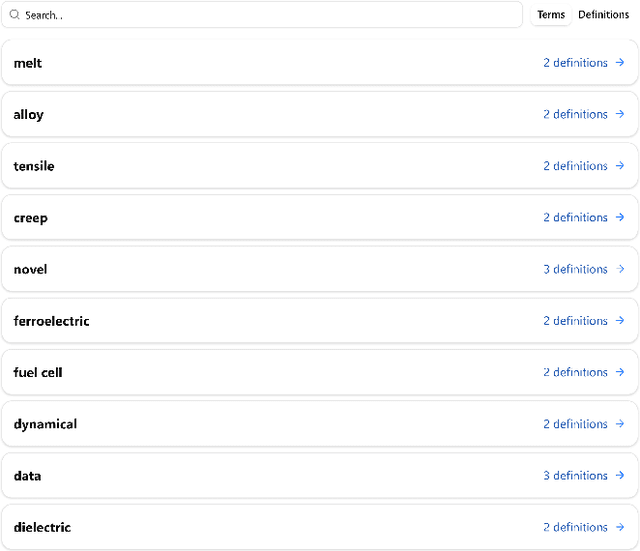
Metadata vocabularies are essential for advancing FAIR and FARR data principles, but their development constrained by limited human resources and inconsistent standardization practices. This paper introduces MatSci-YAMZ, a platform that integrates artificial intelligence (AI) and human-in-the-loop (HILT), including crowdsourcing, to support metadata vocabulary development. The paper reports on a proof-of-concept use case evaluating the AI-HILT model in materials science, a highly interdisciplinary domain Six (6) participants affiliated with the NSF Institute for Data-Driven Dynamical Design (ID4) engaged with the MatSci-YAMZ plaform over several weeks, contributing term definitions and providing examples to prompt the AI-definitions refinement. Nineteen (19) AI-generated definitions were successfully created, with iterative feedback loops demonstrating the feasibility of AI-HILT refinement. Findings confirm the feasibility AI-HILT model highlighting 1) a successful proof of concept, 2) alignment with FAIR and open-science principles, 3) a research protocol to guide future studies, and 4) the potential for scalability across domains. Overall, MatSci-YAMZ's underlying model has the capacity to enhance semantic transparency and reduce time required for consensus building and metadata vocabulary development.

On Identifying Points of Semantic Shift Across Domains
Oct 18, 2023The semantics used for particular terms in an academic field organically evolve over time. Tracking this evolution through inspection of published literature has either been from the perspective of Linguistic scholars or has concentrated the focus of term evolution within a single domain of study. In this paper, we performed a case study to identify semantic evolution across different domains and identify examples of inter-domain semantic shifts. We initially used keywords as the basis of our search and executed an iterative process of following citations to find the initial mention of the concepts in the field. We found that a select set of keywords like ``semaphore'', ``polymorphism'', and ``ontology'' were mentioned within Computer Science literature and tracked the seminal study that borrowed those terms from original fields by citations. We marked these events as semantic evolution points. Through this manual investigation method, we can identify term evolution across different academic fields. This study reports our initial findings that will seed future automated and computational methods of incorporating concepts from additional academic fields.
FAIR Metadata: A Community-driven Vocabulary Application
Nov 06, 2021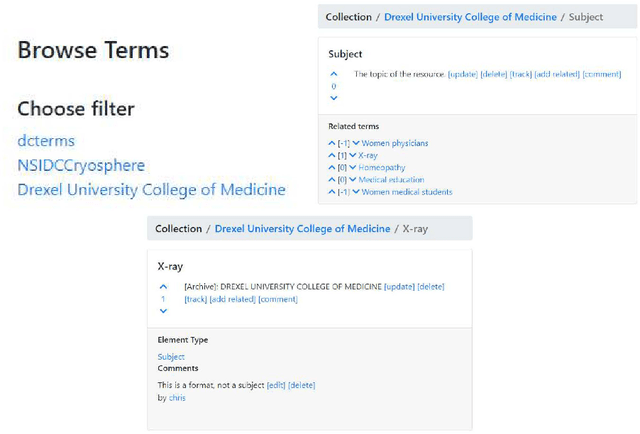
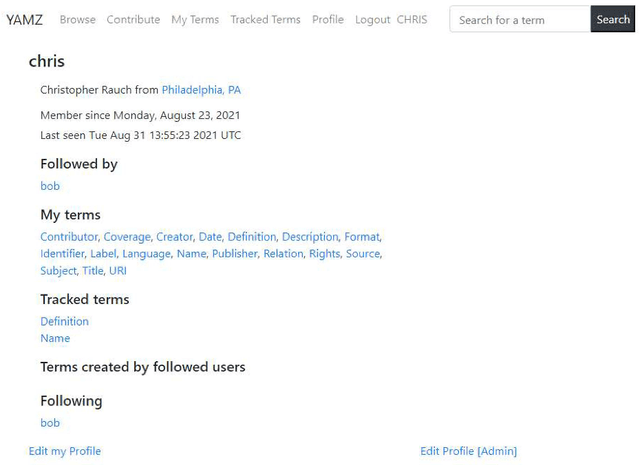
FAIR metadata is critical to supporting FAIR data overall. Transparency, community engagement, and flexibility are key aspects of FAIR that apply to metadata. This paper presents YAMZ (Yet Another Metadata Zoo), a community-driven vocabulary application that supports FAIR. The history ofYAMZ and its original features are reviewed, followed by a presentation of recent innovations and a discussion of how YAMZ supports FAIR principles. The conclusion identifies next steps and key outputs.