 Add to Chrome
 Add to Firefox
 Add to Edge
CoFL-S: Spatially Queryable Sector Flow Fields for Local Language-Conditioned Navigation
Jul 02, 2026
Vision-Language Navigation has increasingly emphasized high-level instruction reasoning, memory, global map construction, and instruction decomposition, while the low-level action representation remains comparatively underexplored. We propose CoFL-S, a low-level vision-language-action framework that predicts a language-conditioned flow field over the robot's local visible sector and generates continuous trajectories by rolling out the predicted field. To train this low-level representation, we convert each VLN-CE episode, originally a whole-episode instruction paired with an action sequence, into frame-level local supervision with aligned sub-instructions and matched action, trajectory, and dense flow-field targets. For evaluation, we introduce a continuous-time Habitat benchmark that isolates low-level action interfaces from instruction decomposition and executes all methods through a shared velocity-command controller, enabling decomposition-independent closed-loop comparison across different planner frequencies rather than fixed discrete forward-and-turn transitions in VLN-CE. Under matched encoders and training settings, CoFL-S consistently outperforms action-token and action-chunk baselines across planner frequencies in the continuous-time Habitat benchmark, and zero-shot real-world closed-loop deployment further shows its advantage over both baselines beyond simulation.

Self-assembling Modular Aerial Robot for Versatile Aerial Tasks
May 19, 2026Multirotor aerial robots excel at maneuvering in three-dimensional space, and recent advances enable nimble navigation in cluttered and confined environments, especially for small airframes. By contrast, platforms built for high-altitude work tend to be larger to deliver high thrust for stable physical interaction with the environment. However, these conflicting design requirements create a long-standing trade-off between nimble navigation and robust aerial manipulation. Here, we present LEGION units, which are reconfigurable modular aerial robots capable of in-flight self-assembly for cooperative manipulation, drawing inspiration from the self-organized collectives formed by ants. Each unit retains nimble maneuverability while joint-equipped docking interfaces at both ends enable end-to-end self-assembly into a flying manipulator. We show that multiple units autonomously dock in flight; once latched, they maintain a zero-clearance interlock by controlling the contact force and torque, enabling reliable aggregation and articulated motion even outdoors. We further show that self-reconfigurability enables morphological switching between nimble individual flight and collective articulated manipulation, while realizing core in-flight manipulation primitives including pushing, pulling, rotating, grasping, and carrying. LEGION's self-organization enables aerial robots, especially in swarms, to shift from passive observers to active participants in their environment, broadening the scope of aerial physical interaction.
CoFL: Continuous Flow Fields for Language-Conditioned Navigation
Mar 03, 2026Language-conditioned navigation pipelines often rely on brittle modular components or costly action-sequence generation. To address these limitations, we present CoFL, an end-to-end policy that directly maps a bird's-eye view (BEV) observation and a language instruction to a continuous flow field for navigation. Instead of predicting discrete action tokens or sampling action chunks via iterative denoising, CoFL outputs instantaneous velocities that can be queried at arbitrary 2D projected locations. Trajectories are obtained by numerical integration of the predicted field, producing smooth motion that remains reactive under closed-loop execution. To enable large-scale training, we build a dataset of over 500k BEV image-instruction pairs, each procedurally annotated with a flow field and a trajectory derived from BEV semantic maps built on Matterport3D and ScanNet. By training on a mixed distribution, CoFL significantly outperforms modular Vision-Language Model (VLM)-based planners and generative policy baselines on strictly unseen scenes. Finally, we deploy CoFL zero-shot in real-world experiments with overhead BEV observations across multiple layouts, maintaining reliable closed-loop control and a high success rate.
Falconry-like palm landing by a flapping-wing drone based on the human gesture interaction and distance-aware flight planning
Jul 23, 2025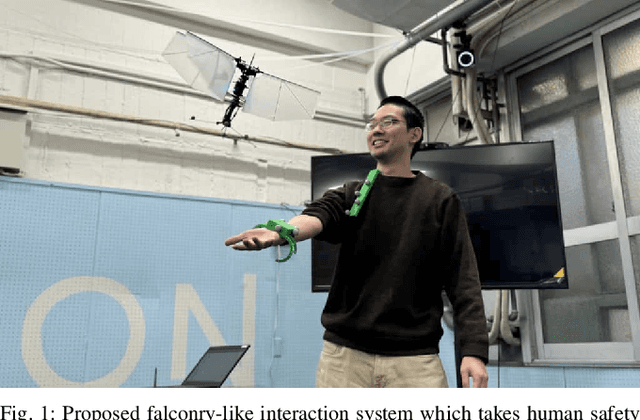
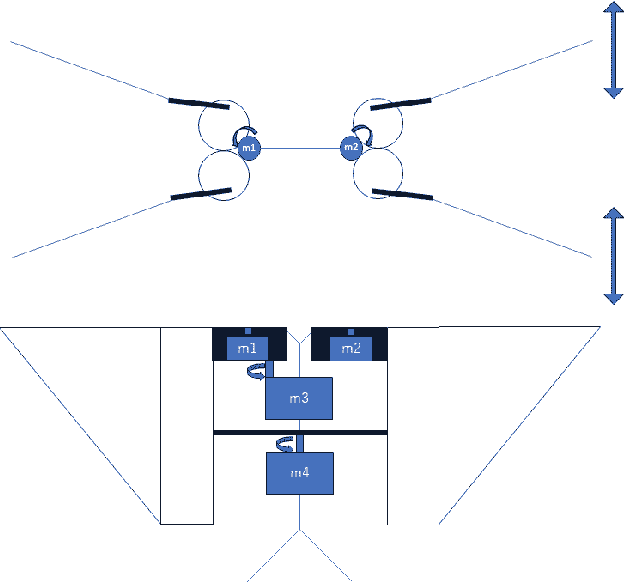
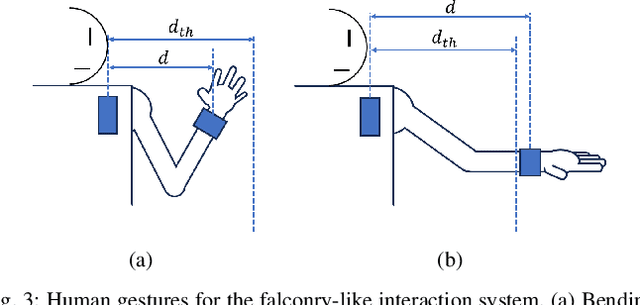
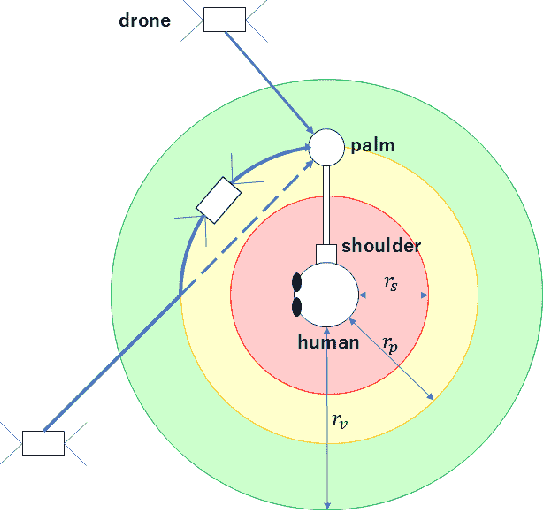
Flapping-wing drones have attracted significant attention due to their biomimetic flight. They are considered more human-friendly due to their characteristics such as low noise and flexible wings, making them suitable for human-drone interactions. However, few studies have explored the practical interaction between humans and flapping-wing drones. On establishing a physical interaction system with flapping-wing drones, we can acquire inspirations from falconers who guide birds of prey to land on their arms. This interaction interprets the human body as a dynamic landing platform, which can be utilized in various scenarios such as crowded or spatially constrained environments. Thus, in this study, we propose a falconry-like interaction system in which a flapping-wing drone performs a palm landing motion on a human hand. To achieve a safe approach toward humans, we design a trajectory planning method that considers both physical and psychological factors of the human safety such as the drone's velocity and distance from the user. We use a commercial flapping platform with our implemented motion planning and conduct experiments to evaluate the palm landing performance and safety. The results demonstrate that our approach enables safe and smooth hand landing interactions. To the best of our knowledge, it is the first time to achieve a contact-based interaction between flapping-wing drones and humans.