 Add to Chrome
 Add to Firefox
 Add to Edge
Learning to Orchestrate Agents under Uncertainty
May 26, 2026
Adaptive orchestration of heterogeneous agents requires making sequential delegation decisions under uncertain and evolving agent behaviour, e.g., coordinating specialised AI models with varying reliability, cost, and response quality. While prior work on agent orchestration focuses on performance or cost, uncertainty in agent reliability and output distributions is typically not modelled explicitly at the orchestration level. In this work, we study the problem of adaptive orchestration of heterogeneous agents under uncertainty, where a meta-controller must decide when to delegate to an agent, accounting for reliability, cost, and uncertainty. We propose BOT-Orch, a lightweight framework that recasts orchestration as a bandit problem over agents, regularized by OT distances between agent output distributions and task-specific reference distributions. We show that the regularised orchestration enjoys $\mathcal{O}(\sqrt{T})$ regret under standard assumptions, and provably induces preference ordering among agents with identical mean rewards but differing distributional alignment. Empirically, we demonstrate that BOT-Orch outperforms standard bandit and heuristic baselines in synthetic but adversarial task allocation settings with heterogeneous, non-i.i.d. agent behaviour.

Laplace Learning in Wasserstein Space
Nov 17, 2025The manifold hypothesis posits that high-dimensional data typically resides on low-dimensional sub spaces. In this paper, we assume manifold hypothesis to investigate graph-based semi-supervised learning methods. In particular, we examine Laplace Learning in the Wasserstein space, extending the classical notion of graph-based semi-supervised learning algorithms from finite-dimensional Euclidean spaces to an infinite-dimensional setting. To achieve this, we prove variational convergence of a discrete graph p- Dirichlet energy to its continuum counterpart. In addition, we characterize the Laplace-Beltrami operator on asubmanifold of the Wasserstein space. Finally, we validate the proposed theoretical framework through numerical experiments conducted on benchmark datasets, demonstrating the consistency of our classification performance in high-dimensional settings.
Conic Formulations of Transport Metrics for Unbalanced Measure Networks and Hypernetworks
Aug 14, 2025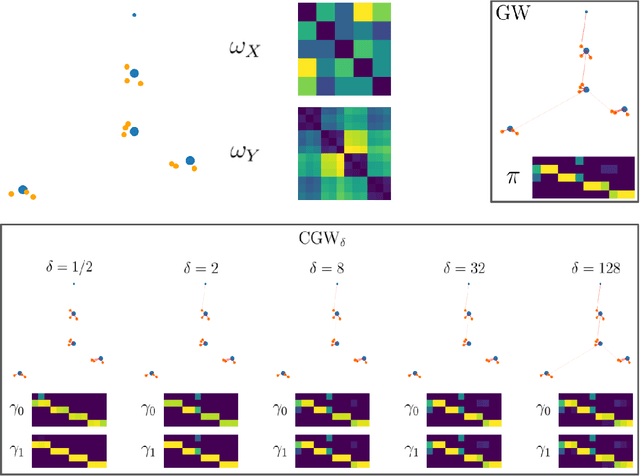
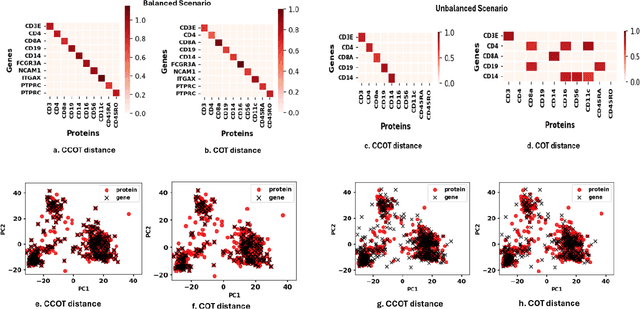
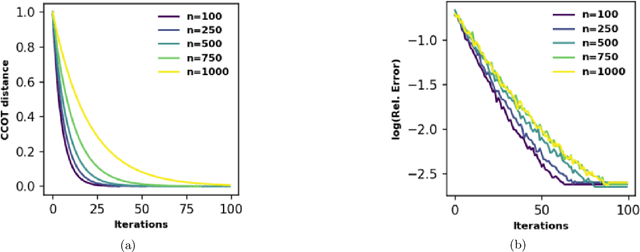
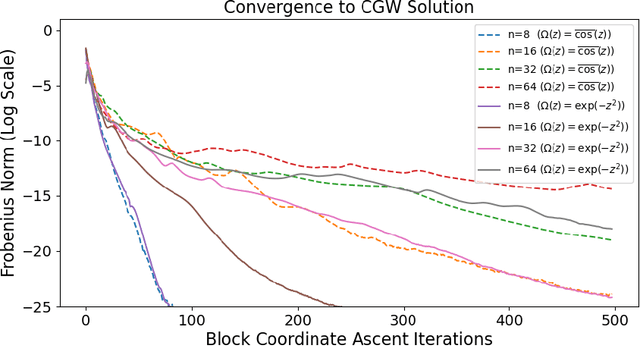
The Gromov-Wasserstein (GW) variant of optimal transport, designed to compare probability densities defined over distinct metric spaces, has emerged as an important tool for the analysis of data with complex structure, such as ensembles of point clouds or networks. To overcome certain limitations, such as the restriction to comparisons of measures of equal mass and sensitivity to outliers, several unbalanced or partial transport relaxations of the GW distance have been introduced in the recent literature. This paper is concerned with the Conic Gromov-Wasserstein (CGW) distance introduced by S\'{e}journ\'{e}, Vialard, and Peyr\'{e}. We provide a novel formulation in terms of semi-couplings, and extend the framework beyond the metric measure space setting, to compare more general network and hypernetwork structures. With this new formulation, we establish several fundamental properties of the CGW metric, including its scaling behavior under dilation, variational convergence in the limit of volume growth constraints, and comparison bounds with established optimal transport metrics. We further derive quantitative bounds that characterize the robustness of the CGW metric to perturbations in the underlying measures. The hypernetwork formulation of CGW admits a simple and provably convergent block coordinate ascent algorithm for its estimation, and we demonstrate the computational tractability and scalability of our approach through experiments on synthetic and real-world high-dimensional and structured datasets.