 Add to Chrome
 Add to Firefox
 Add to Edge
The data geometry of masking diffusion: Certified-optimal schedules via unmasking growth complexity
Aug 13, 2026
We study masking diffusion for discrete sampling and introduce a path-resolved measure of data geometry called the \emph{unmasking growth complexity} ({\textsf{UGC}\xspace}). Its local increments directly control Kullback--Leibler (KL) discretization error, yielding a unified analysis of Bernoulli-subset and fixed-cardinality unmasking schemes. In log-reveal-odds coordinates, this structure yields optimized single-block and multi-block schedules, and quantifies the gains from adapting computational effort to data geometry. Crucially, we show how {\textsf{UGC}\xspace} increments can be estimated from samples via KL increments along coupled reveal trajectories. This leads to \emph{certified-optimal} samplers that achieve a prescribed KL error with high probability and iteration complexity within a constant factor of the corresponding oracle procedure. Collapsing the \ugc path yields the aggregate {\textsf{UGC}\xspace} mass, which connects to classical multivariate dependence measures and complexity measures from previous analyses of discrete diffusion. In the fine-partition limit, the squared integral of the square-root {\textsf{UGC}\xspace} density determines the sharp leading-order optimal Euler discretization error. Examples exhibit substantial dimension-dependent gains over coarse schedules, including $\widetildeΩ(\sqrt{d})$ improvements achievable with a constant number of adaptively placed blocks.

Denoising growth complexity: Data geometry and certified schedules for diffusion sampling
Jul 28, 2026Two central challenges in diffusion-based sampling are the theoretical one of understanding their remarkable effectiveness even in high-dimensional settings, and the practical one of designing algorithms with certified performance guarantees. We show that these questions are intimately connected via the \emph{denoising growth complexity} ($\mathsf{DGC}$). It is a geometric measure defined by a log-time weighted integral of the derivative of the denoising mean-squared error along the Gaussian heat flow. We show how the $\mathsf{DGC}$ increments lead to a simple and explicit bound on the KL error of an Euler scheme applied to the stochastic innovations representation. The bound is local along the path: each step is controlled by the corresponding $\mathsf{DGC}$ increment and its relative stepsize. This structure allows us to derive KL sampling guarantees for optimized stepsize schedules, both in a simpler single-block setting and in a more refined $K$-block setting. The $\mathsf{DGC}$ function has a natural martingale structure, which we exploit to develop fully data-certified versions of these algorithms. It also admits information-theoretic upper bounds in terms of covariance, rate distortion, metric entropy, and the Poincar'e constant, thereby recovering and sharpening a range of existing diffusion-sampling guarantees, as well as giving new results. In log heat-time, the fine partition limit is governed by an integral involving the square root of the $\mathsf{DGC}$ density, whereas a single-block schedule depends on its ordinary integral. This comparison precisely characterizes when adaptation to data geometry yields substantial computational gains, including logarithmic-to-constant separations for simple Gaussian mixture models.
TILT: Target-induced loss tilting under covariate shift
May 14, 2026We introduce and analyze Target-Induced Loss Tilting (TILT) for unsupervised domain adaptation under covariate shift. It is based on a novel objective function that decomposes the source predictor as $f+b$, fits $f+b$ on labeled source data while simultaneously penalizing the auxiliary component $b$ on unlabeled target inputs. The resulting fit $f$ is deployed as the final target predictor. At the population level, we show that this target-side penalty implicitly induces relative importance weighting at the population level, but in terms of an estimand $b^*_f$ that is self-localized to the current error, and remains uniformly bounded for any source-target pair (even those with disjoint supports). We prove a general finite-sample oracle inequality on the excess risk, and use it to give an end-to-end guarantee for training with sparse ReLU networks. Experiments on controlled regression problems and shifted CIFAR-100 distillation show that TILT improves target-domain performance over source-only training, exact importance weighting, and relative density-ratio baselines, with a stable dependence on the regularization parameter.
Residual-as-Teacher: Mitigating Bias Propagation in Student--Teacher Estimation
Mar 26, 2026We study statistical estimation in a student--teacher setting, where predictions from a pre-trained teacher are used to guide a student model. A standard approach is to train the student to directly match the teacher's outputs, which we refer to as student soft matching (SM). This approach directly propagates any systematic bias or mis-specification present in the teacher, thereby degrading the student's predictions. We propose and analyze an alternative scheme, known as residual-as-teacher (RaT), in which the teacher is used to estimate residuals in the student's predictions. Our analysis shows how the student can thereby emulate a proximal gradient scheme for solving an oracle optimization problem, and this provably reduces the effect of teacher bias. For general student--teacher pairs, we establish non-asymptotic excess risk bounds for any RaT fixed point, along with convergence guarantees for the student-teacher iterative scheme. For kernel-based student--teacher pairs, we prove a sharp separation: the RaT method achieves the minimax-optimal rate, while the SM method incurs constant prediction error for any sample size. Experiments on both synthetic data and ImageNette classification under covariate shift corroborate our theoretical findings.
Wild refitting for black box prediction
Jun 26, 2025We describe and analyze a computionally efficient refitting procedure for computing high-probability upper bounds on the instance-wise mean-squared prediction error of penalized nonparametric estimates based on least-squares minimization. Requiring only a single dataset and black box access to the prediction method, it consists of three steps: computing suitable residuals, symmetrizing and scaling them with a pre-factor $\rho$, and using them to define and solve a modified prediction problem recentered at the current estimate. We refer to it as wild refitting, since it uses Rademacher residual symmetrization as in a wild bootstrap variant. Under relatively mild conditions allowing for noise heterogeneity, we establish a high probability guarantee on its performance, showing that the wild refit with a suitably chosen wild noise scale $\rho$ gives an upper bound on prediction error. This theoretical analysis provides guidance into the design of such procedures, including how the residuals should be formed, the amount of noise rescaling in the wild sub-problem needed for upper bounds, and the local stability properties of the block-box procedure. We illustrate the applicability of this procedure to various problems, including non-rigid structure-from-motion recovery with structured matrix penalties; plug-and-play image restoration with deep neural network priors; and randomized sketching with kernel methods.
Sharp Results for Hypothesis Testing with Risk-Sensitive Agents
Dec 21, 2024Statistical protocols are often used for decision-making involving multiple parties, each with their own incentives, private information, and ability to influence the distributional properties of the data. We study a game-theoretic version of hypothesis testing in which a statistician, also known as a principal, interacts with strategic agents that can generate data. The statistician seeks to design a testing protocol with controlled error, while the data-generating agents, guided by their utility and prior information, choose whether or not to opt in based on expected utility maximization. This strategic behavior affects the data observed by the statistician and, consequently, the associated testing error. We analyze this problem for general concave and monotonic utility functions and prove an upper bound on the Bayes false discovery rate (FDR). Underlying this bound is a form of prior elicitation: we show how an agent's choice to opt in implies a certain upper bound on their prior null probability. Our FDR bound is unimprovable in a strong sense, achieving equality at a single point for an individual agent and at any countable number of points for a population of agents. We also demonstrate that our testing protocols exhibit a desirable maximin property when the principal's utility is considered. To illustrate the qualitative predictions of our theory, we examine the effects of risk aversion, reward stochasticity, and signal-to-noise ratio, as well as the implications for the Food and Drug Administration's testing protocols.
Exploiting Exogenous Structure for Sample-Efficient Reinforcement Learning
Sep 22, 2024


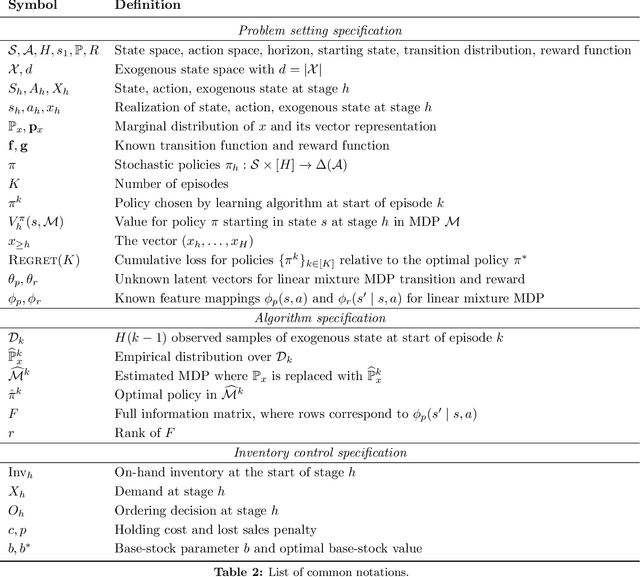
We study a class of structured Markov Decision Processes (MDPs) known as Exo-MDPs, characterized by a partition of the state space into two components. The exogenous states evolve stochastically in a manner not affected by the agent's actions, whereas the endogenous states are affected by the actions, and evolve in a deterministic and known way conditional on the exogenous states. Exo-MDPs are a natural model for various applications including inventory control, finance, power systems, ride sharing, among others. Despite seeming restrictive, this work establishes that any discrete MDP can be represented as an Exo-MDP. Further, Exo-MDPs induce a natural representation of the transition and reward dynamics as linear functions of the exogenous state distribution. This linear representation leads to near-optimal algorithms with regret guarantees scaling only with the (effective) size of the exogenous state space $d$, independent of the sizes of the endogenous state and action spaces. Specifically, when the exogenous state is fully observed, a simple plug-in approach achieves a regret upper bound of $O(H^{3/2}\sqrt{dK})$, where $H$ denotes the horizon and $K$ denotes the total number of episodes. When the exogenous state is unobserved, the linear representation leads to a regret upper bound of $O(H^{3/2}d\sqrt{K})$. We also establish a nearly matching regret lower bound of $\Omega(Hd\sqrt{K})$ for the no observation regime. We complement our theoretical findings with an experimental study on inventory control problems.
Finite-Sample Guarantees for Best-Response Learning Dynamics in Zero-Sum Matrix Games
Jul 29, 2024We study best-response type learning dynamics for two player zero-sum matrix games. We consider two settings that are distinguished by the type of information that each player has about the game and their opponent's strategy. The first setting is the full information case, in which each player knows their own and the opponent's payoff matrices and observes the opponent's mixed strategy. The second setting is the minimal information case, where players do not observe the opponent's strategy and are not aware of either of the payoff matrices (instead they only observe their realized payoffs). For this setting, also known as the radically uncoupled case in the learning in games literature, we study a two-timescale learning dynamics that combine smoothed best-response type updates for strategy estimates with a TD-learning update to estimate a local payoff function. For these dynamics, without additional exploration, we provide polynomial-time finite-sample guarantees for convergence to an $\epsilon$-Nash equilibrium.
Entrywise Inference for Causal Panel Data: A Simple and Instance-Optimal Approach
Jan 24, 2024


In causal inference with panel data under staggered adoption, the goal is to estimate and derive confidence intervals for potential outcomes and treatment effects. We propose a computationally efficient procedure, involving only simple matrix algebra and singular value decomposition. We derive non-asymptotic bounds on the entrywise error, establishing its proximity to a suitably scaled Gaussian variable. Despite its simplicity, our procedure turns out to be instance-optimal, in that our theoretical scaling matches a local instance-wise lower bound derived via a Bayesian Cram\'{e}r-Rao argument. Using our insights, we develop a data-driven procedure for constructing entrywise confidence intervals with pre-specified coverage guarantees. Our analysis is based on a general inferential toolbox for the SVD algorithm applied to the matrix denoising model, which might be of independent interest.
Taming "data-hungry" reinforcement learning? Stability in continuous state-action spaces
Jan 10, 2024We introduce a novel framework for analyzing reinforcement learning (RL) in continuous state-action spaces, and use it to prove fast rates of convergence in both off-line and on-line settings. Our analysis highlights two key stability properties, relating to how changes in value functions and/or policies affect the Bellman operator and occupation measures. We argue that these properties are satisfied in many continuous state-action Markov decision processes, and demonstrate how they arise naturally when using linear function approximation methods. Our analysis offers fresh perspectives on the roles of pessimism and optimism in off-line and on-line RL, and highlights the connection between off-line RL and transfer learning.