 Add to Chrome
 Add to Firefox
 Add to Edge
Corpora deduplication or duplication in Natural Language Processing of few resourced languages ? A case of study: The Mexico's Nahuatl
Apr 08, 2026
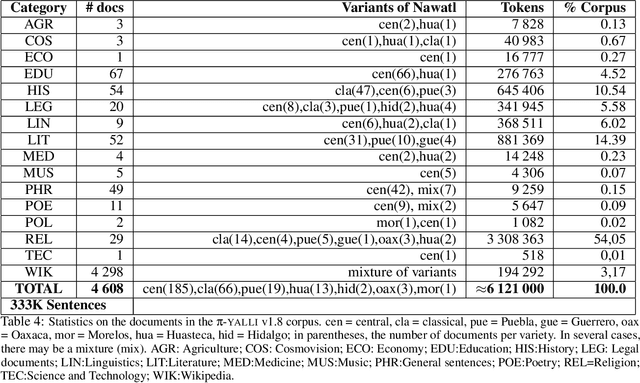
In this article, we seek to answer the following question: could data duplication be useful in Natural Language Processing (NLP) for languages with limited computational resources? In this type of languages (or $π$-languages), corpora available for training Large Language Models are virtually non-existent. In particular, we will study the impact of corpora expansion in Nawatl, an agglutinative and polysynthetic $π$-language spoken by over 2 million people, with a large number of dialectal varieties. The aim is to expand the new $π$-yalli corpus, which contains a limited number of Nawatl texts, by duplicating it in a controlled way. In our experiments, we will use the incremental duplication technique. The aim is to learn embeddings that are well-suited to NLP tasks. Thus, static embeddings were trained and evaluated in a sentence-level semantic similarity task. Our results show a moderate improvement in performance when using incremental duplication compared to the results obtained using only the corpus without expansion. Furthermore, to our knowledge, this technique has not yet been used in the literature.

A First Context-Free Grammar Applied to Nawatl Corpora Augmentation
Oct 06, 2025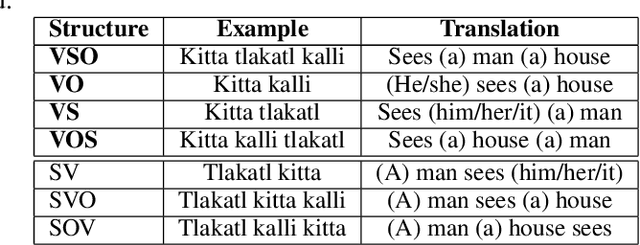
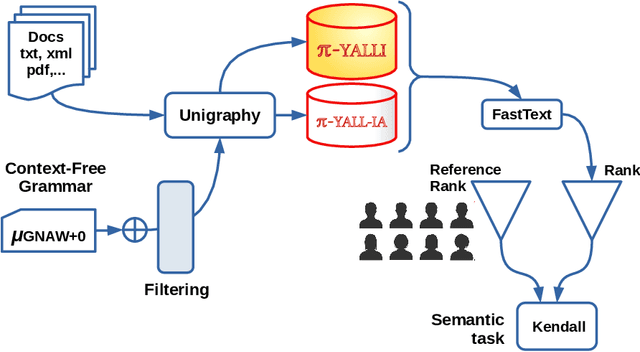

In this article we introduce a context-free grammar (CFG) for the Nawatl language. Nawatl (or Nahuatl) is an Amerindian language of the $\pi$-language type, i.e. a language with few digital resources, in which the corpora available for machine learning are virtually non-existent. The objective here is to generate a significant number of grammatically correct artificial sentences, in order to increase the corpora available for language model training. We want to show that a grammar enables us significantly to expand a corpus in Nawatl which we call $\pi$-\textsc{yalli}. The corpus, thus enriched, enables us to train algorithms such as FastText and to evaluate them on sentence-level semantic tasks. Preliminary results show that by using the grammar, comparative improvements are achieved over some LLMs. However, it is observed that to achieve more significant improvement, grammars that model the Nawatl language even more effectively are required.