 Add to Chrome
 Add to Firefox
 Add to Edge
Classifying several dialectal Nawatl varieties
Jan 05, 2026
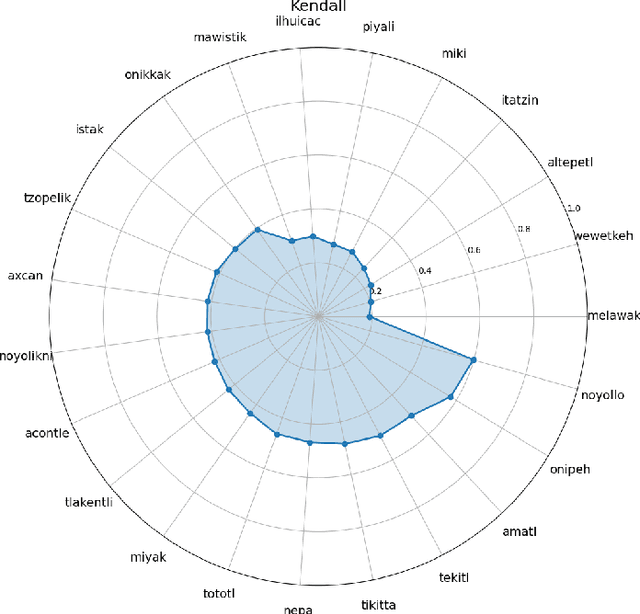
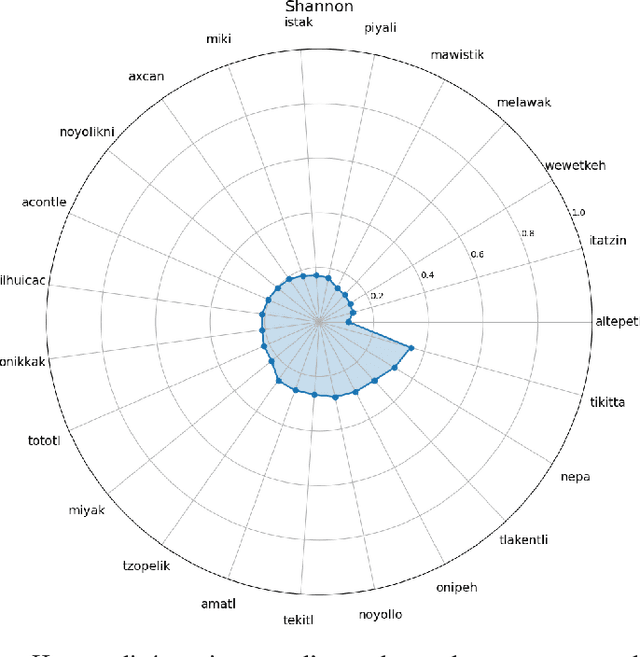
Mexico is a country with a large number of indigenous languages, among which the most widely spoken is Nawatl, with more than two million people currently speaking it (mainly in North and Central America). Despite its rich cultural heritage, which dates back to the 15th century, Nawatl is a language with few computer resources. The problem is compounded when it comes to its dialectal varieties, with approximately 30 varieties recognised, not counting the different spellings in the written forms of the language. In this research work, we addressed the problem of classifying Nawatl varieties using Machine Learning and Neural Networks.

Two CFG Nahuatl for automatic corpora expansion
Dec 16, 2025The aim of this article is to introduce two Context-Free Grammars (CFG) for Nawatl Corpora expansion. Nawatl is an Amerindian language (it is a National Language of Mexico) of the $π$-language type, i.e. a language with few digital resources. For this reason the corpora available for the learning of Large Language Models (LLMs) are virtually non-existent, posing a significant challenge. The goal is to produce a substantial number of syntactically valid artificial Nawatl sentences and thereby to expand the corpora for the purpose of learning non contextual embeddings. For this objective, we introduce two new Nawatl CFGs and use them in generative mode. Using these grammars, it is possible to expand Nawatl corpus significantly and subsequently to use it to learn embeddings and to evaluate their relevance in a sentences semantic similarity task. The results show an improvement compared to the results obtained using only the original corpus without artificial expansion, and also demonstrate that economic embeddings often perform better than some LLMs.
A First Context-Free Grammar Applied to Nawatl Corpora Augmentation
Oct 06, 2025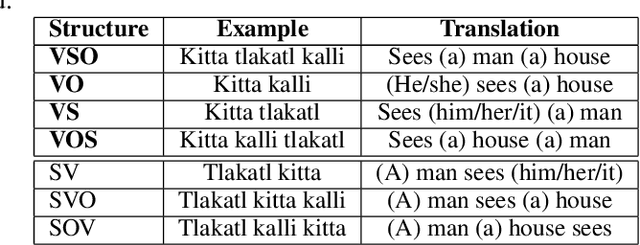
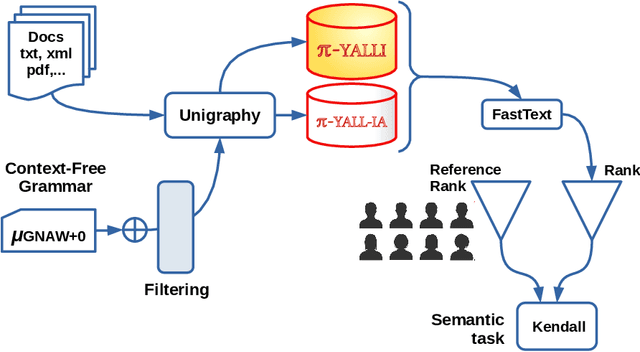

In this article we introduce a context-free grammar (CFG) for the Nawatl language. Nawatl (or Nahuatl) is an Amerindian language of the $\pi$-language type, i.e. a language with few digital resources, in which the corpora available for machine learning are virtually non-existent. The objective here is to generate a significant number of grammatically correct artificial sentences, in order to increase the corpora available for language model training. We want to show that a grammar enables us significantly to expand a corpus in Nawatl which we call $\pi$-\textsc{yalli}. The corpus, thus enriched, enables us to train algorithms such as FastText and to evaluate them on sentence-level semantic tasks. Preliminary results show that by using the grammar, comparative improvements are achieved over some LLMs. However, it is observed that to achieve more significant improvement, grammars that model the Nawatl language even more effectively are required.
$π$-yalli: un nouveau corpus pour le nahuatl
Dec 20, 2024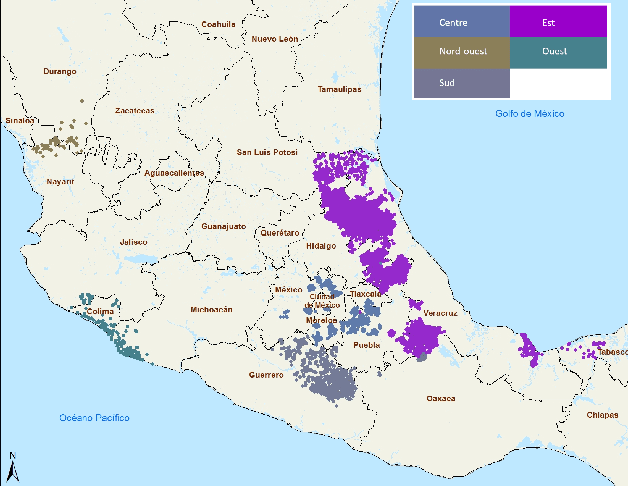
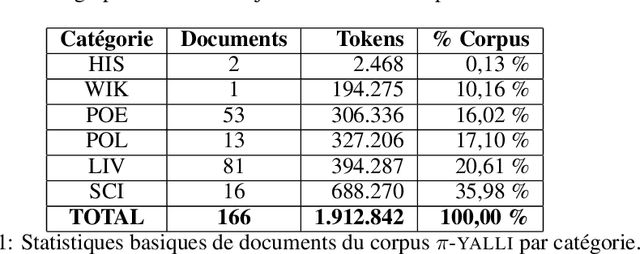
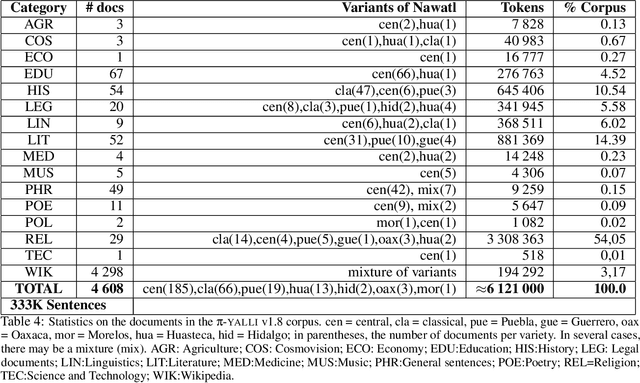
The NAHU$^2$ project is a Franco-Mexican collaboration aimed at building the $\pi$-YALLI corpus adapted to machine learning, which will subsequently be used to develop computer resources for the Nahuatl language. Nahuatl is a language with few computational resources, even though it is a living language spoken by around 2 million people. We have decided to build $\pi$-YALLI, a corpus that will enable to carry out research on Nahuatl in order to develop Language Models (LM), whether dynamic or not, which will make it possible to in turn enable the development of Natural Language Processing (NLP) tools such as: a) a grapheme unifier, b) a word segmenter, c) a POS grammatical analyser, d) a content-based Automatic Text Summarization; and possibly, e) a translator translator (probabilistic or learning-based).