 Add to Chrome
 Add to Firefox
 Add to Edge
ARROW: Augmented Replay for RObust World models
Mar 12, 2026
Continual reinforcement learning challenges agents to acquire new skills while retaining previously learned ones with the goal of improving performance in both past and future tasks. Most existing approaches rely on model-free methods with replay buffers to mitigate catastrophic forgetting; however, these solutions often face significant scalability challenges due to large memory demands. Drawing inspiration from neuroscience, where the brain replays experiences to a predictive World Model rather than directly to the policy, we present ARROW (Augmented Replay for RObust World models), a model-based continual RL algorithm that extends DreamerV3 with a memory-efficient, distribution-matching replay buffer. Unlike standard fixed-size FIFO buffers, ARROW maintains two complementary buffers: a short-term buffer for recent experiences and a long-term buffer that preserves task diversity through intelligent sampling. We evaluate ARROW on two challenging continual RL settings: Tasks without shared structure (Atari), and tasks with shared structure, where knowledge transfer is possible (Procgen CoinRun variants). Compared to model-free and model-based baselines with replay buffers of the same-size, ARROW demonstrates substantially less forgetting on tasks without shared structure, while maintaining comparable forward transfer. Our findings highlight the potential of model-based RL and bio-inspired approaches for continual reinforcement learning, warranting further research.

Augmenting Replay in World Models for Continual Reinforcement Learning
Jan 30, 2024

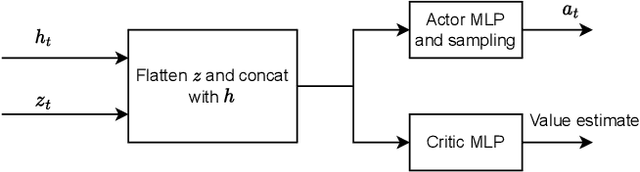

In continual RL, the environment of a reinforcement learning (RL) agent undergoes change. A successful system should appropriately balance the conflicting requirements of retaining agent performance on already learned tasks, stability, whilst learning new tasks, plasticity. The first-in-first-out buffer is commonly used to enhance learning in such settings but requires significant memory. We explore the application of an augmentation to this buffer which alleviates the memory constraints, and use it with a world model model-based reinforcement learning algorithm, to evaluate its effectiveness in facilitating continual learning. We evaluate the effectiveness of our method in Procgen and Atari RL benchmarks and show that the distribution matching augmentation to the replay-buffer used in the context of latent world models can successfully prevent catastrophic forgetting with significantly reduced computational overhead. Yet, we also find such a solution to not be entirely infallible, and other failure modes such as the opposite -- lacking plasticity and being unable to learn a new task -- to be a potential limitation in continual learning systems.