 Add to Chrome
 Add to Firefox
 Add to Edge
SPECTRA: Band-Routed Embedding and Stage-Wise LoRA for Cross-Sensor Fine-Tuning of Geospatial Foundation Models
Aug 03, 2026
Geospatial foundation models (GeoFMs), pretrained on large-scale geospatial data such as Earth observation (EO), climate, and weather data, have shown promising performance when fine-tuned on diverse downstream tasks. However, there are two challenges of adapting EO-pretrained GeoFMs to practical downstream datasets. The first challenge is how to handle spectral mismatch: pretrained patch embeddings expect a fixed set of input bands, whereas downstream sensors may provide different channels. The second challenge is how to reduce fine-tuning cost and make it efficient. While existing work has made efforts on these challenges individually, jointly improving fine-tuning performance under spectral mismatch while reducing adaptation cost remains underexplored. We propose SPECTRA, a parameter-efficient fine-tuning framework that addresses both spectral mismatch and adaptation cost. To handle spectral mismatch, SPECTRA introduces Band-Routed Embedding (BRE), which maps all available downstream bands into the band space expected by the pretrained GeoFM. By using BRE, all available bands in the downstream dataset are utilized to improve the selected-band input without changing the pretrained patch embedding interface. To reduce adaptation cost, SPECTRA further introduces a Stage-wise Transferability-aware LoRA (ST-LoRA) fine-tuning. ST-LoRA estimates stage-wise transferability before fine-tuning and assigns stage-specific LoRA ranks, concentrating trainable parameters on the stages with high transferability for the target task. Across three EO-pretrained GeoFMs and four downstream segmentation datasets, experiments show that BRE improves performance by utilizing all spectral bands, while ST-LoRA reduces trainable parameters compared with full fine-tuning and standard LoRA. Code is available at https://github.com/big-data-lab-umbc/SPECTRA.

Extrapolation of Periodic Functions Using Binary Encoding of Continuous Numerical Values
Dec 11, 2025We report the discovery that binary encoding allows neural networks to extrapolate periodic functions beyond their training bounds. We introduce Normalized Base-2 Encoding (NB2E) as a method for encoding continuous numerical values and demonstrate that, using this input encoding, vanilla multi-layer perceptrons (MLP) successfully extrapolate diverse periodic signals without prior knowledge of their functional form. Internal activation analysis reveals that NB2E induces bit-phase representations, enabling MLPs to learn and extrapolate signal structure independently of position.
SatVision-TOA: A Geospatial Foundation Model for Coarse-Resolution All-Sky Remote Sensing Imagery
Nov 26, 2024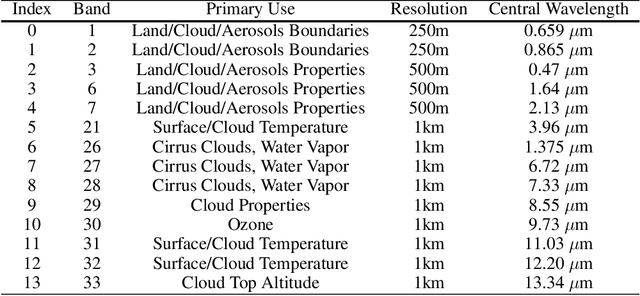
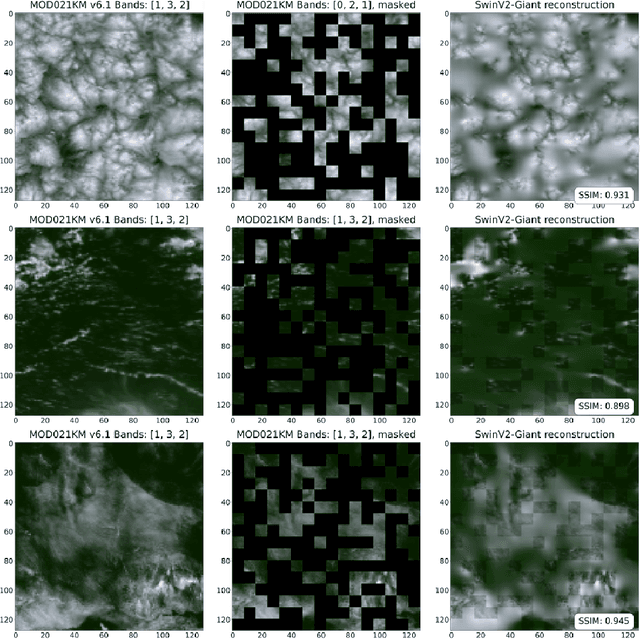

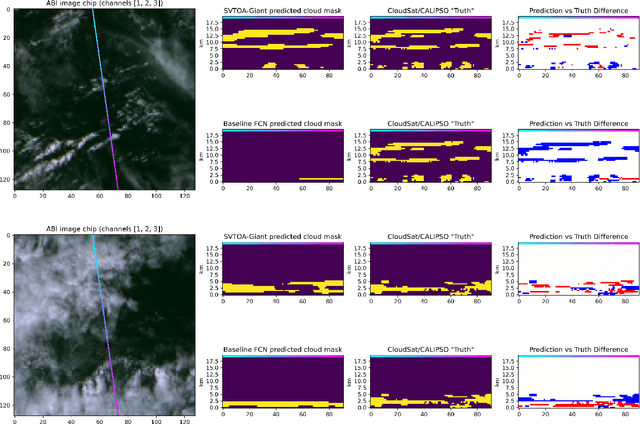
Foundation models have the potential to transform the landscape of remote sensing (RS) data analysis by enabling large computer vision models to be pre-trained on vast amounts of remote sensing data. These models can then be fine-tuned with small amounts of labeled training and applied to a variety of applications. Most existing foundation models are designed for high spatial resolution, cloud-free satellite imagery or photos, limiting their applicability in scenarios that require frequent temporal monitoring or broad spectral profiles. As a result, foundation models trained solely on cloud-free images have limited utility for applications that involve atmospheric variables or require atmospheric corrections. We introduce SatVision-TOA, a novel foundation model pre-trained on 14-band MODIS L1B Top-Of-Atmosphere (TOA) radiance imagery, addressing the need for models pre-trained to handle moderate- and coarse-resolution all-sky remote sensing data. The SatVision-TOA model is pre-trained using a Masked-Image-Modeling (MIM) framework and the SwinV2 architecture, and learns detailed contextual representations through self-supervised learning without the need for labels. It is a 3 billion parameter model that is trained on 100 million images. To our knowledge this is the largest foundation model trained solely on satellite RS imagery. Results show that SatVision-TOA achieves superior performance over baseline methods on downstream tasks such as 3D cloud retrieval. Notably, the model achieves a mean intersection over union (mIOU) of 0.46, a substantial improvement over the baseline mIOU of 0.22. Additionally, the rate of false negative results in the fine-tuning task were reduced by over 50% compared to the baseline. Our work advances pre-trained vision modeling for multispectral RS by learning from a variety of atmospheric and aerosol conditions to improve cloud and land surface monitoring.