 Add to Chrome
 Add to Firefox
 Add to Edge
A Theory for Locus Ellipticity of Poncelet 3-Periodic Centers
Jun 08, 2021
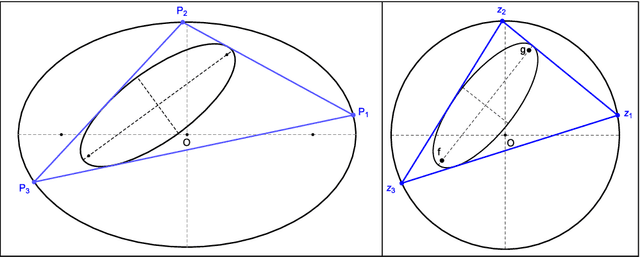
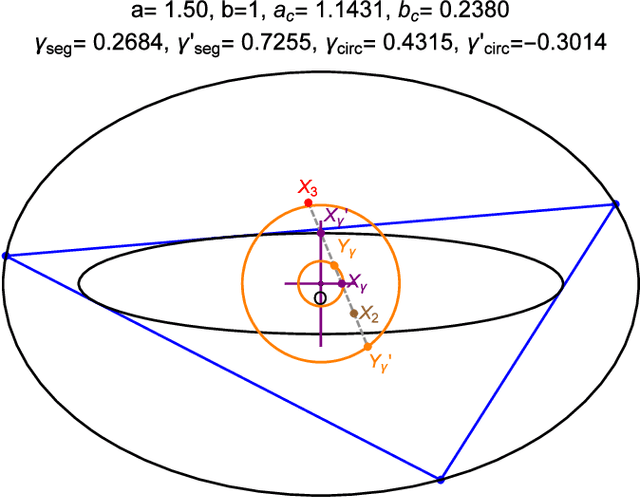
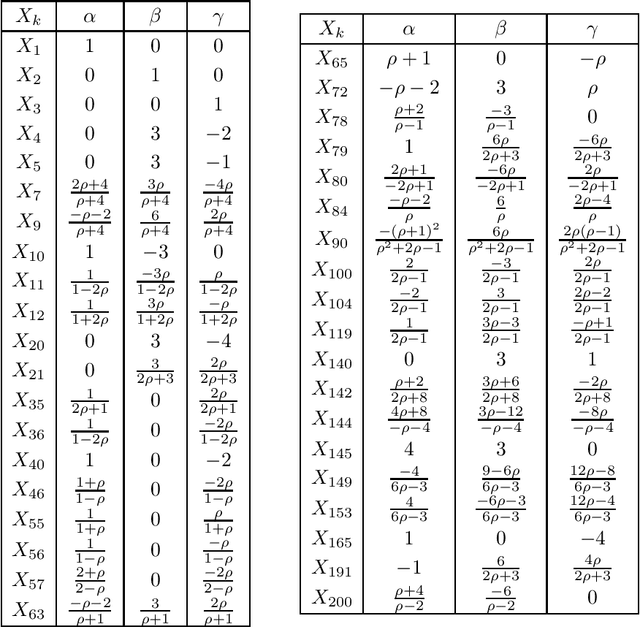
We propose a theory which predicts the ellipticity of a triangle center's locus over a Poncelet 3-periodic family. We show that if the triangle center can be expressed as a fixed affine combination of barycenter, circumcenter, and a third, stationary point over some family, then its locus will be an ellipse. Taking billiard 3-periodics as an example, the third point is the mittenpunkt. We derive conditions under which a locus degenerates to a segment or is a circle. We show a locus turning number is either plus or minus 3 and predict its movement monotonicity with respect to vertices of the 3-periodic family. Finally, we derive a (long) expression for the loci of the incenter and excenters over a generic Poncelet 3-periodic family, showing they are roots of a quartic. We conjecture (i) those loci are convex, and (ii) that they can only be ellipses if the pair is confocal, i.e., within a 1d subspace of the 5d space of ellipse pairs which admit 3-periodics.

Invariant Center Power and Elliptic Loci of Poncelet Triangles
Feb 21, 2021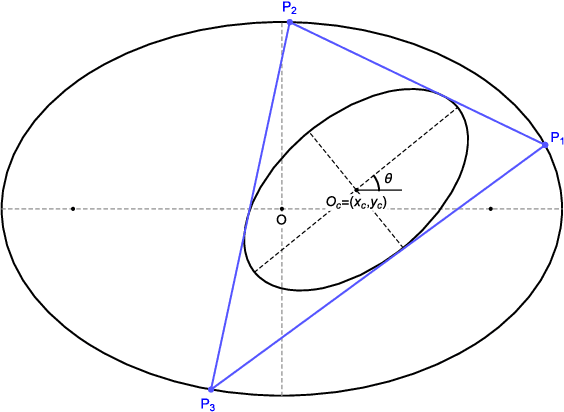
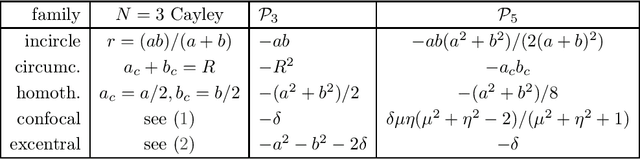
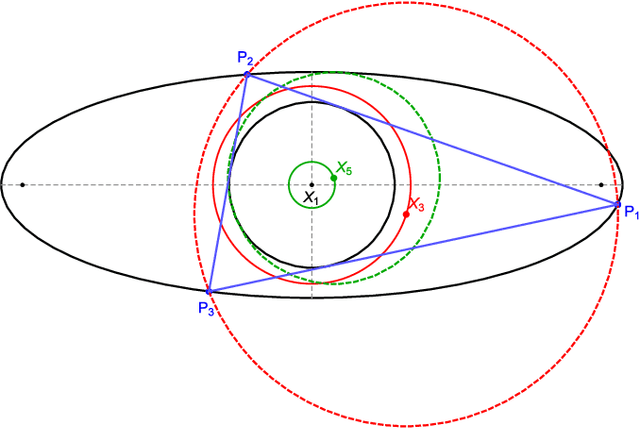
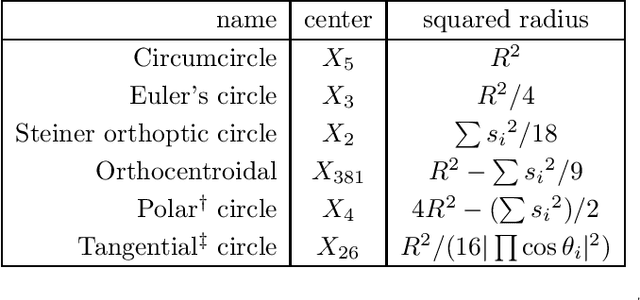
We study center power with respect to circles derived from Poncelet 3-periodics (triangles) in a generic pair of ellipses as well as loci of their triangle centers. We show that (i) for any concentric pair, the power of the center with respect to either circumcircle or Euler's circle is invariant, and (ii) if a triangle center of a 3-periodic in a generic nested pair is a fixed linear combination of barycenter and circumcenter, its locus over the family is an ellipse.
Loci and Envelopes of Ellipse-Inscribed Triangles
Oct 20, 2020



We study a family of ellipse-inscribed triangles with two vertices V1,V2 fixed on the ellipse boundary while a third one which sweeps it. We prove that: (i) if a triangle center is a fixed linear combination of barycenter and orthocenter, its locus over the family is an ellipse; (ii) over the 1d family of said linear combinations, loci centers sweep a line; (iii) over the family of parallel V1V2, said elliptic loci are rigidly-translating ellipses. Additionally, we study the external envelope of elliptic loci for fixed V1 and over all V2 on the ellipse. We show that (iv) the area of said envelope is invariant with respect to V1, and that (v) for the barycenter (resp. orthocenter), the envelope is an ellipse (resp. an affine image of Pascal's Lima\c{c}on).