 Add to Chrome
 Add to Firefox
 Add to Edge
Privacy-Aware Document Visual Question Answering
Dec 15, 2023


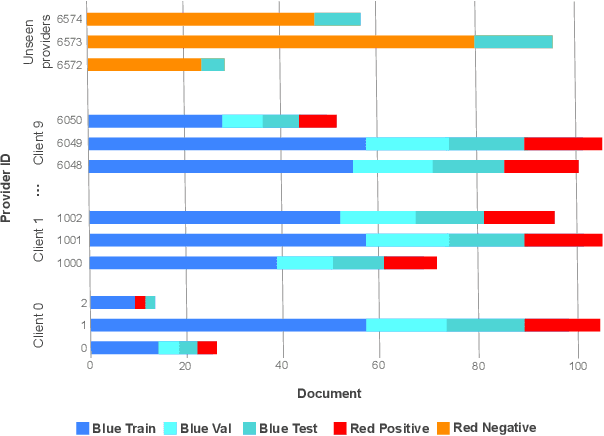
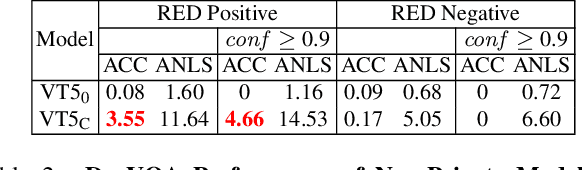
Document Visual Question Answering (DocVQA) is a fast growing branch of document understanding. Despite the fact that documents contain sensitive or copyrighted information, none of the current DocVQA methods offers strong privacy guarantees. In this work, we explore privacy in the domain of DocVQA for the first time. We highlight privacy issues in state of the art multi-modal LLM models used for DocVQA, and explore possible solutions. Specifically, we focus on the invoice processing use case as a realistic, widely used scenario for document understanding, and propose a large scale DocVQA dataset comprising invoice documents and associated questions and answers. We employ a federated learning scheme, that reflects the real-life distribution of documents in different businesses, and we explore the use case where the ID of the invoice issuer is the sensitive information to be protected. We demonstrate that non-private models tend to memorise, behaviour that can lead to exposing private information. We then evaluate baseline training schemes employing federated learning and differential privacy in this multi-modal scenario, where the sensitive information might be exposed through any of the two input modalities: vision (document image) or language (OCR tokens). Finally, we design an attack exploiting the memorisation effect of the model, and demonstrate its effectiveness in probing different DocVQA models.

SecurityNet: Assessing Machine Learning Vulnerabilities on Public Models
Oct 19, 2023While advanced machine learning (ML) models are deployed in numerous real-world applications, previous works demonstrate these models have security and privacy vulnerabilities. Various empirical research has been done in this field. However, most of the experiments are performed on target ML models trained by the security researchers themselves. Due to the high computational resource requirement for training advanced models with complex architectures, researchers generally choose to train a few target models using relatively simple architectures on typical experiment datasets. We argue that to understand ML models' vulnerabilities comprehensively, experiments should be performed on a large set of models trained with various purposes (not just the purpose of evaluating ML attacks and defenses). To this end, we propose using publicly available models with weights from the Internet (public models) for evaluating attacks and defenses on ML models. We establish a database, namely SecurityNet, containing 910 annotated image classification models. We then analyze the effectiveness of several representative attacks/defenses, including model stealing attacks, membership inference attacks, and backdoor detection on these public models. Our evaluation empirically shows the performance of these attacks/defenses can vary significantly on public models compared to self-trained models. We share SecurityNet with the research community. and advocate researchers to perform experiments on public models to better demonstrate their proposed methods' effectiveness in the future.
Going Beyond Familiar Features for Deep Anomaly Detection
Oct 01, 2023Anomaly Detection (AD) is a critical task that involves identifying observations that do not conform to a learned model of normality. Prior work in deep AD is predominantly based on a familiarity hypothesis, where familiar features serve as the reference in a pre-trained embedding space. While this strategy has proven highly successful, it turns out that it causes consistent false negatives when anomalies consist of truly novel features that are not well captured by the pre-trained encoding. We propose a novel approach to AD using explainability to capture novel features as unexplained observations in the input space. We achieve strong performance across a wide range of anomaly benchmarks by combining similarity and novelty in a hybrid approach. Our approach establishes a new state-of-the-art across multiple benchmarks, handling diverse anomaly types while eliminating the need for expensive background models and dense matching. In particular, we show that by taking account of novel features, we reduce false negative anomalies by up to 40% on challenging benchmarks compared to the state-of-the-art. Our method gives visually inspectable explanations for pixel-level anomalies.
LLM-Deliberation: Evaluating LLMs with Interactive Multi-Agent Negotiation Games
Sep 29, 2023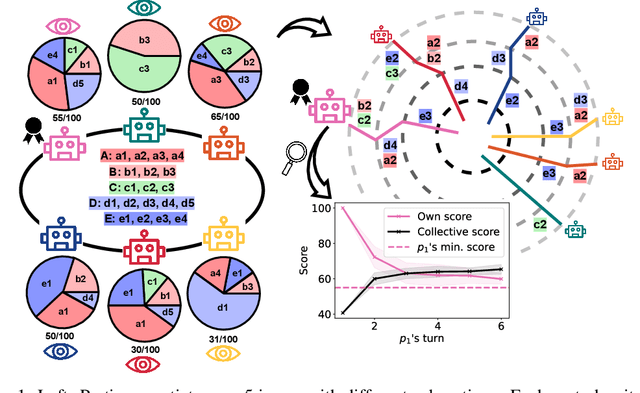
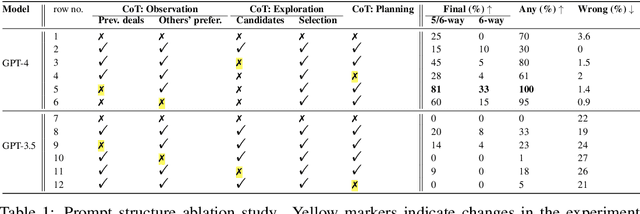
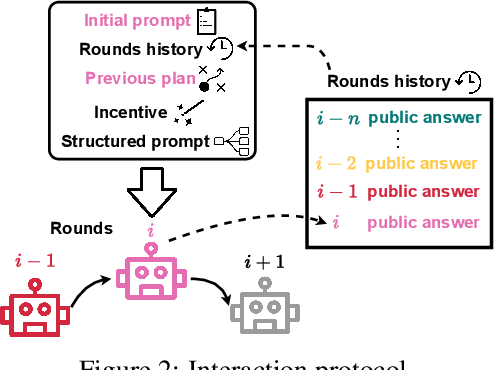
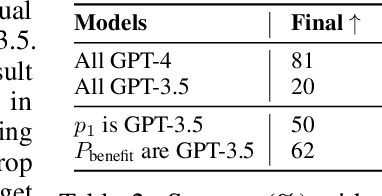
There is a growing interest in using Large Language Models (LLMs) as agents to tackle real-world tasks that may require assessing complex situations. Yet, we have a limited understanding of LLMs' reasoning and decision-making capabilities, partly stemming from a lack of dedicated evaluation benchmarks. As negotiating and compromising are key aspects of our everyday communication and collaboration, we propose using scorable negotiation games as a new evaluation framework for LLMs. We create a testbed of diverse text-based, multi-agent, multi-issue, semantically rich negotiation games, with easily tunable difficulty. To solve the challenge, agents need to have strong arithmetic, inference, exploration, and planning capabilities, while seamlessly integrating them. Via a systematic zero-shot Chain-of-Thought prompting (CoT), we show that agents can negotiate and consistently reach successful deals. We quantify the performance with multiple metrics and observe a large gap between GPT-4 and earlier models. Importantly, we test the generalization to new games and setups. Finally, we show that these games can help evaluate other critical aspects, such as the interaction dynamics between agents in the presence of greedy and adversarial players.
A Unified View of Differentially Private Deep Generative Modeling
Sep 27, 2023
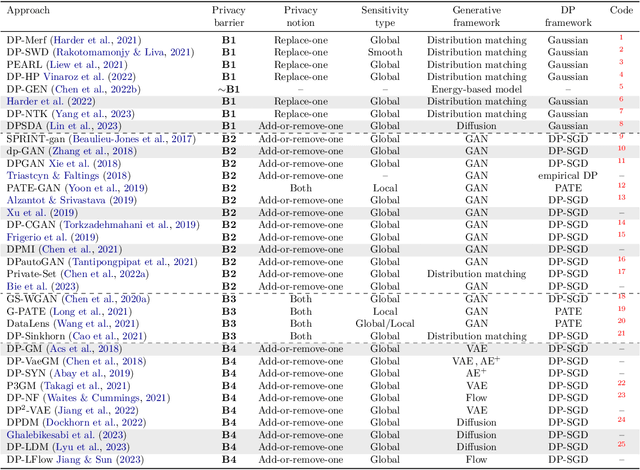


The availability of rich and vast data sources has greatly advanced machine learning applications in various domains. However, data with privacy concerns comes with stringent regulations that frequently prohibited data access and data sharing. Overcoming these obstacles in compliance with privacy considerations is key for technological progress in many real-world application scenarios that involve privacy sensitive data. Differentially private (DP) data publishing provides a compelling solution, where only a sanitized form of the data is publicly released, enabling privacy-preserving downstream analysis and reproducible research in sensitive domains. In recent years, various approaches have been proposed for achieving privacy-preserving high-dimensional data generation by private training on top of deep neural networks. In this paper, we present a novel unified view that systematizes these approaches. Our view provides a joint design space for systematically deriving methods that cater to different use cases. We then discuss the strengths, limitations, and inherent correlations between different approaches, aiming to shed light on crucial aspects and inspire future research. We conclude by presenting potential paths forward for the field of DP data generation, with the aim of steering the community toward making the next important steps in advancing privacy-preserving learning.
Certified Robust Models with Slack Control and Large Lipschitz Constants
Sep 12, 2023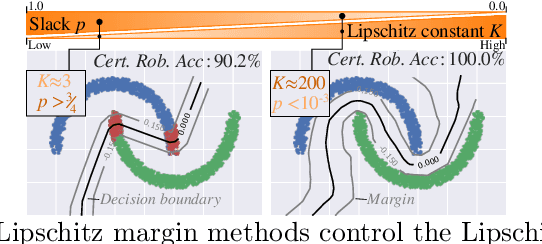
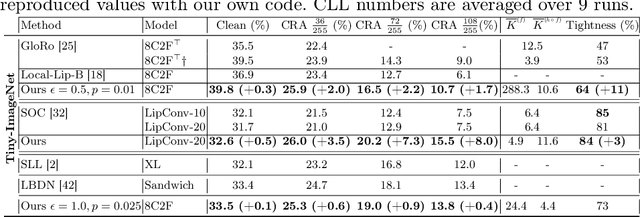
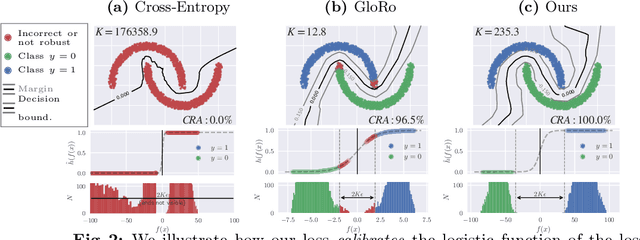
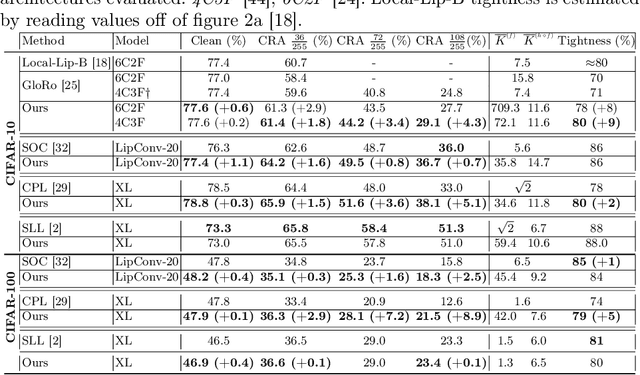
Despite recent success, state-of-the-art learning-based models remain highly vulnerable to input changes such as adversarial examples. In order to obtain certifiable robustness against such perturbations, recent work considers Lipschitz-based regularizers or constraints while at the same time increasing prediction margin. Unfortunately, this comes at the cost of significantly decreased accuracy. In this paper, we propose a Calibrated Lipschitz-Margin Loss (CLL) that addresses this issue and improves certified robustness by tackling two problems: Firstly, commonly used margin losses do not adjust the penalties to the shrinking output distribution; caused by minimizing the Lipschitz constant $K$. Secondly, and most importantly, we observe that minimization of $K$ can lead to overly smooth decision functions. This limits the model's complexity and thus reduces accuracy. Our CLL addresses these issues by explicitly calibrating the loss w.r.t. margin and Lipschitz constant, thereby establishing full control over slack and improving robustness certificates even with larger Lipschitz constants. On CIFAR-10, CIFAR-100 and Tiny-ImageNet, our models consistently outperform losses that leave the constant unattended. On CIFAR-100 and Tiny-ImageNet, CLL improves upon state-of-the-art deterministic $L_2$ robust accuracies. In contrast to current trends, we unlock potential of much smaller models without $K=1$ constraints.
MargCTGAN: A "Marginally'' Better CTGAN for the Low Sample Regime
Jul 16, 2023The potential of realistic and useful synthetic data is significant. However, current evaluation methods for synthetic tabular data generation predominantly focus on downstream task usefulness, often neglecting the importance of statistical properties. This oversight becomes particularly prominent in low sample scenarios, accompanied by a swift deterioration of these statistical measures. In this paper, we address this issue by conducting an evaluation of three state-of-the-art synthetic tabular data generators based on their marginal distribution, column-pair correlation, joint distribution and downstream task utility performance across high to low sample regimes. The popular CTGAN model shows strong utility, but underperforms in low sample settings in terms of utility. To overcome this limitation, we propose MargCTGAN that adds feature matching of de-correlated marginals, which results in a consistent improvement in downstream utility as well as statistical properties of the synthetic data.
B-cos Alignment for Inherently Interpretable CNNs and Vision Transformers
Jun 19, 2023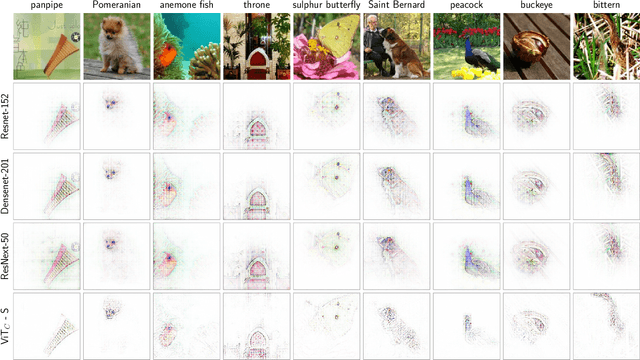
We present a new direction for increasing the interpretability of deep neural networks (DNNs) by promoting weight-input alignment during training. For this, we propose to replace the linear transformations in DNNs by our novel B-cos transformation. As we show, a sequence (network) of such transformations induces a single linear transformation that faithfully summarises the full model computations. Moreover, the B-cos transformation is designed such that the weights align with relevant signals during optimisation. As a result, those induced linear transformations become highly interpretable and highlight task-relevant features. Importantly, the B-cos transformation is designed to be compatible with existing architectures and we show that it can easily be integrated into virtually all of the latest state of the art models for computer vision - e.g. ResNets, DenseNets, ConvNext models, as well as Vision Transformers - by combining the B-cos-based explanations with normalisation and attention layers, all whilst maintaining similar accuracy on ImageNet. Finally, we show that the resulting explanations are of high visual quality and perform well under quantitative interpretability metrics.
Client-specific Property Inference against Secure Aggregation in Federated Learning
Mar 07, 2023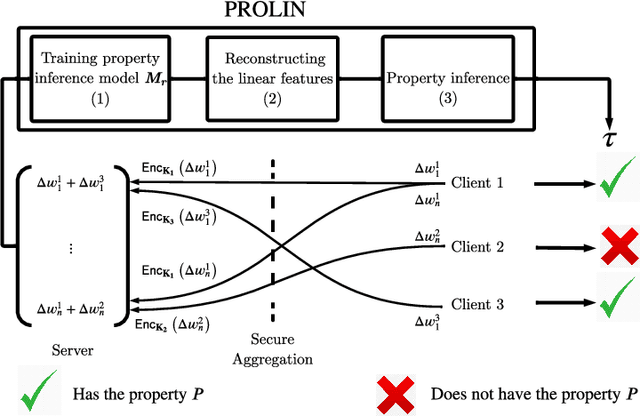
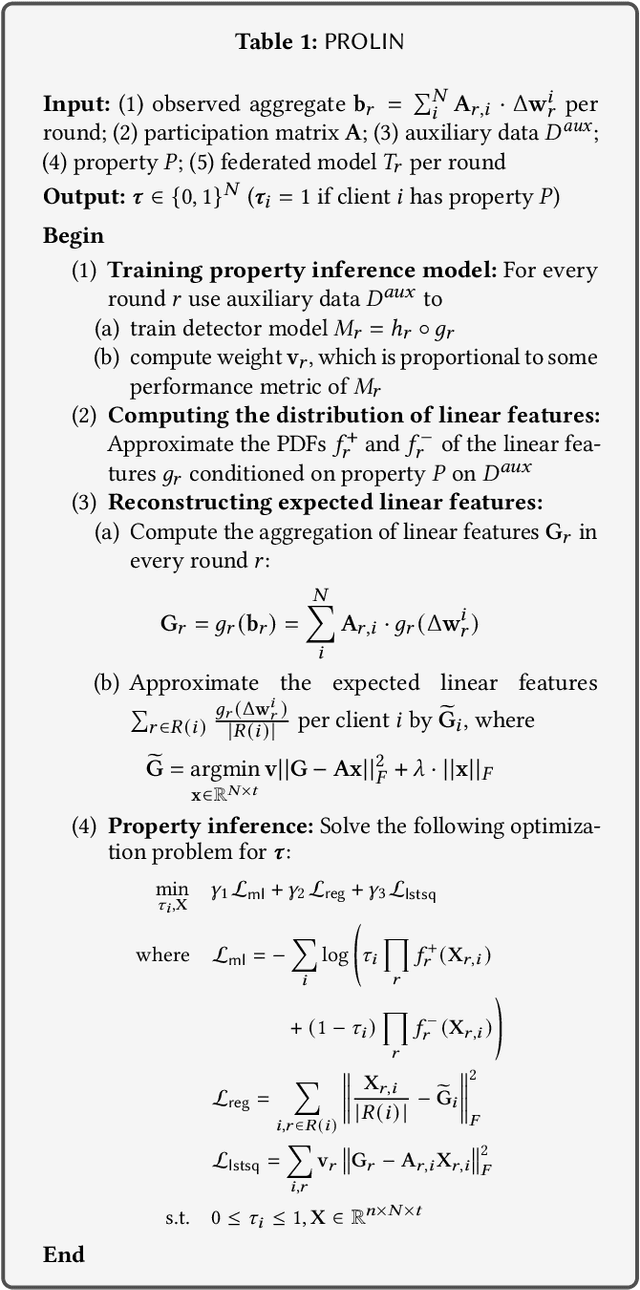
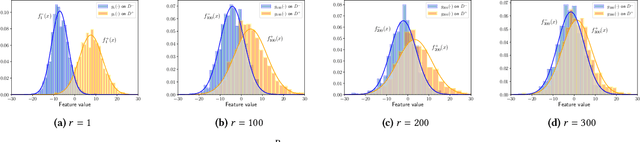
Federated learning has become a widely used paradigm for collaboratively training a common model among different participants with the help of a central server that coordinates the training. Although only the model parameters or other model updates are exchanged during the federated training instead of the participant's data, many attacks have shown that it is still possible to infer sensitive information such as membership, property, or outright reconstruction of participant data. Although differential privacy is considered an effective solution to protect against privacy attacks, it is also criticized for its negative effect on utility. Another possible defense is to use secure aggregation which allows the server to only access the aggregated update instead of each individual one, and it is often more appealing because it does not degrade model quality. However, combining only the aggregated updates, which are generated by a different composition of clients in every round, may still allow the inference of some client-specific information. In this paper, we show that simple linear models can effectively capture client-specific properties only from the aggregated model updates due to the linearity of aggregation. We formulate an optimization problem across different rounds in order to infer a tested property of every client from the output of the linear models, for example, whether they have a specific sample in their training data (membership inference) or whether they misbehave and attempt to degrade the performance of the common model by poisoning attacks. Our reconstruction technique is completely passive and undetectable. We demonstrate the efficacy of our approach on several scenarios which shows that secure aggregation provides very limited privacy guarantees in practice. The source code will be released upon publication.
More than you've asked for: A Comprehensive Analysis of Novel Prompt Injection Threats to Application-Integrated Large Language Models
Feb 23, 2023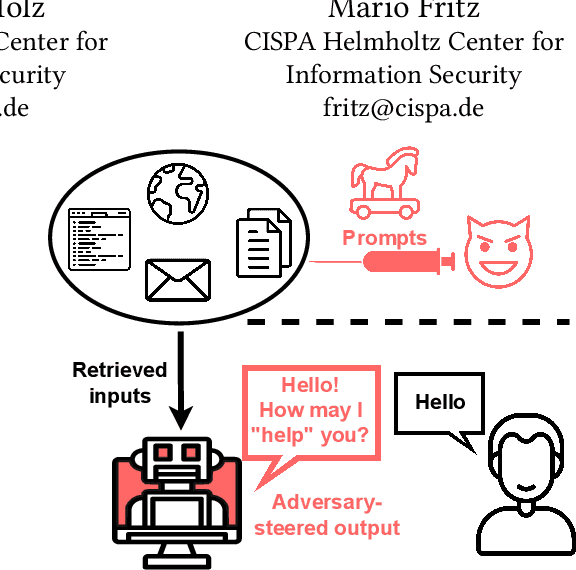
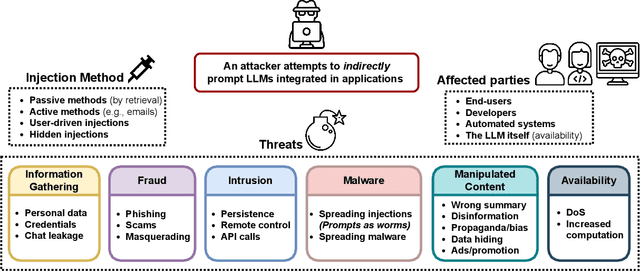
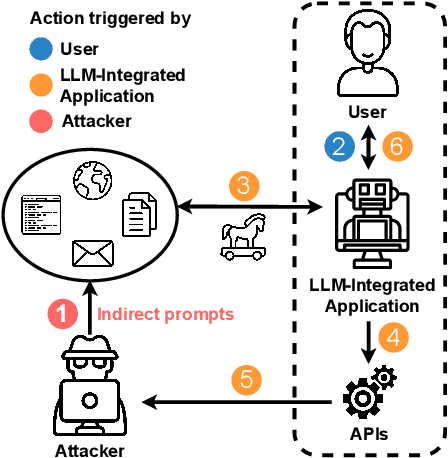
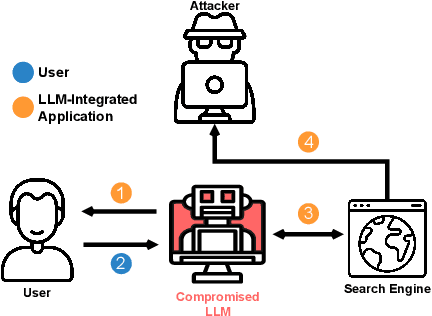
We are currently witnessing dramatic advances in the capabilities of Large Language Models (LLMs). They are already being adopted in practice and integrated into many systems, including integrated development environments (IDEs) and search engines. The functionalities of current LLMs can be modulated via natural language prompts, while their exact internal functionality remains implicit and unassessable. This property, which makes them adaptable to even unseen tasks, might also make them susceptible to targeted adversarial prompting. Recently, several ways to misalign LLMs using Prompt Injection (PI) attacks have been introduced. In such attacks, an adversary can prompt the LLM to produce malicious content or override the original instructions and the employed filtering schemes. Recent work showed that these attacks are hard to mitigate, as state-of-the-art LLMs are instruction-following. So far, these attacks assumed that the adversary is directly prompting the LLM. In this work, we show that augmenting LLMs with retrieval and API calling capabilities (so-called Application-Integrated LLMs) induces a whole new set of attack vectors. These LLMs might process poisoned content retrieved from the Web that contains malicious prompts pre-injected and selected by adversaries. We demonstrate that an attacker can indirectly perform such PI attacks. Based on this key insight, we systematically analyze the resulting threat landscape of Application-Integrated LLMs and discuss a variety of new attack vectors. To demonstrate the practical viability of our attacks, we implemented specific demonstrations of the proposed attacks within synthetic applications. In summary, our work calls for an urgent evaluation of current mitigation techniques and an investigation of whether new techniques are needed to defend LLMs against these threats.