 Add to Chrome
 Add to Firefox
 Add to Edge
Point Cloud Upsampling through Patch-based Frequency Superposition
Jun 12, 2026
In recent years, neural networks have become the dominant models in most point cloud upsampling methods. Although these approaches are achieving good results, they do have drawbacks, such as a lack of interpretability and data dependency. Moreover, they have to be trained on a dataset that is similar to the test data in order to perform well. To avoid these disadvantages, we propose Point Cloud Upsampling through Patch-based Frequency Superposition (PUtPFS), an optimization-based approach that selects subsets of points and estimates the surface of this set through superpositioning spatial frequencies. Then, new points are placed on this surface. By successively selecting points in the least dense regions of the point cloud, a uniform upsampling can be reached. With this method, we surpass the current best upsampling results in the commonly considered point-to-surface distance. Furthermore, we achieve the best Chamfer and Hausdorff distance among the optimization-based approaches. As an additional advantage, our method does not need any training data and is mathematically interpretable.

I2PRef: Image-Driven Point Completion with Iterative Refinement
May 26, 2026We present an image-conditioned point cloud completion approach that treats images as the primary geometric source rather than a secondary guide. To this end, we introduce an Image-to-Point (I2P) module that can reconstruct complete point clouds directly from a single RGB image, with no need for 3D inputs. Additionally, we introduce a transformer-based Point-to-Point (P2P) refinement module that uses self- and cross-attention between point tokens and image features to iteratively refine the coarse I2P output. The I2P module enables the image encoder to learn rich geometric representations, while the P2P module progressively recovers fine-grained details. Unlike existing multimodal methods that rely on auxiliary losses or fusion modules, our explicit I2P task provides a strong, geometry-aware prior based on images alone. Extensive experiments on ShapeNet-ViPC demonstrate state-of-the-art completion performance with a 12.3% relative Chamfer Distance improvement over prior methods. Code is available at: https://github.com/AzharSindhi/I2PRef.git
Improved Motion Plane Adaptive 360-Degree Video Compression Using Affine Motion Models
Mar 29, 2025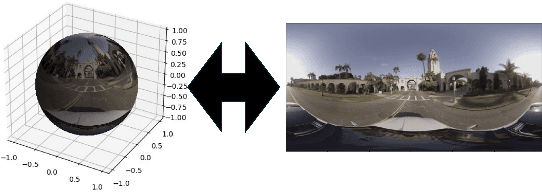
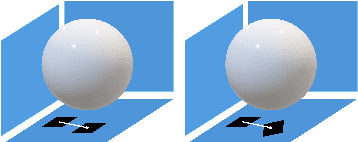
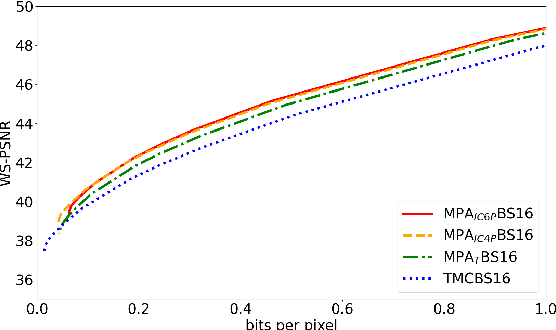
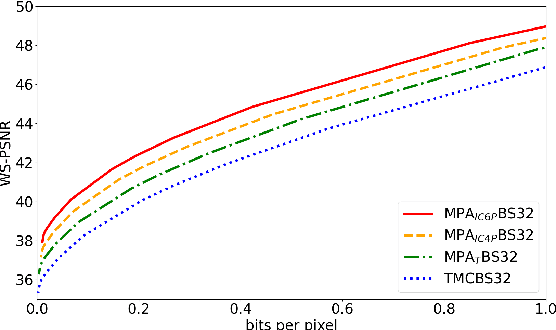
Efficient compression of 360-degree video content requires the application of advanced motion models for interframe prediction. The Motion Plane Adaptive (MPA) motion model projects the frames on multiple perspective planes in the 3D space. It improves the motion compensation by estimating the motion on those planes with a translational diamond search. In this work, we enhance this motion model with an affine parameterization and motion estimation method. Thereby, we find a feasible trade-off between the quality of the reconstructed frames and the computational cost. The affine motion estimation is hereby done with the inverse compositional Lucas-Kanade algorithm. With the proposed method, it is possible to improve the motion compensation significantly, so that the motion compensated frame has a Weighted-to-Spherically-uniform Peak Signal-to-Noise Ratio (WS-PSNR) which is about 1.6 dB higher than with the conventional MPA. In a basic video codec, the improved inter prediction can lead to Bj{\o}ntegaard Delta (BD) rate savings between 9 % and 35 % depending on the block size (BS) and number of motion parameters.