 Add to Chrome
 Add to Firefox
 Add to Edge
Backdoor Directions in Vision Transformers
Mar 11, 2026
This paper investigates how Backdoor Attacks are represented within Vision Transformers (ViTs). By assuming knowledge of the trigger, we identify a specific ``trigger direction'' in the model's activations that corresponds to the internal representation of the trigger. We confirm the causal role of this linear direction by showing that interventions in both activation and parameter space consistently modulate the model's backdoor behavior across multiple datasets and attack types. Using this direction as a diagnostic tool, we trace how backdoor features are processed across layers. Our analysis reveals distinct qualitative differences: static-patch triggers follow a different internal logic than stealthy, distributed triggers. We further examine the link between backdoors and adversarial attacks, specifically testing whether PGD-based perturbations (de-)activate the identified trigger mechanism. Finally, we propose a data-free, weight-based detection scheme for stealthy-trigger attacks. Our findings show that mechanistic interpretability offers a robust framework for diagnosing and addressing security vulnerabilities in computer vision.

BlindSage: Label Inference Attacks against Node-level Vertical Federated Graph Neural Networks
Aug 04, 2023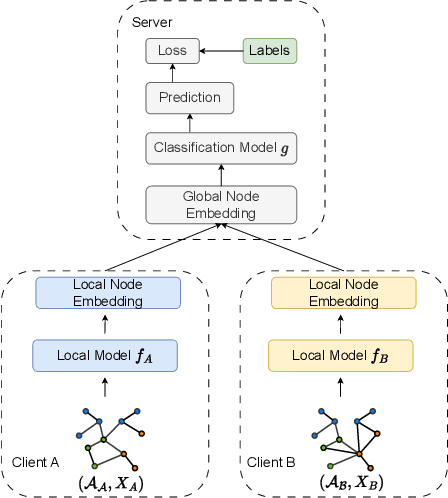


Federated learning enables collaborative training of machine learning models by keeping the raw data of the involved workers private. One of its main objectives is to improve the models' privacy, security, and scalability. Vertical Federated Learning (VFL) offers an efficient cross-silo setting where a few parties collaboratively train a model without sharing the same features. In such a scenario, classification labels are commonly considered sensitive information held exclusively by one (active) party, while other (passive) parties use only their local information. Recent works have uncovered important flaws of VFL, leading to possible label inference attacks under the assumption that the attacker has some, even limited, background knowledge on the relation between labels and data. In this work, we are the first (to the best of our knowledge) to investigate label inference attacks on VFL using a zero-background knowledge strategy. To concretely formulate our proposal, we focus on Graph Neural Networks (GNNs) as a target model for the underlying VFL. In particular, we refer to node classification tasks, which are widely studied, and GNNs have shown promising results. Our proposed attack, BlindSage, provides impressive results in the experiments, achieving nearly 100% accuracy in most cases. Even when the attacker has no information about the used architecture or the number of classes, the accuracy remained above 85% in most instances. Finally, we observe that well-known defenses cannot mitigate our attack without affecting the model's performance on the main classification task.