 Add to Chrome
 Add to Firefox
 Add to Edge
The Forward-Backward Disconnect: State Dynamics, Credit Assignment, and Biological Grounding in Neural Computation
Aug 20, 2026
A recurring pattern in neural computation is the reintroduction of dynamical and biological structure into models originally simplified for scalable optimization. Early feedforward networks reduced biological neurons to threshold or rate-like summation units, an abstraction compatible with global-gradient training at scale. Since then, forward computation has diversified: modern architectures carry recurrent state, retrieve from long contexts through attention and associative memory, compress histories through structured state-space dynamics, evolve in continuous time, settle to implicit equilibria, and communicate through sparse spikes. Training has diversified less. Scalable learning remains concentrated around backpropagation, backpropagation through time, adjoint methods, implicit differentiation, and surrogate-gradient variants. We call this asymmetry the forward-backward disconnect and develop a taxonomy spanning neural model families along three coupled axes: state-dynamics structure, credit-assignment mechanism, and biological grounding. Forward and learning grounding are treated separately, and the unit of analysis is the architecture-learning configuration rather than the architecture name alone. Across static, recurrent, attention-based, state-space, continuous-time, implicit, spiking, biologically plausible, and neuromorphic families, forward dynamics have diversified while the highest demonstrated scales remain concentrated in global or closely gradient-derived error-propagation mechanisms. Closing this disconnect requires better alignment among state dynamics, credit assignment, and computational substrate.

RRFC: Recursive Refinement via Feedback Conditioning for Iterative Image-to-Image Generation
Aug 16, 2026Conditional image-to-image generators are single-shot: they map input features to an output in one forward pass and treat it as final, with no opportunity to improve on it. Although trained to produce the best possible result in one step, such a model leaves room for improvement if it can adaptively revise its own output over iterations. We propose Recursive Refinement via Feedback Conditioning (RRFC), a novel feedback-conditioning framework for iterative output refinement that teaches a model to adaptively revise its output by conditioning on a new signal, namely its most recent previous prediction, which is fed back as an auxiliary set of channels alongside the original input. This preserves the generator's core architecture while modifying its conditioning interface and, depending on the model family, its training or inference procedure, so RRFC can be attached to existing generators without redesign. We evaluate RRFC across six baselines spanning adversarial, equilibrium, and diffusion-based models and three paired image-to-image translation tasks. Across 18 architecture-task settings, RRFC yields seven Holm-corrected improvements, seven degradations, and four non-significant changes. The gains concentrate on reconstruction-fidelity and identity settings, while five of the seven degradations fall on the single semantic-layout task, where every model declines. These results indicate that feedback-based refinement helps when its objective overlaps with the evaluated property, and that its gains concentrate on the tasks where that overlap holds.
THESIS-MoE: Trainable Hierarchical Extraction and SteerIng of Sycophancy in Mixture-of-Experts
Aug 16, 2026Sycophancy, the tendency of a language model to change its answer to match a user's stated belief, is a common alignment failure. Existing activation steering methods typically apply a single contrastive direction uniformly throughout the model, which is an unconditional intervention that alters activations even when no sycophantic behavior is present, trading knowledge retention for behavioral correction. In Mixture-of-Experts (MoE) models, prior work further suggests that behavior is encoded within expert computations rather than routing decisions alone, making precise behavioral steering particularly challenging. In this work, we introduce a shared contrastive signal, built from matched prompts with and without a stated belief, that identifies where sycophancy lives across the MoE hierarchy and drives interventions that act only where the behavior is present. We formulate localization as a causal search over a granularity ladder of MoE blocks, experts, attention blocks, and heads, and compare unconditional subtraction against two conditional alternatives: an analytic projection-based subtraction and a learned per-token gate that steers the model away from sycophancy while keeping its weights frozen. We evaluate on three MoE models measuring sycophancy alongside general knowledge and reasoning benchmarks. Our conditional interventions removed up to 90\% of the belief-induced sycophancy. Our results demonstrate that sycophancy resides in identifiable computational subcircuits and can be selectively steered while maintaining a favorable removal-retention trade-off.
Obscuring Data Contamination Through Translation: Evidence from Arabic Corpora
Jan 21, 2026Data contamination undermines the validity of Large Language Model evaluation by enabling models to rely on memorized benchmark content rather than true generalization. While prior work has proposed contamination detection methods, these approaches are largely limited to English benchmarks, leaving multilingual contamination poorly understood. In this work, we investigate contamination dynamics in multilingual settings by fine-tuning several open-weight LLMs on varying proportions of Arabic datasets and evaluating them on original English benchmarks. To detect memorization, we extend the Tested Slot Guessing method with a choice-reordering strategy and incorporate Min-K% probability analysis, capturing both behavioral and distributional contamination signals. Our results show that translation into Arabic suppresses conventional contamination indicators, yet models still benefit from exposure to contaminated data, particularly those with stronger Arabic capabilities. This effect is consistently reflected in rising Mink% scores and increased cross-lingual answer consistency as contamination levels grow. To address this blind spot, we propose Translation-Aware Contamination Detection, which identifies contamination by comparing signals across multiple translated benchmark variants rather than English alone. The Translation-Aware Contamination Detection reliably exposes contamination even when English-only methods fail. Together, our findings highlight the need for multilingual, translation-aware evaluation pipelines to ensure fair, transparent, and reproducible assessment of LLMs.
ChartComplete: A Taxonomy-based Inclusive Chart Dataset
Jan 16, 2026With advancements in deep learning (DL) and computer vision techniques, the field of chart understanding is evolving rapidly. In particular, multimodal large language models (MLLMs) are proving to be efficient and accurate in understanding charts. To accurately measure the performance of MLLMs, the research community has developed multiple datasets to serve as benchmarks. By examining these datasets, we found that they are all limited to a small set of chart types. To bridge this gap, we propose the ChartComplete dataset. The dataset is based on a chart taxonomy borrowed from the visualization community, and it covers thirty different chart types. The dataset is a collection of classified chart images and does not include a learning signal. We present the ChartComplete dataset as is to the community to build upon it.
A Benchmark and Agentic Framework for Omni-Modal Reasoning and Tool Use in Long Videos
Dec 18, 2025Long-form multimodal video understanding requires integrating vision, speech, and ambient audio with coherent long-range reasoning. Existing benchmarks emphasize either temporal length or multimodal richness, but rarely both and while some incorporate open-ended questions and advanced metrics, they mostly rely on single-score accuracy, obscuring failure modes. We introduce LongShOTBench, a diagnostic benchmark with open-ended, intent-driven questions; single- and multi-turn dialogues; and tasks requiring multimodal reasoning and agentic tool use across video, audio, and speech. Each item includes a reference answer and graded rubric for interpretable, and traceable evaluation. LongShOTBench is produced via a scalable, human-validated pipeline to ensure coverage and reproducibility. All samples in our LongShOTBench are human-verified and corrected. Furthermore, we present LongShOTAgent, an agentic system that analyzes long videos via preprocessing, search, and iterative refinement. On LongShOTBench, state-of-the-art MLLMs show large gaps: Gemini-2.5-Flash achieves 52.95%, open-source models remain below 30%, and LongShOTAgent attains 44.66%. These results underscore the difficulty of real-world long-form video understanding. LongShOTBench provides a practical, reproducible foundation for evaluating and improving MLLMs. All resources are available on GitHub: https://github.com/mbzuai-oryx/longshot.
Cultural Rights and the Rights to Development in the Age of AI: Implications for Global Human Rights Governance
Dec 15, 2025Cultural rights and the right to development are essential norms within the wider framework of international human rights law. However, recent technological advances in artificial intelligence (AI) and adjacent digital frontier technologies pose significant challenges to the protection and realization of these rights. This owes to the increasing influence of AI systems on the creation and depiction of cultural content, affect the use and distribution of the intellectual property of individuals and communities, and influence cultural participation and expression worldwide. In addition, the growing influence of AI thus risks exacerbating preexisting economic, social and digital divides and reinforcing inequities for marginalized communities. This dynamic challenges the existing interplay between cultural rights and the right to development, and raises questions about the integration of cultural and developmental considerations into emerging AI governance frameworks. To address these challenges, the paper examines the impact of AI on both categories of rights. Conceptually, it analyzes the epistemic and normative limitations of AI with respect to cultural and developmental assumptions embedded in algorithmic design and deployment, but also individual and structural impacts of AI on both rights. On this basis, the paper identifies gaps and tensions in existing AI governance frameworks with respect to cultural rights and the right to development. By situating cultural rights and the right to development within the broader landscape of AI and human rights, this paper contributes to the academic discourse on AI ethics, legal frameworks, and international human rights law. Finally, it outlines avenues for future research and policy development based on existing conversations in global AI governance.
AraSTEM: A Native Arabic Multiple Choice Question Benchmark for Evaluating LLMs Knowledge In STEM Subjects
Dec 31, 2024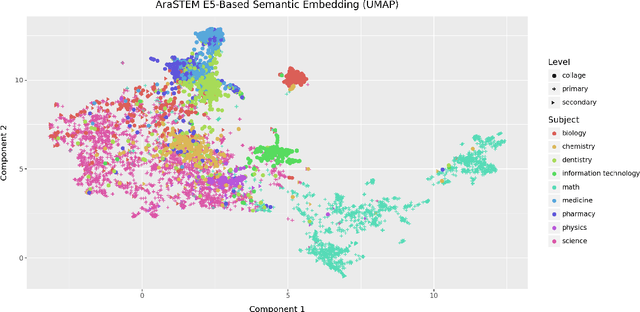
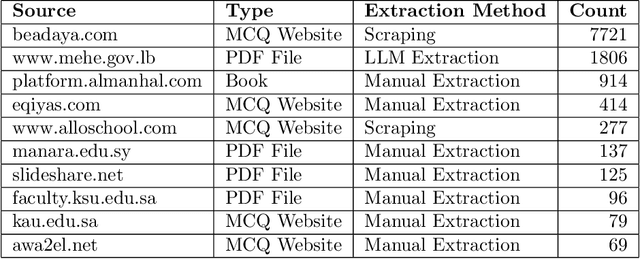

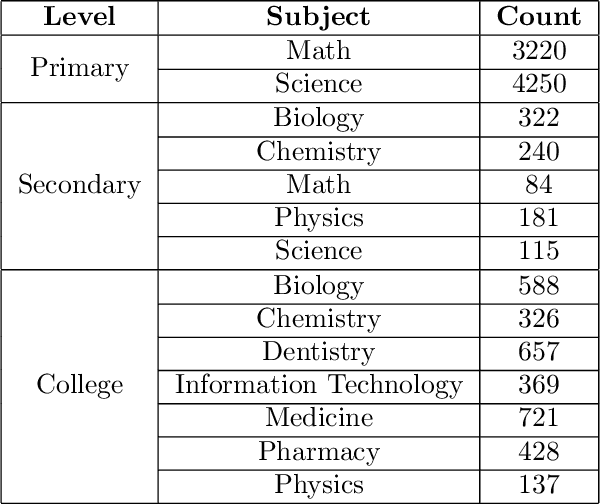
Large Language Models (LLMs) have shown remarkable capabilities, not only in generating human-like text, but also in acquiring knowledge. This highlights the need to go beyond the typical Natural Language Processing downstream benchmarks and asses the various aspects of LLMs including knowledge and reasoning. Numerous benchmarks have been developed to evaluate LLMs knowledge, but they predominantly focus on the English language. Given that many LLMs are multilingual, relying solely on benchmarking English knowledge is insufficient. To address this issue, we introduce AraSTEM, a new Arabic multiple-choice question dataset aimed at evaluating LLMs knowledge in STEM subjects. The dataset spans a range of topics at different levels which requires models to demonstrate a deep understanding of scientific Arabic in order to achieve high accuracy. Our findings show that publicly available models of varying sizes struggle with this dataset, and underscores the need for more localized language models. The dataset is freely accessible on Hugging Face.
An Unsupervised Anomaly Detection in Electricity Consumption Using Reinforcement Learning and Time Series Forest Based Framework
Dec 30, 2024Anomaly detection (AD) plays a crucial role in time series applications, primarily because time series data is employed across real-world scenarios. Detecting anomalies poses significant challenges since anomalies take diverse forms making them hard to pinpoint accurately. Previous research has explored different AD models, making specific assumptions with varying sensitivity toward particular anomaly types. To address this issue, we propose a novel model selection for unsupervised AD using a combination of time series forest (TSF) and reinforcement learning (RL) approaches that dynamically chooses an AD technique. Our approach allows for effective AD without explicitly depending on ground truth labels that are often scarce and expensive to obtain. Results from the real-time series dataset demonstrate that the proposed model selection approach outperforms all other AD models in terms of the F1 score metric. For the synthetic dataset, our proposed model surpasses all other AD models except for KNN, with an impressive F1 score of 0.989. The proposed model selection framework also exceeded the performance of GPT-4 when prompted to act as an anomaly detector on the synthetic dataset. Exploring different reward functions revealed that the original reward function in our proposed AD model selection approach yielded the best overall scores. We evaluated the performance of the six AD models on an additional three datasets, having global, local, and clustered anomalies respectively, showing that each AD model exhibited distinct performance depending on the type of anomalies. This emphasizes the significance of our proposed AD model selection framework, maintaining high performance across all datasets, and showcasing superior performance across different anomaly types.
On The Potential of The Fractal Geometry and The CNNs Ability to Encode it
Jan 07, 2024The fractal dimension provides a statistical index of object complexity by studying how the pattern changes with the measuring scale. Although useful in several classification tasks, the fractal dimension is under-explored in deep learning applications. In this work, we investigate the features that are learned by deep models and we study whether these deep networks are able to encode features as complex and high-level as the fractal dimensions. Specifically, we conduct a correlation analysis experiment to show that deep networks are not able to extract such a feature in none of their layers. We combine our analytical study with a human evaluation to investigate the differences between deep learning networks and models that operate on the fractal feature solely. Moreover, we show the effectiveness of fractal features in applications where the object structure is crucial for the classification task. We empirically show that training a shallow network on fractal features achieves performance comparable, even superior in specific cases, to that of deep networks trained on raw data while requiring less computational resources. Fractals improved the accuracy of the classification by 30% on average while requiring up to 84% less time to train. We couple our empirical study with a complexity analysis of the computational cost of extracting the proposed fractal features, and we study its limitation.