 Add to Chrome
 Add to Firefox
 Add to Edge
Engineering Reliable Autonomous Systems: Challenges and Solutions
Jun 24, 2026
Engineering reliable autonomous systems is an important and growing topic in computer science. As autonomous systems become more prevalent, easy-to-use techniques for building them reliably are increasingly important. This workshop report captures and expands on the discussions at the Lorentz Center Workshop "Engineering Reliable Autonomous Systems" (ERAS), held from 10 to 14 June 2024. The workshop was co-organised by the organisers of the Workshop on Formal Methods for Autonomous Systems (FMAS) and the Workshop on Agents and Robots for reliable Engineered Autonomy (AREA). It brought together members of the FMAS and AREA communities, industry practitioners, and representatives from sectors where autonomous systems pose distinctive engineering challenges. The workshop focused on three main research topics: techniques for verification and validation of autonomous systems; engineering real-world autonomous systems; and software architectures for safe autonomous systems. Its main outcome is a catalogue of challenges in these areas and, most importantly, a pathway to solutions. Some challenges can already be tackled by techniques that are well known in academia but have not yet become regularly used in practice. Other challenges remain unresolved and require further research. This roadmap is intended to support future research and industrial collaboration.

Towards Responsibly Non-Compliant Machines
Jun 10, 2026We consider the problem of engineering autonomous intelligent agents that are capable to responsibly not comply with user requests. We argue that machine non-compliance comes in many different forms, and sketch the issues we should pursue on the road of accomplishing responsibly non-compliant intelligent machines. We anchor responsible non-compliance in justifications for task refusal, pathways to override the non-compliance, as well as careful tracking of security risks and liability transfers.
An Abstract Architecture for Explainable Autonomy in Hazardous Environments
Jun 05, 2026Autonomous robotic systems are being proposed for use in hazardous environments, often to reduce the risks to human workers. In the immediate future, it is likely that human workers will continue to use and direct these autonomous robots, much like other computerised tools but with more sophisticated decision-making. Therefore, one important area on which to focus engineering effort is ensuring that these users trust the system. Recent literature suggests that explainability is closely related to how trustworthy a system is. Like safety and security properties, explainability should be designed into a system, instead of being added afterwards. This paper presents an abstract architecture that supports an autonomous system explaining its behaviour (explainable autonomy), providing a design template for implementing explainable autonomous systems. We present a worked example of how our architecture could be applied in the civil nuclear industry, where both workers and regulators need to trust the system's decision-making capabilities.
Towards A Catalogue of Requirement Patterns for Space Robotic Missions
Nov 18, 2025In the development of safety and mission-critical systems, including autonomous space robotic missions, complex behaviour is captured during the requirements elicitation phase. Requirements are typically expressed using natural language which is ambiguous and not amenable to formal verification methods that can provide robust guarantees of system behaviour. To support the definition of formal requirements, specification patterns provide reusable, logic-based templates. A suite of robotic specification patterns, along with their formalisation in NASA's Formal Requirements Elicitation Tool (FRET) already exists. These pre-existing requirement patterns are domain agnostic and, in this paper we explore their applicability for space missions. To achieve this we carried out a literature review of existing space missions and formalised their requirements using FRET, contributing a corpus of space mission requirements. We categorised these requirements using pre-existing specification patterns which demonstrated their applicability in space missions. However, not all of the requirements that we formalised corresponded to an existing pattern so we have contributed 5 new requirement specification patterns as well as several variants of the existing and new patterns. We also conducted an expert evaluation of the new patterns, highlighting their benefits and limitations.
* In Proceedings FMAS 2025, arXiv:2511.13245
Safe-ROS: An Architecture for Autonomous Robots in Safety-Critical Domains
Nov 18, 2025Deploying autonomous robots in safety-critical domains requires architectures that ensure operational effectiveness and safety compliance. In this paper, we contribute the Safe-ROS architecture for developing reliable and verifiable autonomous robots in such domains. It features two distinct subsystems: (1) an intelligent control system that is responsible for normal/routine operations, and (2) a Safety System consisting of Safety Instrumented Functions (SIFs) that provide formally verifiable independent oversight. We demonstrate Safe-ROS on an AgileX Scout Mini robot performing autonomous inspection in a nuclear environment. One safety requirement is selected and instantiated as a SIF. To support verification, we implement the SIF as a cognitive agent, programmed to stop the robot whenever it detects that it is too close to an obstacle. We verify that the agent meets the safety requirement and integrate it into the autonomous inspection. This integration is also verified, and the full deployment is validated in a Gazebo simulation, and lab testing. We evaluate this architecture in the context of the UK nuclear sector, where safety and regulation are crucial aspects of deployment. Success criteria include the development of a formal property from the safety requirement, implementation, and verification of the SIF, and the integration of the SIF into the operational robotic autonomous system. Our results demonstrate that the Safe-ROS architecture can provide safety verifiable oversight while deploying autonomous robots in safety-critical domains, offering a robust framework that can be extended to additional requirements and various applications.
* In Proceedings FMAS 2025, arXiv:2511.13245
Proceedings Fifth International Workshop on Formal Methods for Autonomous Systems
Nov 15, 2023This EPTCS volume contains the proceedings for the Fifth International Workshop on Formal Methods for Autonomous Systems (FMAS 2023), which was held on the 15th and 16th of November 2023. FMAS 2023 was co-located with 18th International Conference on integrated Formal Methods (iFM) (iFM'22), organised by Leiden Institute of Advanced Computer Science of Leiden University. The workshop itself was held at Scheltema Leiden, a renovated 19th Century blanket factory alongside the canal. FMAS 2023 received 25 submissions. We received 11 regular papers, 3 experience reports, 6 research previews, and 5 vision papers. The researchers who submitted papers to FMAS 2023 were from institutions in: Australia, Canada, Colombia, France, Germany, Ireland, Italy, the Netherlands, Sweden, the United Kingdom, and the United States of America. Increasing our number of submissions for the third year in a row is an encouraging sign that FMAS has established itself as a reputable publication venue for research on the formal modelling and verification of autonomous systems. After each paper was reviewed by three members of our Programme Committee we accepted a total of 15 papers: 8 long papers and 7 short papers.
Proceedings Fourth International Workshop on Formal Methods for Autonomous Systems (FMAS) and Fourth International Workshop on Automated and verifiable Software sYstem DEvelopment (ASYDE)
Sep 27, 2022This EPTCS volume contains the joint proceedings for the fourth international workshop on Formal Methods for Autonomous Systems (FMAS 2022) and the fourth international workshop on Automated and verifiable Software sYstem DEvelopment (ASYDE 2022), which were held on the 26th and 27th of September 2022. FMAS 2022 and ASYDE 2022 were held in conjunction with 20th International Conference on Software Engineering and Formal Methods (SEFM'22), at Humboldt University in Berlin. For FMAS, this year's workshop was our return to having in-person attendance after two editions of FMAS that were entirely online because of the restrictions necessitated by COVID-19. We were also keen to ensure that FMAS 2022 remained easily accessible to people who were unable to travel, so the workshop facilitated remote presentation and attendance. The goal of FMAS is to bring together leading researchers who are using formal methods to tackle the unique challenges presented by autonomous systems, to share their recent and ongoing work. Autonomous systems are highly complex and present unique challenges for the application of formal methods. Autonomous systems act without human intervention, and are often embedded in a robotic system, so that they can interact with the real world. As such, they exhibit the properties of safety-critical, cyber-physical, hybrid, and real-time systems. We are interested in work that uses formal methods to specify, model, or verify autonomous and/or robotic systems; in whole or in part. We are also interested in successful industrial applications and potential directions for this emerging application of formal methods.
Modelling the Turtle Python library in CSP
Jul 20, 2022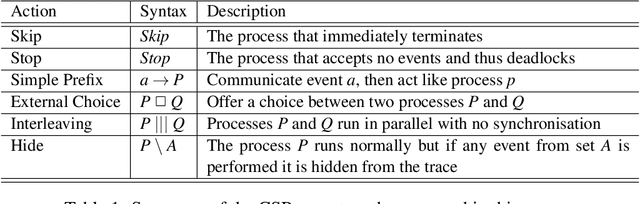
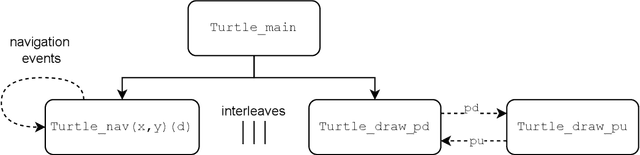


Software verification is an important tool in establishing the reliability of critical systems. One potential area of application is in the field of robotics, as robots take on more tasks in both day-to-day areas and highly specialised domains. Robots are usually given a plan to follow, if there are errors in this plan the robot will not perform reliably. The capability to check plans for errors in advance could prevent this. Python is a popular programming language in the robotics domain, through the use of the Robot Operating System (ROS) and various other libraries. Python's Turtle package provides a mobile agent, which we formally model here using Communicating Sequential Processes (CSP). Our interactive toolchain CSP2Turtle with CSP model and Python components, enables Turtle plans to be verified in CSP before being executed in Python. This means that certain classes of errors can be avoided, and provides a starting point for more detailed verification of Turtle programs and more complex robotic systems. We illustrate our approach with examples of robot navigation and obstacle avoidance in a 2D grid-world.
* In Proceedings AREA 2022, arXiv:2207.09058
Proceedings Third Workshop on Formal Methods for Autonomous Systems
Oct 22, 2021Autonomous systems are highly complex and present unique challenges for the application of formal methods. Autonomous systems act without human intervention, and are often embedded in a robotic system, so that they can interact with the real world. As such, they exhibit the properties of safety-critical, cyber-physical, hybrid, and real-time systems. This EPTCS volume contains the proceedings for the third workshop on Formal Methods for Autonomous Systems (FMAS 2021), which was held virtually on the 21st and 22nd of October 2021. Like the previous workshop, FMAS 2021 was an online, stand-alone event, as an adaptation to the ongoing COVID-19 restrictions. Despite the challenges this brought, we were determined to build on the success of the previous two FMAS workshops. The goal of FMAS is to bring together leading researchers who are tackling the unique challenges of autonomous systems using formal methods, to present recent and ongoing work. We are interested in the use of formal methods to specify, model, or verify autonomous and/or robotic systems; in whole or in part. We are also interested in successful industrial applications and potential future directions for this emerging application of formal methods.
Towards Compositional Verification for Modular Robotic Systems
Dec 03, 2020

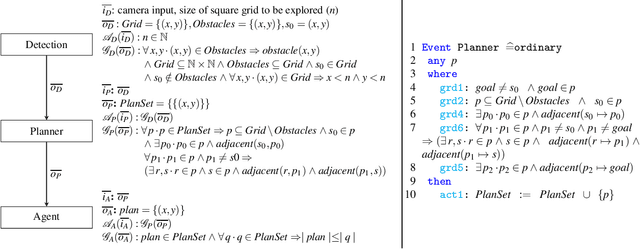
Software engineering of modular robotic systems is a challenging task, however, verifying that the developed components all behave as they should individually and as a whole presents its own unique set of challenges. In particular, distinct components in a modular robotic system often require different verification techniques to ensure that they behave as expected. Ensuring whole system consistency when individual components are verified using a variety of techniques and formalisms is difficult. This paper discusses how to use compositional verification to integrate the various verification techniques that are applied to modular robotic software, using a First-Order Logic (FOL) contract that captures each component's assumptions and guarantees. These contracts can then be used to guide the verification of the individual components, be it by testing or the use of a formal method. We provide an illustrative example of an autonomous robot used in remote inspection. We also discuss a way of defining confidence for the verification associated with each component.
* In Proceedings FMAS 2020, arXiv:2012.01176