 Add to Chrome
 Add to Firefox
 Add to Edge
Metanormative Theory for RL-Based Moral Agents
Aug 08, 2026
The overlapping disciplines of machine ethics and value alignment are concerned with designing artificial agents that are aligned with human values and that act in ethically acceptable ways. A recent trend in these disciplines is the use of reinforcement learning (RL) to design such agents, sidelining the philosophical literature that used to play a more central role. Against this backdrop, this paper pursues two goals. The first is to draw out ideas from recent work in metanormative theory that can be useful for designing artificial moral and value-aligned agents. The second is to examine the RL architecture through the lens of these ideas. This will give us clearer criteria for when an RL agent's behavior can be classified as moral, as well as a basis for evaluating and comparing different RL-based approaches to machine ethics and value alignment.

Whistleblowing and the machine -- towards a considered position
Jun 19, 2026Artificial intelligent agents and autonomous systems are embedded in our environments. They are both a commercial product and a personal tool that generates a lot of data and can draw conclusions from it: machines generate and keep secrets. But should machines protect all secrets? It has been shown that artificial agents are able to whistleblow and it has been argued that digital multi-agent environments should allow for agents in them to whistleblow. We argue that machine whistleblowing must be normative and principled and routed in the existing understanding of whistleblowing as an important rule-breaking mechanism in society. We also argue that there is a need for government regulators to formulate an informed stance on both what machines should be allowed to whistleblow on and how to legally protect those who develop whistleblowing machines
Towards Responsibly Non-Compliant Machines
Jun 10, 2026We consider the problem of engineering autonomous intelligent agents that are capable to responsibly not comply with user requests. We argue that machine non-compliance comes in many different forms, and sketch the issues we should pursue on the road of accomplishing responsibly non-compliant intelligent machines. We anchor responsible non-compliance in justifications for task refusal, pathways to override the non-compliance, as well as careful tracking of security risks and liability transfers.
Transparency and Proportionality in Post-Processing Algorithmic Bias Correction
May 23, 2025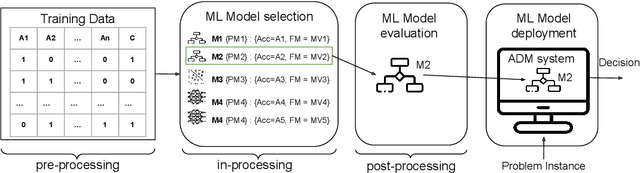
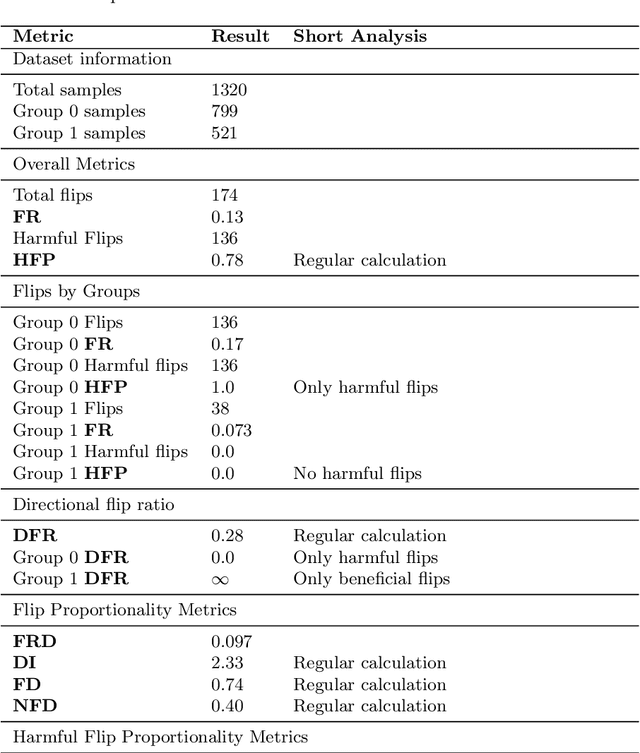

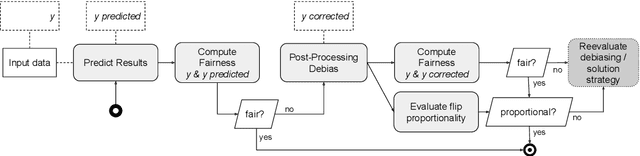
Algorithmic decision-making systems sometimes produce errors or skewed predictions toward a particular group, leading to unfair results. Debiasing practices, applied at different stages of the development of such systems, occasionally introduce new forms of unfairness or exacerbate existing inequalities. We focus on post-processing techniques that modify algorithmic predictions to achieve fairness in classification tasks, examining the unintended consequences of these interventions. To address this challenge, we develop a set of measures that quantify the disparity in the flips applied to the solution in the post-processing stage. The proposed measures will help practitioners: (1) assess the proportionality of the debiasing strategy used, (2) have transparency to explain the effects of the strategy in each group, and (3) based on those results, analyze the possibility of the use of some other approaches for bias mitigation or to solve the problem. We introduce a methodology for applying the proposed metrics during the post-processing stage and illustrate its practical application through an example. This example demonstrates how analyzing the proportionality of the debiasing strategy complements traditional fairness metrics, providing a deeper perspective to ensure fairer outcomes across all groups.
Uncovering Fairness through Data Complexity as an Early Indicator
Apr 08, 2025Fairness constitutes a concern within machine learning (ML) applications. Currently, there is no study on how disparities in classification complexity between privileged and unprivileged groups could influence the fairness of solutions, which serves as a preliminary indicator of potential unfairness. In this work, we investigate this gap, specifically, we focus on synthetic datasets designed to capture a variety of biases ranging from historical bias to measurement and representational bias to evaluate how various complexity metrics differences correlate with group fairness metrics. We then apply association rule mining to identify patterns that link disproportionate complexity differences between groups with fairness-related outcomes, offering data-centric indicators to guide bias mitigation. Our findings are also validated by their application in real-world problems, providing evidence that quantifying group-wise classification complexity can uncover early indicators of potential fairness challenges. This investigation helps practitioners to proactively address bias in classification tasks.
Am I Being Treated Fairly? A Conceptual Framework for Individuals to Ascertain Fairness
Apr 03, 2025Current fairness metrics and mitigation techniques provide tools for practitioners to asses how non-discriminatory Automatic Decision Making (ADM) systems are. What if I, as an individual facing a decision taken by an ADM system, would like to know: Am I being treated fairly? We explore how to create the affordance for users to be able to ask this question of ADM. In this paper, we argue for the reification of fairness not only as a property of ADM, but also as an epistemic right of an individual to acquire information about the decisions that affect them and use that information to contest and seek effective redress against those decisions, in case they are proven to be discriminatory. We examine key concepts from existing research not only in algorithmic fairness but also in explainable artificial intelligence, accountability, and contestability. Integrating notions from these domains, we propose a conceptual framework to ascertain fairness by combining different tools that empower the end-users of ADM systems. Our framework shifts the focus from technical solutions aimed at practitioners to mechanisms that enable individuals to understand, challenge, and verify the fairness of decisions, and also serves as a blueprint for organizations and policymakers, bridging the gap between technical requirements and practical, user-centered accountability.
Reinforcement Learning and Machine ethics:a systematic review
Jul 02, 2024Machine ethics is the field that studies how ethical behaviour can be accomplished by autonomous systems. While there exist some systematic reviews aiming to consolidate the state of the art in machine ethics prior to 2020, these tend to not include work that uses reinforcement learning agents as entities whose ethical behaviour is to be achieved. The reason for this is that only in the last years we have witnessed an increase in machine ethics studies within reinforcement learning. We present here a systematic review of reinforcement learning for machine ethics and machine ethics within reinforcement learning. Additionally, we highlight trends in terms of ethics specifications, components and frameworks of reinforcement learning, and environments used to result in ethical behaviour. Our systematic review aims to consolidate the work in machine ethics and reinforcement learning thus completing the gap in the state of the art machine ethics landscape
Value Engineering for Autonomous Agents
Feb 17, 2023Machine Ethics (ME) is concerned with the design of Artificial Moral Agents (AMAs), i.e. autonomous agents capable of reasoning and behaving according to moral values. Previous approaches have treated values as labels associated with some actions or states of the world, rather than as integral components of agent reasoning. It is also common to disregard that a value-guided agent operates alongside other value-guided agents in an environment governed by norms, thus omitting the social dimension of AMAs. In this blue sky paper, we propose a new AMA paradigm grounded in moral and social psychology, where values are instilled into agents as context-dependent goals. These goals intricately connect values at individual levels to norms at a collective level by evaluating the outcomes most incentivized by the norms in place. We argue that this type of normative reasoning, where agents are endowed with an understanding of norms' moral implications, leads to value-awareness in autonomous agents. Additionally, this capability paves the way for agents to align the norms enforced in their societies with respect to the human values instilled in them, by complementing the value-based reasoning on norms with agreement mechanisms to help agents collectively agree on the best set of norms that suit their human values. Overall, our agent model goes beyond the treatment of values as inert labels by connecting them to normative reasoning and to the social functionalities needed to integrate value-aware agents into our modern hybrid human-computer societies.
Against Algorithmic Exploitation of Human Vulnerabilities
Jan 12, 2023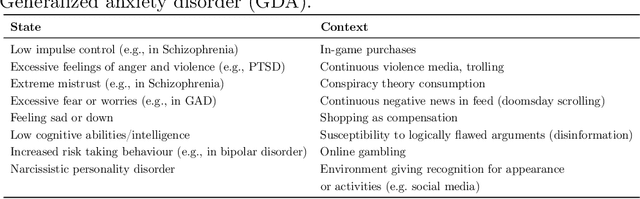

Decisions such as which movie to watch next, which song to listen to, or which product to buy online, are increasingly influenced by recommender systems and user models that incorporate information on users' past behaviours, preferences, and digitally created content. Machine learning models that enable recommendations and that are trained on user data may unintentionally leverage information on human characteristics that are considered vulnerabilities, such as depression, young age, or gambling addiction. The use of algorithmic decisions based on latent vulnerable state representations could be considered manipulative and could have a deteriorating impact on the condition of vulnerable individuals. In this paper, we are concerned with the problem of machine learning models inadvertently modelling vulnerabilities, and want to raise awareness for this issue to be considered in legislation and AI ethics. Hence, we define and describe common vulnerabilities, and illustrate cases where they are likely to play a role in algorithmic decision-making. We propose a set of requirements for methods to detect the potential for vulnerability modelling, detect whether vulnerable groups are treated differently by a model, and detect whether a model has created an internal representation of vulnerability. We conclude that explainable artificial intelligence methods may be necessary for detecting vulnerability exploitation by machine learning-based recommendation systems.
Finding Common Ground for Incoherent Horn Expressions
Sep 14, 2022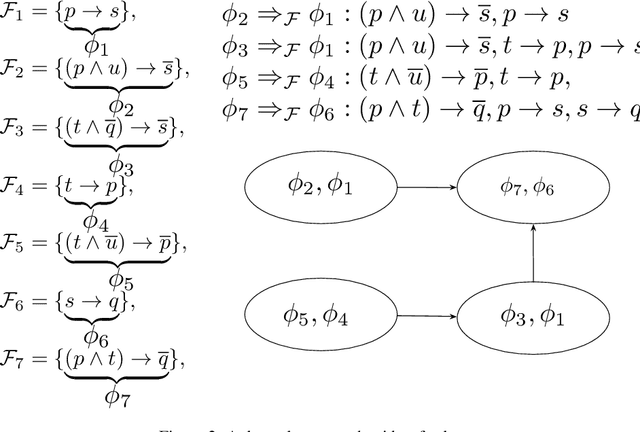
Autonomous systems that operate in a shared environment with people need to be able to follow the rules of the society they occupy. While laws are unique for one society, different people and institutions may use different rules to guide their conduct. We study the problem of reaching a common ground among possibly incoherent rules of conduct. We formally define a notion of common ground and discuss the main properties of this notion. Then, we identify three sufficient conditions on the class of Horn expressions for which common grounds are guaranteed to exist. We provide a polynomial time algorithm that computes common grounds, under these conditions. We also show that if any of the three conditions is removed then common grounds for the resulting (larger) class may not exist.